Month: March 2013

  • Behind the Bridge: Hendrix, Korea-Style

    Behind the Bridge:
    Hendrix, Korea-Style

    This is perfectly awesome:

    Luna Lee is playing a gayageum, a Korean zither related to the Japanese koto, Vietnamesese dΓ n tranh, and the Chinese guzheng. She’e got other fun blues and rock covers posted on her YouTube page. Lee’s version of “Voodoo Chile” is the internet hit, but I dig her “Bold as Love” because the canned backing tracks are less intrusive, plus it’s my fave Hendrix song. πŸ™‚

    The drumstick as bridge.
    The drumstick as bridge.

    Like many guitarists exposed to Asian zither players, I find myself envying the movable bridges they have on each string. By positioning the bridge relatively close to the center of the string (and not, as on guitars, near one end), they can pluck notes or generate vibrato on either side of the bridge.

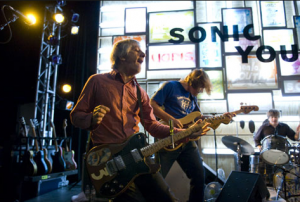
    Lee and Thurston from Sonic Youth achieve related effect by placing drumsticks and screwdrivers between the neck and strings of their guitars near the 12th fret. (It’s not like those guys are Asian music scholars or anything, but another similarity is their use of tunings with closer-than-standard intervals between the strings.)

    But no one took the notion further than the late Hans Reichel, whose beautiful, handmade instruments used center-positioned bridges to elicit eerie sonorities and startling portamento and glissando effects. This video is a nice showcase for Reichel’s radical re-imagining of the guitar. (Reichel also demonstrates his dachsophone β€” literally, “hedgehog-o-phone” β€” which, depending on your perspective, is one of the most expressive, amusing, or just plain irritating musical contraptions ever conceived.)

    Anyone ever explored similar ground? (FWIW, I took a semester of koto back in the Triassic Era college. I sucked.)
  • Playing with Pain

    ouch

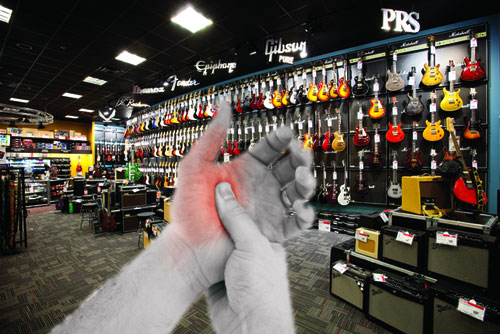
    I’m lucky β€” I’ve never suffered from any playing-related pain. (I mean, other than expected stuff, like spurting blood all over a guitar when you bash it a little too hard, or picking up a soldering iron by the wrong end.) But I’ve been blissfully untouched by carpal tunnel syndrome, numbness, arthritis, etc.

    Until recently.

    A few months ago, my left thumb joint started aching. It didn’t directly affect my playing β€” all those clams in my videos happened on their own! But it scared the crap out of me.

    My doctor suggested it might be non-degenerative arthritis.

    Arthritis?” I squawked. “But I’m only . . . oh, yeah, probably arthritis.”

    Which it may well be. But it also occurred to me that I had been indulging in a new behavior for the last year or two, and wondered whether it might be contributing to the problem. See, I’m almost as addicted to my iPad as I am to flatwound strings. I’ve embraced the post-paper lifestyle, and I use the iPad for most of my reading and much of my correspondence. I keep it on my workbench while I solder, use it as a remote in the studio, watch movies while working out, and most important, use it to read comic books in the bathtub. I usually support it with my left hand, with the modest but constant 1.44 lb. weight centered right where I was hurting. I migrated to a .68 lb. iPad Mini a few months ago. Lo and behold, the pain has receded β€” for now, anyway.

    That's got to hurt!
    That’s got to hurt!

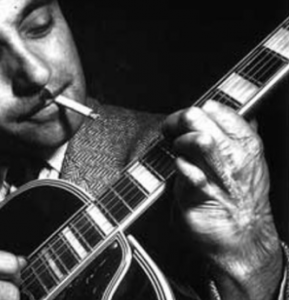
    But it makes me realize how much I take for granted the simple act of pain-free playing. Then I think of all the players who have either been derailed by playing-related pain, or who persevere despite it. And that’s not even taking into account injury-related pain. (Hello, Django!)

    So has guitar playing ever become a pain for you? (No, working with singers doesn’t count.) Were you able to overcome it by modifying your technique, or through therapy? Any words of wisdom to share?

  • Pinn Panelle’s Derek Song:
    12 Million Views and Counting

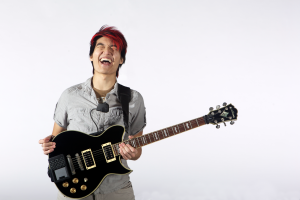
    Pinn Panelle's Derek Song.
    Pinn Panelle’s Derek Song.

    A highlight of this year’s NAMM show was hanging out with Derek Song, a 23-year-old digital guitarist whose band, Pinn Panelle, has racked up an astonishing 12.5 million YouTube views with their realtime cover versions of electronic music hits, especially their version of Skrillex’s “Scary Monster and Nice Sprites”

    Song, a Berklee College of Music grad, is DIY personified. He’s developed his own innovate guitar controllers and written custom software to milk them to the max. Those hit videos were shot on a shoestring. A Kickstarter campaign financed the Pinn Panelle’s last tour, where they brought live-band energy to DJ-driven EDM concerts and festivals. And the group has created two full albums without help from a label, including the just-released Ghosts and Liars. (However, days before the album’s release, the group’s bassist and keyboardist left the band. Now Derek and drummer Justin Conway are plotting their next moves, though Derek says Pinn Panelle will continue.)

    Derek, a blisteringly smart guy with a friendly, unpretentious attitude, was kind enough to let me drag him into a relatively quiet corner of the NAMM show, shove a recorder in his face, and bark questions at him.

    But first, that video again:

    You’re a music-school dude.

    I grew up in Glenview, Illinois, but moved Boston to go to Berklee because I knew I wanted to pursue music and new ideas. When I got there, I figured out that I would waste the least amount of money by pursuing electronic music production rather than performance. I’m not docking performance β€” some kids get so good at it! But I’ve always been more of a self-learner. I’m a terrible student, especially when I’m given exercises. I just want to play the ideas I have in my mind, and as long as I have the facility to do that, I don’t care about additional technique. But the Electronic Production and Design program at Berkeley had so many cool avenues for exploration, and I knew that technology was the future.

    Did you always tinker with tech?

    Well, one thing that influenced me as a composer and technologist was the fact that my dad used to fix TVs. Later on, when I started developing my own controllers, I’d work on them with him, and that’s really inspired me musically. When I first started playing in bands, my dad and I invested in a Boss GT-6 multi-effect pedal. I never used stompboxes because I could never afford them! But I read the Boss manual till I knew that thing like the back of my hand, and I still use that GT-6. Basically, I hacked it. I discovered some functions under the surface that open up a lot of opportunities for controlling specific effect parameters.

    For example? (more…)

  • My Flatwound Addiction

    flatwound
    So smooth. So sexy.
    So frickin’ expensive!

    Hi. I’m Joe, and I’m a flatwound addict.

    It took me a long time admit it. “What wrong with a little recrational flatwound use?” I used to ask. “I can quit anytime I want.”

    Sure, I’d sometimes put flatwound strings on my Guild archtop. And sometimes on a bass. And yeah, I did that post about how flatwounds are the key to nailing that ’60s electric 12-string sound. And that other post on how flatwounds brought my reissue Fender Bass VI to life. And yeah, I may have happened to blurt out that I like using flatwounds on a MIDI guitar.

    But I wouldn’t use them on, you know, one of my normal guitars.

    But then I recorded that BartΓ³k piece, using the above-mentioned Guid and Bass VI alongside two standard-tuned guitars with roundwounds. The piece has a lot of counterpoint β€” all these motifs bouncing between the instruments. And the more I listened, the more I realized that I liked the tone of the two flatwound guitars far more than that of the two roundwound guitars.

    And then I bottomed out. I put flats on four more guitars. It wasn’t just musically risky β€” it was economically catastrophic! And that’s what brought me here tonight.

    Funny thing about flatwounds: Everytime I pick up a guitar with flats, I react negatively to the dullness of the wound strings. Where’s the shimmer? Where’s the zing?

    But the more I listen, the more I get sucked in. Parts layer over each other more readily. Chords speak more clearly. Fuzz and distortion yield sweeter overtones. It’s easier to get a consistent sound from melodies spanning wound and unwound strings. And the feel? Smooth, sleek and sensual.

    Sigh. Maybe I’ll try and kick the habit again tomorrow.

  • An Alternate-Tuning Capo

    Spider Capo

    UPDATE, 03.07.13: I should have mentioned a point that several readers noted in comments: The capo only alters the tuning of open strings. Which means that while you can play many harmonies normally available only in dropped tunings, any notes above the capo appear at their usual frets. For example, all barre chords are played exactly as in standard tuning.

    After all the digital guitar stuff I’ve been writing about lately, I really wanted to spend an afternoon without plugging in any frickin’ USB cables. So I finally got around to experimenting with the SpiderCapo I picked up last year on a whim.

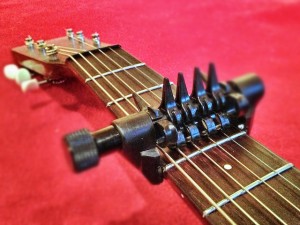
    The SpiderCapo his six independently adjustable clamps, each of which can either stop the string or let it ring freely. That means you can dial in most dropped tunings without actually detuning any strings β€” instead, you transpose the entire voicing up. It’s a lot of fun to play, and seems like it could be a cool composing tool if you’re the sort of musician who gets inspired by unfamiliar tunings. Plus, it looks kind of wicked when you fret the unstopped strings behind the capo.

    Here’s a little video I made, noodling around in a few tunings I particularly liked:

    Anyone else tried one of these? Or any other “tricky” alternate-tuning capo? How about those gadgets that (unlike the SpiderCapo) can stop strings at differing frets?

  • My Friend Bill

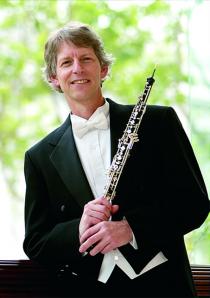
    William Bennett, 1956-2013
    William Bennett, 1956-2013
    I lost one of my oldest and dearest friends yesterday β€” and one of the deepest musicians I’ve ever known.

    Bill Bennett, longtime oboist with the San Francisco Symphony, suffered a cerebral hemorrhage onstage last weekend while performing Richard Strauss’s Oboe Concerto at Davies Symphony Hall here in San Francisco. He passed away yesterday, surrounded by his family.

    Here’s a fine obituary written by our local classical music critic, a cool guy who also knew Bill well.

    I met Bill 30 years ago. I was a classical musician recently turned rocker, teaching guitar in San Francisco and hoping for a break. I received a call one day from a young-sounding dude who’d seen one of my ads.

    “Do you teach rock guitar?” he asked with a slight air of suspicion.

    “Of course I teach rock,” I sniffed.

    “I only want to study rock,” he said. “Not classical.” I assumed I was talking to some close-minded metal kid, and reassured him that I wouldn’t try to foist any classical stuff on him.

    You know the punchline: My “close-minded” student turned out to be one of the most celebrated classical musicians of his generation. (more…)