Categories
Music

14th-Century Freakout!

Codex Chantilly
Codex Chantilly: the electrifying page-turner that blew the lid off the perverse musical excesses of the late Middle Ages!
NOTE: I am a known perpetrator of musical hoaxes, but this isn’t one of them. This bizarre composition really is over 600 years old.

As Marsellus Wallace once quipped: “I’m’a get medieval on your ass.”

I’ve been obsessing again on a medieval composition that’s fascinated me since my geeky teens. It’s Fumeux fume par fumee, a bizarre artifact from a bizarre moment in music history: France in the final years of the 14th century.

(If you’re wondering why I was listening to medieval and Renaissance music when I was 17 instead of Zep and Floyd, and what the stuff brings to my guitar playing today, read on. But first, that freaky music!)

The world that produced Fumeux fume par fumee wasn’t your storybook Middle Ages. We’re talking Hundred Years War, Black Death, Papal Schism — and a radical musical style of head-spinning complexity and abstraction. It was dissonant music for dissonant times. The death rattle of the Dark Ages.

The 14th century had witnessed the rise of ars nova, a florid and intellectual style characterized by bold new approaches to counterpoint and musical structure. But by the 1380s or so, ars nova had mutated into ars subtilior, an even more abstract and experimental style.

“Ars nova” means “new art.” It was.

“Ars subtilior” means “more subtle art.” It wasn’t — unless by “subtle,” you mean “characterized by extreme dissonance and chaotic rhythms.” And Fumeux is a perfect embodiment of this radical style.

Here’s what I’m talking about:

WTF, right?

You probably don’t need me to specify why this music is so freaky, but I will anyway: 

Categories
guitar Music

Meet the REAL Spiders from Mars!
Bartók on Electric Guitar

Bartók: Smarter than math-rock — and way more violent.

My Bowie fandom is second to none. Yet I’ve always felt a vague sense of disappointment that the Spiders from Mars didn’t really sound much like spiders from Mars.

On the other hand, the fourth movement from Béla Bartók‘s Fourth String Quartet really does sound like Martian spiders — assuming the critters in question had been force-fed a diet of chord clusters, mathematics, Hungarian folk music, and some of the most astonishing counterpoint this side of J.S. Bach.

And dig it: This white-hot blast of dissonant modernism was composed in 1928!

And how does this string quartet music sound on guitars? Awesome, IMHO — largely because the movement is played entirely pizzicato (plucked, not bowed). Very few modifications were needed to adopt it for four electric guitars.

Categories
Bass guitar Music

The Bass VI Boss

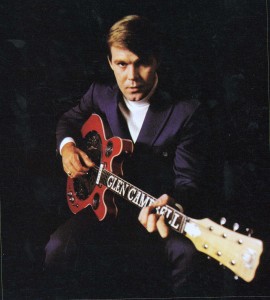
Dang — I wish I had a white turtleneck and a Mosrite electric resophonic!

After some of the long-running contests around here, it was nice having a quickie for a change. San Diego-based steel guitarist Doug Meyer was the first of several readers to correctly identify the four iconic Bass VI riffs in the post on ancient strings. He wins a Seymour Duncan Pickup Booster, a cool clean boost pedal that sound fabulous on 6-string bass, not to mention standard-tuned guitars.

The tunes were, in order of appearance:

1. Glen Campbell’s “Wichita Lineman”
2. Glen Campbell’s “Galveston”
3. Elmer Bernstein’s “Theme from The Magnificent Seven
4. Steve Earle’s “Guitar Town”

Glen Campbell not only sang those two classic Jimmy Webb songs, but played the beautiful 6-string bass parts. As most ’60s pop fans know, Campbell was a leading L.A. session player before becoming a star — he played with Elvis, the Everly Brothers, the Monkees, and on many Beach Boys sessions, including Pet Sounds (that’s him playing electric 12-string on “Sloop John B.”) [CORRECTION IN COMMENTS.]

About the ’90s reissue Bass VI that inspired my original post: I’ve always liked it, and I’ve used it on a zillion sessions, but I never thought it sounded as good as an original. Now I realize that it sounds just like an original — all it needed was the right strings! 🙂

Categories
Acoustic Bass guitar

In Search of Ancient Strings

PLUS: New Contest! Name the Classic 6-String Bass Riffs and Win a Seymour Duncan Pickup Booster Pedal!

"We both love candlelight, long walks on the beach, and really expensive old-school strings."

NOTE: The contest is at the bottom of this post. You can skip ahead if you don’t care about rare and expensive guitar strings.

What do the classical guitar and the Fender Bass VI have in common?

Both instruments were developed using types of strings that are practically extinct.

First, let’s talk nylon strings. When these appeared after WWII, classical guitarists, led by Andrés Segovia, ditched gut overnight. Nylon strings were louder and brighter, and they offered better consistency, superior intonation, and longer life.

Few living guitarists have ever actually played gut strings, which really are made from animal guts (usually cows, goats, or sheep). I’ve never tried them myself.

But one of my darkest secrets is the fact that I started out as a teenaged lute player. (I have a photo of myself playing on a hay bale at a Renaissance Faire, wearing a feathered tudor cap and white tights. And you will never, ever see it.) I experimented with gut lute strings, only to run screaming. Total tuning nightmare, especially on an Elizabethan-era axe with friction tuning pegs, not to mention lots of unison- and octave-tuned strings. Guitarists were smart when they ditched the stuff.

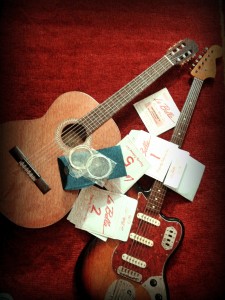
But I recently bought a new ukelele, which came strung a set of Aquila strings from Italy. They have several lines of faux-gut nylon strings made from a proprietary material called — wait for it — “nylgut,” which allege to capture the sound of gut without the tears. They sounded cool on the uke, so I ordered a few guitar sets. At between $12 and $21 dollars per set, depending on the bass-string wrap material, they’re pricy, but not crazy expensive — about the same as other high-end, E.U.-made brands, like Savarez or Thomastik-Infeld. (Aquila’s US distributor is Just Strings.)

And holy cow, do I love ’em! They don’t look anything like gut strings, which resemble, well, dried-out intestines. But they really do capture a lot of “gutness.” Their tone is quieter and warmer than conventional nylon, with markedly less string noise (a great thing for a very rusty classical player like me). Check out this demo: