Hi friend! Please note that tonefiend.com is a dormant site. I’ve shifted my focus to my YouTube channel.
My apologies if anything here is broken. If you have any questions, or comments, please write me directly at joe@joegore.com.
Thanks! —Joe Gore
Hi friend! Please note that tonefiend.com is a dormant site. I’ve shifted my focus to my YouTube channel.
My apologies if anything here is broken. If you have any questions, or comments, please write me directly at joe@joegore.com.
Thanks! —Joe Gore

The Subversive Guitarist is for any intermediate or advanced player who feels like they are stuck in a rut. If you’ve ever thought, “I always play the same things whenever I pick up a guitar,” this is your remedy.
The Subversive Guitarist includes hundreds of exercises designed to free your hands and mind from auto-pilot licks, muscle-memory repetition, and box-pattern boredom.
These lessons are applicable to all musical styles. Music reading is not required — all musical examples appear in tab as well as standard notation.
The book purchase includes audio downloads for the hundreds of musical examples and links to relevant videos. —Joe Gore
“It’s hard to imagine any serious guitarist not coming away from this important book as a better musician. It offers such a fresh approach to breaking out of ruts and forces you to look at the guitar from a different angle. Joe Gore’s incredibly deep knowledge of music history and his unique approach to the instrument make this an invaluable tool for any dedicated guitarist. It has certainly helped me! I will return to this book again and again for years to come. Thanks for the inspiration!” —Richard Fortus (Guns N’ Roses, Psychedelic Furs, Dead Daisies)
“The Subversive Guitarist is unique in the pantheon of guitar instruction. Joe Gore’s prodigious intellect and empathic heart are engaged in the vital work of illuminating alternative ways to approach guitar, giving inquisitive seekers new ways to find their own voice. Joe invites and gently provokes players to truly become themselves, out from under the shadow of Guitar Industrial Complex conformity. The Subversive Guitarist sits alongside such classics as Mick Goodrick’s The Advancing Guitarist and Philip Toshio Sudo’s Zen Guitar.” — Vernon Reid (Living Colour, Jack Bruce, Public Enemy, Mick Jagger)
“This book is fantastic! It’s chock-full of ideas and exercises to expand a player’s command of the instrument and break free from habits that hinder advancement. It guides your fingers through new journeys, expanding your ears in the process. I highly recommend this brilliant book!” — Lyle Workman (film composer, Sting, Beck, Frank Black, Todd Rundgren)
“Learning guitar is difficult. Learning how to use your own instincts and creativity to make your best music is even more difficult. Joe Gore has managed to fuse teaching guitar techniques with simultaneous expansion of musical knowledge. You will learn about things you never knew you wanted to learn. You can’t get any more subversive than that!” —Dweezil Zappa (composer, bandleader)
“Joe Gore is among today’s most versatile and knowledgeable guitarists. With expertise that spans genres and eras, his uniquely wide view provides valuable perspectives for any musician seeking to push past convention, grow a richer musical vocabulary, and cultivate a more adventurous creative approach. I’ll be geeking out alongside the rest of you with these exercises and concepts.” — Gretchen Menn (solo artist, Zepparella, guitar clinician)
“My homie Joe Gore could be the most subversive guitarist of all. He has somehow found a way to get guitar players to learn all of the bedrock fundamentals without seeming like that’s what they’re doing. Think of The Subversive Guitarist as one of the classic guitar method books, without any dogma or agenda. One which, if the player puts in the hours, will do two things very effectively: create a guitar player who is an asset on the bandstand, and one who has their own voice. I wish this book was around when I was coming up. Bravo, Joe!” — Charlie Hunter (solo artist, T.J. Kirk, Norah Jones, Frank Ocean, D’Angelo)
“This book is incredible! The internet is full of guitarists following well worn paths, known patterns, and predictable music. What’s needed now is a generation willing to seek beyond the clichés. Joe has written a book full of clues and cues to inspire your own fresh ideas. These are the best kind of concepts: the ones you never finish working on.” — James Valentine (Maroon 5, John Mayer)

This guitar blog has been around since 2011. The site remains active, and I reply to almost all comments. But I’ve posted here less frequently as my focus has shifted from text to video.
Please visit my YouTube channel. And if you find anything worth your time, please subscribe. There too I reply to most comments. And you can always contact me via my personal page, joegore.com.
Don’t be a stranger — keep in touch! 🙂
. . . to a blog about all the things you can do with — or to — a guitar. Topics: DIY, instruments, amps, effects, recording, software, technique, music history, music heresy.

This is the third installment of Cryptomusicology, a work in progress featuring 24 solo acoustic guitar pieces in all major and minor keys, inspired by paranormal entities.
Previous installments: Cryptomusicology Vol. 1 (featuring pieces inspired by Sasquatch, Mokele-Mbembe, La Llorana, and Mothman): • Music for Monsters: Cryptomusicology …
Cryptomusicology Vol. 2 (featuring pieces inspired by the Wendigo, Nessie, the Agool, and Conan Doyle’s Fairies: • Joe Gore’s Cryptomusicology Volume 2
Cryptomusicology is dedicated to my dad, a lifelong fan of horror and the supernatural. He would have been 100 years old when I posted the first installment.
Intro: 00:00 #9: Mananaggal (in C sharp minor0 00:30
#10: Jersey Devil (in E major) 03:55
#11: The March of the Golem (in G sharp minor) 06:53 #
12: Black Shuck Stomp (in B major) 10:04
Acknowledgments and tech notes: 13:19
You can download the scores for all Cryptomusicology pieces in both standard notation and tablature. Volume 1 scores: https://www.dropbox.com/scl/fi/ak50it…
Volume 2 scores: https://www.dropbox.com/scl/fi/2pvvwb…
Volume 3 scores: https://www.dropbox.com/scl/fi/g7jr6h…
I just heard that Marianne Faithfull has died. It wasn’t a total shock — she’d been grappling with health problems for years. But it’s incredibly sad, and it makes me feel even more grateful for the few days that I got to spend playing and traveling with her in the summer of 2013.
She was booked for two outdoor shows in Northern California. My old pal, keyboardist Rob Burger, enlisted me, I think because her usual guitarist, Bill Frisell, couldn’t make the dates. Robbie is one of the two or three best musicians I’ve ever known. He’s played with … well, pretty much everybody, the fucker.

Robbie is one of several friends who knew Marianne far better than I. Another is Richard Fortus from Guns N’ Roses, who was her housemate for a time. Yet another is music journalism icon Sylvie Simmons, who Marianne sometimes treated like a kid sister. My encounter was relatively fleeting, but I can’t help jotting down some memories.
I knew Marianne’s legend, from Swingin’ London It Girl to brutally honest singer/songwriter. I’d seen her in Lucifer Rising and Girl on a Motorcycle. I’d heard how she fought for her rightful authorship of the Rolling Stones song “Sister Morphine.” Her vicious and uncompromising 1979 comeback album, Broken English, blew me away, as it did countless other listeners. And she was the featured speaker at a music journalism awards event I attended in LA. (She literally phoned in sick, delivering her address via loudspeaker.)
I’d also read the first of her two autobiographies, titled Memories, Dreams, and Reflections after the Carl Jung book with a near-identical title. It’s one of the best music bios you’ll ever read — and one of the few that was actually written by its subject. Most are ghost-written as-told-to tales. But Marianne had the literary chops to handle the job herself.
Marianne might not have grown up wealthy, but she was raised in an environment of extraordinary cultural privilege. Her parents were artists and intellectuals, and she was literally a baroness — her great-great uncle was Baron Leopold von Sacher-Masoch, who wrote Venus in Furs and gave us the word “masochism.” She was an extraordinarily intelligent and literate woman.
I was thrilled by this opportunity, but nervous before the first rehearsal because Marianne sometimes had a reputation as a prickly diva. She arrived last for rehearsal, draped in couture and managing something like regal grandeur in a practice space the size of a suburban bathroom. She was already stout by then, but you could still detect that youthful beauty in her face. She was … imposing and amazing.
But I figured I had a good opening line: “Hey, we’ve both worked with Polly Harvey and Tom Waits.”
“Polly Harvey,” she said, voicing the name with deliberate slowness. “Did you find her difficult to work with? I certainly did.”
I mentioned Tom, which elicited a stronger reaction. “Tom Waits — that arrogant little punk! He’s the most conceited man I’ve ever met aside from Macca. But then, Macca was a Beatle, wasn’t he? There’s not many who can say that.” Apparently the bad blood stemmed from her time performing the role of the Devil in the stage version of Waits’s The Black Rider. (I played guitar and banjo on the original album, but never performed it live.)

The backup was minimal — just Robbie on piano and me on baritone guitar. Happily, Marianne seemed satisfied with what we played, and she treated me nicely. I owe a lot to Robbie for helping me learn some of the material — and pointing out that I’d always played the “Broken English” riff incorrectly. (It starts on the second scale degree, not the first.)
Marianne treated us all to dinner at a fancy San Francisco sushi restaurant. An overweening waiter fawned as he took our orders. “Thank you,” she said, adding “Now fuck off” as he walked away. I’m pretty sure he heard her.
The first gig — at a rustic vineyard venue — went well enough, though there was one memorable rough spot. On one song, Robbie and I simultaneously bungled a chord change going into a bridge. This was a freak occurrence, because Robbie is the sort of musician who simply doesn’t make mistakes — everything sounds perfect on the first take, whereas I can rarely manage 16 clam-free bars. Furious, Marianne whipped her head around to glare at Robbie. “Now,” she told the audience, “we’re going to play it again from the beginning because he fucked it up.” Thanks, Robbie, for taking my bullet.
She, of course, was fabulous. That presence! That chilling, gravel-toned voice! Marianne was an actor as well as a musician, and you knew it.
The next gig was at an outdoor hippie festival in rural Northern California. The drive took many hours, and I got to sit next to Marianne in the passenger van. Man, I wish I’d recorded those conversations! We talked a lot about literature, particularly the Brontë sisters. How the fuck, I wondered, did Emily emerge from such a sheltered upbringing to conceive something as emotionally and sexually explosive as Wuthering Heights? Marianne attributed it to the influence of brother Branwell, the worldliest of the Brontë kids, who failed in multiple careers before succumbing to alcohol and opium addiction.
She loved to gossip about the music icons of the ’60s. Pete Townshend had recently been embroiled in scandal for possessing child porn, which he claimed was research material for his own autobiography. (He was eventually cleared of charges.) Marianne believed him 100%. And I was struck by how she remembered Keith Moon. Not as a drunken maniac, but as a nice guy. “Keith was a very, very kind man,” she said.

Then as now, I’ve suspected that Keith Richards did not play the guitar solo on “Sympathy for the Devil.” (Long story — let’s skip it for now.) But I figured I might get some info from Marianne, since she was at the frickin’ session, singing those woo-woos alongside Anita Pallenberg.
According to rock legend, hyper-literate Marianne had read Mikhail Bulgakov’s The Master and Margarita, a religious/political satire written in the 1930s, but censored by Russian authorities until the late ’60s. It depicts a charming, urbane Satan — AKA Professor Woland — wreaking havoc on pre-WWII Moscow. She reportedly shared the book with then-squeeze Mick Jagger, who promptly penned “Sympathy.”
I asked if the story was true.
“Well,” she replied, “have you read the book?”
Like three times!
“Have you heard the song?” she asked.
I nodded. Duh.
She gave a theatrical shrug that I interpreted as “Of course it’s fucking true.”
“Who played the solo on that song?” I asked with fake casualness.
She turned to stare out the window. Long seconds of silence. “I just knew,” she finally grumbled, “that you were eventually going to ask me something idiotic like that.”
For once I stood strong. “Look, I’m not asking that as some drooling Stones fan. I’ve devoted my life to the craft of guitar playing, and that recording was an important influence on several generations of players. Those details matter.”
Marianne seemed to buy it. She dropped the belligerence and sighed. “I guess you’ll have to ask Keith, won’t you? He is the guitar player, after all. You do know Keith, don’t you, darling?” (Yes, she really said “darling,” like on Absolutely Fabulous, where she had portrayed God.)
No, I didn’t know Keith. But one time when I was staying at the Mandarin Oriental in Knightsbridge on tour, I kept running into him and his bodyguard in the elevator and on the stairway. Only later did it occur to me that I had a great opening line: “Hey, you and I both played on Tom Waits’s Bone Machine!” (Though not on the same songs.) Maybe that line would have worked better with Keith than it had with Marianne.
We arrived at the venue and parked the van in a dirt lot near the ad-hoc backstage area. The vibe was vintage hippie. I saw Wavy Gravy wandering around.

The road manger helped Marianne down from the van — she was already having mobility problems. As her heels touched the dirt, she turned to me and asked, “Darling, do you think I’m the only one here wearing Chanel?”
That show also went fairly well, but I don’t think it connected with much of the audience, who probably had no idea who Marianne was or what she represented. Afterward she seemed tired and a bit melancholy.
That night we stayed in a modest motel near the event. John Prine, who had also appeared at the festival, was staying there too. We’d included one of Prine’s songs in the set. I’d known of both Prine and Marianne since my early teens. How weird, I thought, for these paths to intersect at a rural motel four decades later.
The next morning we drove back to SF. We talked more about books. I raved about Jake Arnott’s recent The House of Rumor. One of its labyrinthine subplots involved rocket scientist/Satanist Jack Parsons, who had inspired Marianne’s song “City of Quartz.” She earnestly advised me not to pursue Satanism. (“It can be very harmful.”) When we stopped for coffee in San Rafael, I dashed to a nearby bookstore for a copy. They didn’t have it. I promised to send Marianne the book, but I never did. Not long after we all said goodbye in San Francisco.
That was the last time I saw Marianne. I heard about her subsequent travails via Robbie: the near-fatal covid episode, its dire after-effects. I’m just grateful to have spent a few days in the company of such a fiery, imposing, and brilliant artist. Thank you, Robbie. Thank you, Marianne.
I only had one meaningful encounter with Jeff Beck, but it was a memorable one — and it involved Stevie Ray Vaughan as well.
In 1990, Matt Resnicoff and I were assigned a Guitar Player cover story on the Jeff Beck/Stevie Ray Vaughan tour. We were the two young guys on staff, eager to prove ourselves. Hard to believe, but music magazines had actual budgets in those days — enough to send me to NYC, where Matt lived, to interview the duo while they were in town for their two Madison Square Garden shows.
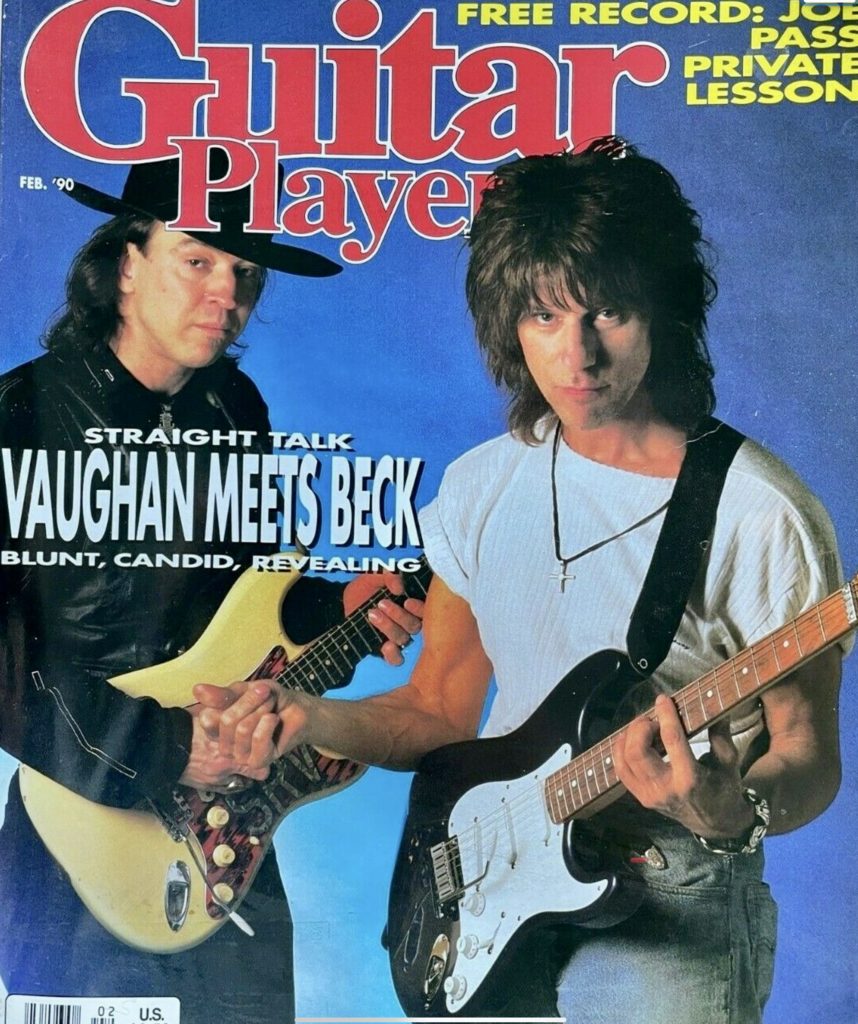
Despite promises from the record label and management, the pair basically just blew us off. Matt was far more aggressive than I about pursuing unauthorized interviews. (Once, after being declined an Eddie Van Halen face-to-face, he pursued Ed into the mens room and hurled questions while Ed stood at the urinal.) So we hung out in the lobby of the guitarists’ Midtown hotel. We saw Beck walk by with an attractive young woman at his side, but there was no interviewing to be done that day. Or the next one.
The label, Epic, offered to send us to the next show in Worcester, MA. Even better, we could hitch a ride back to NYC afterwards on Stevie Ray’s tour bus!
Alas, blown off again — and there was no one from the label or management to secure our ride. We’d returned our rental car, so we were pretty much stranded. We somehow forced our way to SRV’s bus and explained our situation to the road manager, who of course knew nothing about the supposed arrangement. But he kindly let us ride with Stevie Ray and the band overnight. Our interactions with SRV were minimal. Everyone was watching some mediocre western on TV, and one by one folks slipped off to their bunks. As the last person in the main lounge, I flicked off the TV. An irate Stevie Ray poked his head out the star lounge, asking who the hell had turned off his movie, which he was watching on a second screen.
“Sorry!” I squeaked.
The Epic publicist then offered to send us to the Cincinnati show. By now Matt and I were rather stressed out. We’d heard rumors that Beck could be an ornery interview, and Matt was spinning fantasies about potential disasters to come.
“I can’t believe anyone would be so stupid as to ask that idiotic question,” Matt said, imagining one possible scenario.
“Come on,” I said. “He’s probably not going to say that, and he’s definitely not going to talk in that Nigel Tufnel accent you’re using.”
The upside of all this was getting to watch the show up close — four times! Don’t hate me, but I confess that the SRV performances got old for me. The show varied little from night to night. And while I have vast respect for his musical skill and ability to touch so many hearts, I’ve always had limited patience for by-the-book blues licks.
Beck was different. This won’t be news to anyone fortunate enough to have seen him in concert, but he was no mere virtuoso. His playing was positively supernatural. He seemed to pull each note down from somewhere on high, each one requiring a mighty effort. (I hope it’s obvious that I’m not talking about any technical shortcomings on his part.) I’m not a woo woo-type person, but I swear, it was like watching Sisyphus push his rock, or Prometheus stealing fire, or some such mythological shit. He was the least complacent and most suspenseful guitarist I’ve ever witnessed. And for me, nothing on his records comes close to capturing that live energy.
At the time, his latest record was Guitar Shop, and the highlight of each set was his rendition of the album’s “Where Were You,” inspired by the La Mystère des Voix Bulgares, a 1975 album of Bulgarian folk singing. Each performance was unique, and each time he’d summon different versions of those impossibly high harmonics and that improbable sustain. His body coiled with the effort, as if he were in constant danger of falling to his death from a high wire. It was otherworldly. We often say virtuosos make difficult tasks look easy, but Beck made impossible tasks look really fucking hard. (And no — watching up close up didn’t demystify his technique in the slightest.)
Finally, Beck, Vaughan, Matt and I met in a nondescript Cincinnati hotel room. They were both perfectly nice, and Matt’s interview predictions were happily unfounded — sort of. Beck, fit and youthful-looking, pretty much WAS Nigel. If Christopher Guest didn’t derive his Nigel character directly from Beck, well, that performance was an uncanny coincidence.
You can find the interview online by googling “Beck Vaughan Guitar Player Interview 1990,” though GP has split the interview into irritating little sections. I have a difficult time revisiting my work, be it words or music, so I haven’t looked at it in 33 years. I remember feeling that the story was a bit flat simply because the two players seemed to have genuine respect for each other, and there was a lot of sincere but unexciting “No, you’re the man!” energy.
I was struck by Beck’s humility. He said that the experience of jamming with Hendrix was “awful” because it made him feel “like a peanut.” Jeff professed astonishment that Jimi seemed to admire his playing in return. He sorely regretted never having spoken to his hero Cliff Gallup. He said he’d have been satisfied just to hear his voice, even if he only said “fuck off.”
Beck reiterated what he said in so many interviews: He just wasn’t that into guitar. He compared himself negatively to Jimi, Steve Ray, and Buddy Guy, players who, he felt, lived and breathed the instrument. He said he merely “picked it up and played sometimes,” and that he felt guilty about that. Beck’s true passions were his hot rods. But perversely, the facts that he wasn’t obsessed with guitar and that he seldom, if ever, practiced only add to his mystique.
The best obit I’ve read since getting the sad news yesterday appeared in the Guardian. It quotes what was probably the most significant passage from our interview: Beck’s statement that “I shouldn’t have done Blow by Blow.” The Guardian quotes make it sound as if he was uncomfortable in that jazz-fusion format, even though the album was his greatest commercial success. True, no doubt! But I got the impression that he was mostly mortified about being immortalized in a cover image wearing those flared trousers.
We kibitzed for a few minutes after the interview. For some reason, Jamie Lee Curtis’s name came up. (Maybe someone had seen the then-recent A Fish Called Wanda.) I’d read somewhere that Curtis had pursued future husband Christopher Guest after falling in love with his Nigel character. Beck hadn’t heard this. “Oh my god,” he moaned. “That exquisite creature! And to think that she could have had the real thing!” (So yeah, he was indirectly acknowledging the Nigel/Jeff parallels.)
One grim aspect of working in music journalism for decades is the sheer number of encounters with artists who are no longer with us. I sometimes think of all the departed greats I had a chance to speak with: Ray Charles, Ennio Morricone, Bowie, Dr. John, Sonny Sharrock, Leon Russell, and on and on. Recalling my brief encounters with Beck and Vaughan evokes sadness and gratitude in equal measure.
My friend and frequent collaborator Gretchen Menn interviewed me about various guitar topics, including my new album, Falling Through Time: Music from the 1300s. (Links below.)
If you don’t know Gretchen’s playing, do yourself a kindness and discover it (https://bit.ly/3FOcYIW). She is utterly brilliant. My album is available via BandCamp and the streaming services.
Bandcamp https://bit.ly/3JNcHt6
Apple Music https://apple.co/3t5iZ1e
Spotify https://spoti.fi/3q4k0oC
YouTube Music: https://bit.ly/3GDlP1H
Booklet (via joeggore.com) https://bit.ly/3qVNRyD
I’ve worked on many projects by many artists, but this is my first release under my own name. And it only took me 50 years!
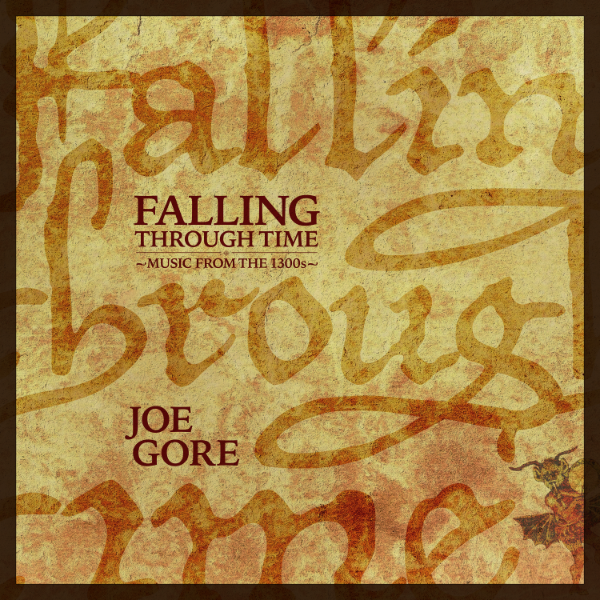
It’s a back-to-the-roots project for me, though I have some fairly strange roots. When I was a teen I wanted to go into academia, specializing in early music (that is, European classical music from before 1650). Fate choose a different path for me, but I’ve always been fascinated by ancient music, especially the bizarre stuff that emerged toward the end of the Middle Ages. So this is a collection of music composed during the 1300s.
I followed a simple but strict “rule book”: I played only the notes and rhythms the composers specified, but I allowed myself total freedom in applying modern instrumentation and production. (As opposed to when I was young, when my goal, like that of most early music practitioners, was to perform the music as authentically as possible.) The resulting album is surreal, psychedelic, and, for better or worse, unlike anything I’ve ever heard.
Here are some places you can listen:
This is a digital-only release for now, though I’ll do a vinyl pressing if there’s enough interest.
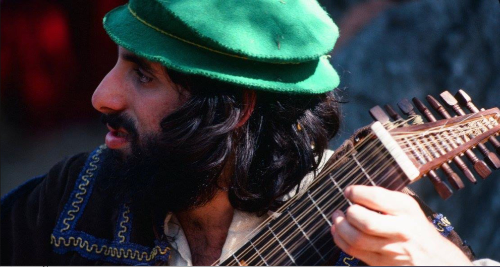
I could say a lot more about the project, but I already did: I created a little booklet with credits, liner notes, background, and lots of amazing 14th-century images. It’s a free download from here:
I also created several videos. Here’s the first one:
I’ll be honored if you can spare the time to listen to this passion project. Thanks, friends!
I’d never have imagined that I’d get to participate in so many cool music collaborations during Covid lockdown — man, was I fortunate! One of the most exciting developments was being invited to join Another Night on Earth, an international octet of electric guitarist who perform classical music.
A few months ago I posted our first virtual concert. The link includes some info about the incredible musicians I get to work with, ranging from Steve Vai’s favorite contemporary guitarist to the guy who leads the conducting department at Julliard. There’s an old musicians’ saying: You’re lucky when you get to perform with players who are better than you. If it’s true, I am really frickin’ lucky.
Last week we posted our second concert.
This one is a real mixed bag. It starts with a medieval piece that I transcribed for two guitars, which I perform with group founder Heiko Ossig from Hamburg, Germany. Next comes a octatonic-scale workout by Daniele Gottardo, performed with Steven Mackey, who is almost certainly the world’s leading exponent of using electric guitar in contemporary classical music. Finally, all eight of us perform Bill Ryan’s recent composition Simple Lines, originally written for eight cellos.
Assembling complex music remotely has presented challenging technical hurdles, and not just the complexities of trans-continental file management. Unlike most pop music, classical pieces usually aren’t performed to a steady click — tempos breathe freely, and the BPM number can vary bar by bar. We’ve experimented with unusual workflows, sometimes reverse-engineering audio that was recorded in strict tempo. In some cases, conductor David Robertson creates a free-flowing tempo map, which we enter into Logic Pro (our primary DAW of choice) so each of us can perform independently to a free, ever-shifting click.
Speaking of medieval music: I’ve been obsessed with early music since I was a teen. When I was 18 or so, I was certain that I would become a university professor specializing in music from before 1650. Fate decided differently — I wound up playing in rock bands and writing about music. Now, in late middle age, I’m returning to those roots. I have a particular passion for the music of the 14th century, the catastrophic era that included the 100 Years War, the Papal schism, and the worst ravages of the Black Plague. The era’s art music is an extreme as its time. It can be incredibly bizarre, especially the stuff from the end of the century, right before what we call the Renaissance.
Besides being strange in its own right, the era’s music forces us to listen in new ways. This was a time before chords. I’m not talking about monophonic Gregorian chant, which evolved centuries earlier. This is intensely polyphonic/contrapuntal music, with multiple lines weaving in and around each other. But there’s nothing like the chordal “skeleton” that underlies almost all music from subsequent centuries. And OMG, the rhythms! It would be 400 years before classical composers created rhythms of equal complexity.
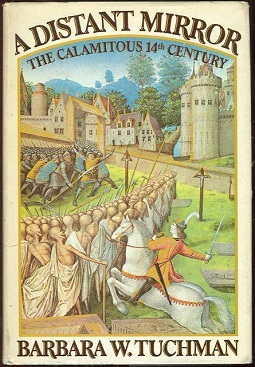
Listening to this literature forces us to hear all music in new ways. It brings to mind the title of Barbara Tuchmann’s epic history of the 14th century: A Distant Mirror. When we turn back the musical clock by 500 years or more, we perceive some aspects that feel timeless and contemporary, testimony to our common humanity. (That’s the “mirror” part.) At the same time, it’s so alien and unknowable that it could have come from Mars. (That’s the “distant” part.) By the way, A Distant Mirror is a spellbinding page-turner, even if you don’t have a particular interest in history or the late Middle Ages. I can’t recommend it more highly.
I’m currently making an album featuring modernistic interpretations of this radical music. I’m not going for maximum historical accuracy the way I did when I was young. I want to capture both “distant” and “mirror.” It’s been a slow, experimental process with many dead ends and false starts. So many seemingly good ideas turned out to be cheesy in practice! But I’ve been making major headway recently, and I hope to have an album to share before the end of the year. (And that, by the way, is one of my main excuses for posting relatively few new YouTube videos over the last year.)
I’ve been wanting to try this A/B test for ages. I recorded my lipstick-tube “parts” Strat/ Then I replaced the MIM Fender neck with an aluminum neck from Alef Guitars before playing the same music through the same signal chain. The sound contrast is dramatic, consistent, and repeatable.
Is an aluminum neck for you? That’s a subjective call. It makes tones tighter and brighter, possibly at the expense of some midrange warmth. Since the EQ curve produced by the aluminum neck looks an awful lot like EQ adjustments I commonly make while mixing, I love the results.
The feel is equally subjective, but I love that as well. It’s almost surreally smooth and consistent.
What are your impressions?
This is my fifth and latest DIY guitar experiment using Warmoth parts. Most of the tech details are in the video, but I’ll share a few additional experiences and impressions.
I’ve been thinking about making something using the Fender Swinger body profile for a couple of years. My earlier Kitschcaster used Wamoth’s Fender Starcaster (“Mooncaster”) body, but when I made it, the company didn’t yet offer a version of that swooping Starcaster headstock. (No biggie — that Starcaster body looks great with a Strat-style headstock.) When they finally introduced a Starcaster neck last year, it occurred to me that the headstock’s curves might go nicely with the Swinger body.
I confess that when I unboxed the parts and saw that screaming orange finish, I had a “What was I thinking?” moment. But the look has grown on me since then. It’s also the first time I ordered a neck with stainless steel frets, which some players rave about. They felt weird at first, and now they feel normal. Now I’m not sure whether I perceive any difference in tone or feel.
I’ve had those Lollar pickups sitting around for a few years. (I previously demoed them as alternate strat pickups.) So I had the guitar routed for them. I’d forgotten how different the P-90 and the “Staple” sound! But they’re complimentary in an oddball way, and they produce cool yet crisp blended tone.
I didn’t decide on the final wiring till I heard the pickups in the body The P-90 has distinctive resonant peaks, so I voiced the bass-cut controls to compliment that. (I have some sort of bass cut in most of my non-vintage guitars.) I don’t love the look of toggle switches, but the Swinger/Musiclander body is too small to permit a third pot in the control cavity.
As usual I’m using expensive but awesome Thomastik-Infeld flatwound strings. No one ever listens, but for the zillionth time I’ll declare that flatwounds are great for distorted playing. When these pickups were designer, flats would have been the reference. And of course, anyone playing one of those early Les Paul Customs before the mid-1960s would have employed flats with that guitar’s P-90/staple pickup set.
I own all the appropriate tools for doing a proper guitar setup, but these days I’m lazy. I set the intonation by ear, and then just guess on the action. I keep a set of hex wrenches on hand while I play, and make adjustments on the fly, eventually arriving at something that feels good. (Same with pickup and pole piece height.) For some reason, it took me a long time to arrive at the right combination of neck relief, bridge height, and saddle height for this instrument. But I wound up with something that feels great. Even though I use heavier-than-usual strings and a wound third string, I’m not macho about the action. I like it as low as possible without buzzing.