Awesome! I just received production prototypes for my next three stompbox releases, in the wake of last month’s launch of my Duh Remedial Fuzz. I’m still making minor tweaks, but these should be available in just a few weeks. Whee!
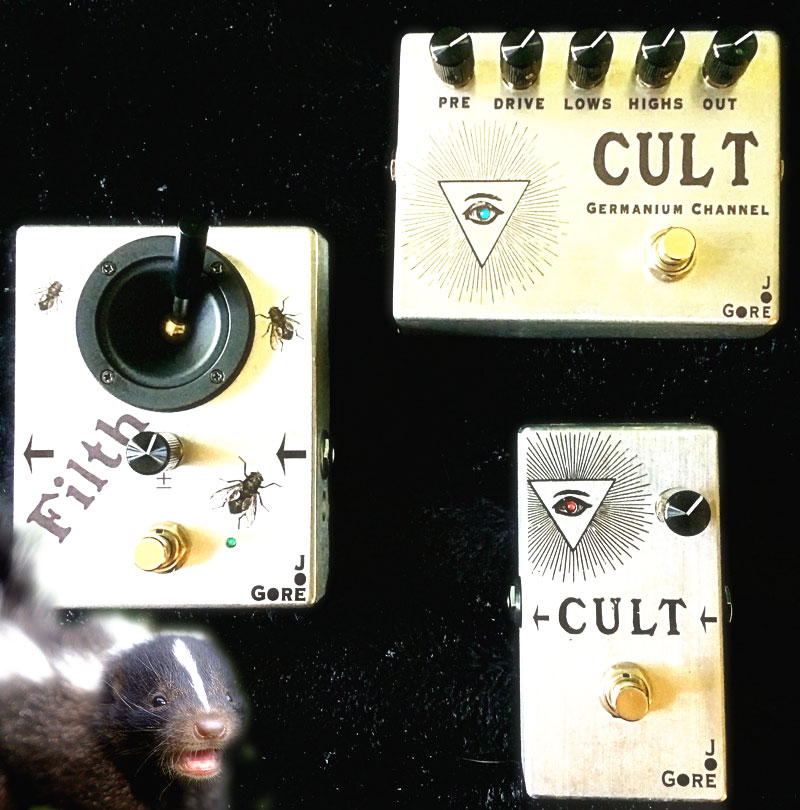
(Baby skunk sold separately.)
Filth. I love whack-job fuzz boxes like the Z. Vex Fuzz Factory and the countless “sick fuzz” pedals it’s inspired over the last two decades. But here my goal was to create one with a higher percentage of “likely to use” settings — I wanted to make it easier to find the good stuff. Topologically, the circuit’s nothing tricky — basically a Fuzz Face descendent coupled with an extra JFET boost stage (though it doesn’t sound remotely like any Fuzz Face you’ve ever heard). The main innovation is the x/y control, which jiggers the transistor biasing, producing a broad array of timbres. It’s not a conventional tone control, though it’s arranged so that it’s easy to summon smooth, chubby tones or angry, brittle ones.
There was a lot of interest in this a couple of years ago when Fuzz Box Girl posted a demo (apparently no longer online) of one of my handmade ones. She focused on the pedal’s maximum-gain, My Bloody Valentine side, which was fine — Filth can definitely make your amp melt like a Salvador Dali timepiece. But now it’s easier to dial in crisp, lower-gain tones.
I’m making two Filth versions: the joystick model [pictured], and one with three conventional knobs. They sound identical — only the interfaces differ. The three-knob is good if you want to mark an exact setting for use onstage, while the joystick is more fun when concocting new sounds. (I don’t know the exact pricing yet, but the joystick model will cost more, because that’s an expensive part!)
I’m far from the first builder to create a joystick stompbox, but you usually encounter them on crazy noisemaker effects, or deployed as conventional EQ controls. I’m not aware of another pedal where it regulates the fuzz’s fundamental timbre this way. But then, I don’t get out as much as I should.
Cult. If you’ve seen my videos or heard my audio demos, you’ve probably heard Cult. I’ve built it into several guitars (while others have a built-in Duh fuzz). It’s a one-germanium-transisor boost descended from the Dallas Rangemaster of the 1960s, though the apple has rolled far from the tree: All part values differ, the EQ profile is modernized, and the gain control works in an unconventional way. But like a Rangemaster, it boasts spectacular dynamic response and electrifying tones that crackle with presence.
To my (admittedly odd) ear, no other distortion sounds as bitchin’ as a single-transistor boost between a good guitar and a great amp. The weird thing is, while most players know the countless ’60s rock tracks produced with such primitive boosters, many have never tried this sort of circuit. I love faithful Rangemaster clones, and I love many of the variations I’ve explored over the last five years. But Cult is my very favorite recipe.
Cult Germanium Channel. This one pairs the Cult circuit with relatively modern active EQ/boost stage, with proper tone controls that don’t suck tone. The added circuitry sacrifices a touch of Cult’s explosive presence, but it provides a greater range of tones. There’s also more gain on tap, so it’s better for those high-testosterone rawk tones that I’m far too much of an prissy, effete San Franciscan to use myself.
Thanks a Lott. As mentioned, these are manufactured by Cusack Music in Michigan, under the expert eye of engineer Tony Lott. Cusack builds pedals for numerous boutique brands you know, many of whom prefer to keep the fact a secret. But I’m proud of the relationship, because Tony and his team improve everything I submit. (More about the collaborative process below. It’s fascinating stuff, assuming you’re a geek — which I do assume, since you’re here.) (more…)