
I hereby announce the first Tonefiend Mutant Beauty Pageant.
I know many deadbeats with too much time on their hands musicians, and most of them have a thing for weird gear. I’m talking real freak-show stuff, the items that make anyone who walks into your music room shriek, “What the hell is that thing?”
Here’s the idea: You post your oddities, and the coolest/weirdest item wins. They can be anything music-related: guitars, basses, amps, effects, CDs or vinyl, music industry swag, some crazy DIY project—anything goes! The winner will receive—well, let’s just say something as weird and cool as the stuff being posted.
Good, cheap tone doesn't grow on...oh, never mind.
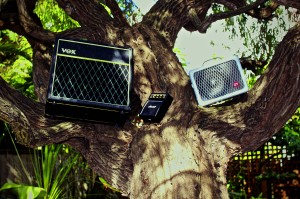
We all love tube amps. Yayy, tubes. Some of us love amp models. Yayy, models. And how about those cheap little solid-state amps?
[…crickets…]
Oh, come on! Am I really the only person who digs the barking attack and corrosive crunch of the subcompact tubeless combo? Will none step forward to sing the praises of those brave little badgers of the amp kingdom?
Don't fear the mic! (Illustration: Elise Malmberg)
Recording be be brutal. Tracking vocals is tough. Capturing pianos or acoustic guitars is painstaking work. But recording electric guitars is easy, easy, easy—once you learn a few basics.
The post focuses on the simplest way to record a guitar amp: sticking a single mic in front of a speaker. In future posts we’ll tackle the tricky stuff: multiple mics, unorthodox mic positions, amps in shower stalls or aluminum trash cans. Those techniques are great—but you don’t need any arcane tricks to record great electric sounds. You don’t even have to have a fancy mic—countless great guitar tracks have been recorded with the humble Shure SM-57.
In fact, if the guitar, amp, and performance sound good, it’s actually pretty difficult to screw things up. Basically, you’ve got two things to consider: Which mic to use, and where to stick it. We’ll tackle those topics in reverse order.
"The more you can take yourself out of the picture and dive into the emotional world of the song, the better music you’ll make."
Chicarrelli on Jack White: "He has an attack unlike anyone else. The concussion of his playing is just unbelievable."
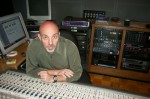
Joe Chiccarelli is one of music’s most respected producers and engineers—and one of the most versatile. After making his mark as Frank Zappa’s studio right-hand, he went on to work with such artists as U2, Elton John, Beck, Tori Amos, Morrissey, Dwight Yoakam, Rufus Wainwright, and Jason Mraz. He’s particularly admired for his recent work with guitar-heavy rock bands such as the White Stripes, the Raconteurs, the Strokes, My Morning Jacket, the Shins, and the Killers.
Joe started out as a bass player in his native Boston. He only plays a bit of guitar, but he knows more about getting great guitar sounds that almost anyone I know. I’ve been lucky to enough to record several albums under his supervision, and each time I’ve been floored by his superb taste, vast tech knowledge, superhuman work ethic, and mind-boggling attention to detail. He can be a real taskmaster! But he’s also one of the most patient, considerate, and just plain sweet guys I’ve ever worked with.
Joe is the polar opposite of those technicians who jealously guard their “secrets.” He’s always generous with his knowledge, and was kind enough to take a break from a recent session to let me fire a few questions at him.
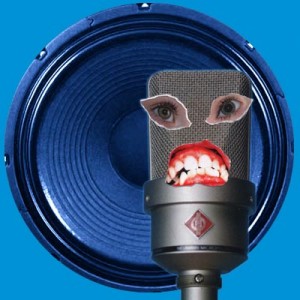
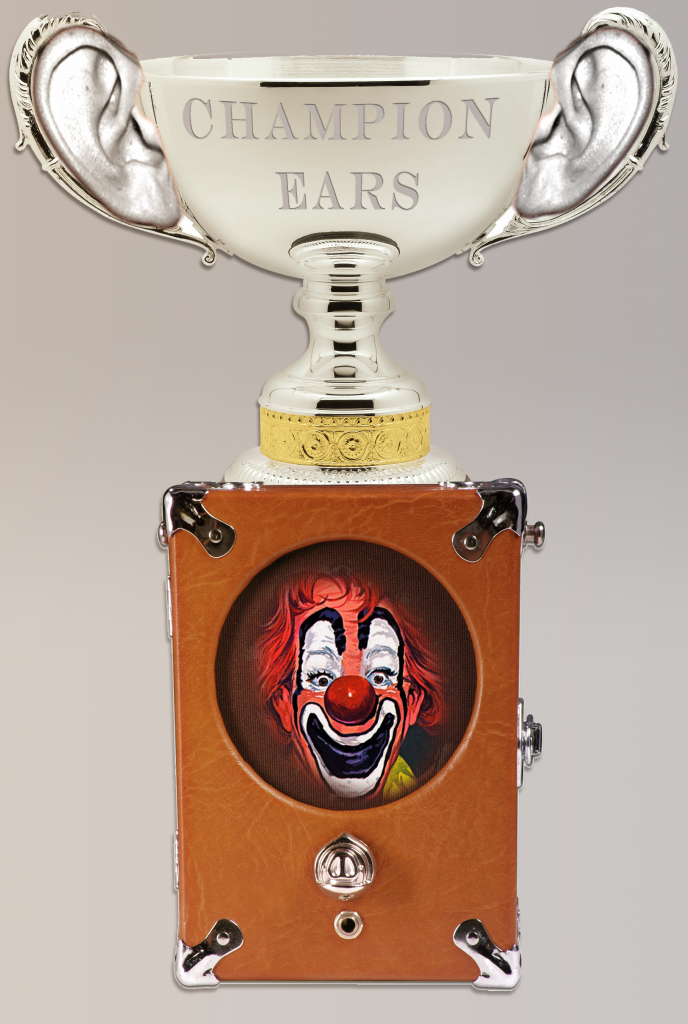
Don't worry, it's just Photoshop. We never inflict anything son hideous on one of our winners.
WARNING! This post contains the answers to the quiz! If you still want to take the test, stop reading now and challenge your ear here.
Don't worry, it's only Photoshop. We would never inflict anything this hideous on one of our winners.
It was only two weeks, but it feels so much longer—at least for me, after processing some 220 entries before receiving the third perfect eight-out-of-eight score last night, which concluded the contest.
I honestly didn’t think it would take as long as it did. Not that I’m complaining! The Amps Vs. Models Contest was a fascinating experiment that produced many interesting comments. Thanks to everyone who chimed in!
The final entry was from Jessie Nieboer of Walkerville, Michigan, who selected a Seymour Duncan Twin Tube Mayhem pedal as his prize. Several days earlier, Ralf Tyra of Hamburg, Germany, claimed second place. He chose a Twin Tube Classic and a Tweak Fuzz. And last week Colm Kelley of Dublin, Ireland, took first place with the first perfect score. He hasn’t yet decided which stompboxes he wants, but mentioned the possibility of three Deja Vu delay pedals.
Yet another thing you could be doing instead of practicing.
UPDATE, Friday Sept. 23: The contest is now closed! Read the results here.
Yet another thing you could be doing instead of practicing.
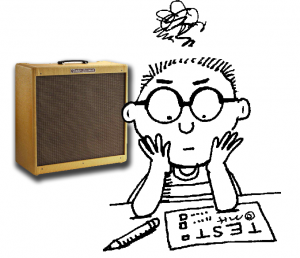
I knew it would be hard, but I didn’t think it would be that hard!
The Amps vs. Models Contest is still very much in progress. Yes, yes, yes—you still have a chance to win fabulous prizes and even more fabulous bragging rights.
One of two things must occur to conclude this thing: Either a) three contestants need to get perfect scores to claim the three instant prizes, which hasn’t happened yet, or b) we wait another six weeks till Halloween, when the prizes simply go to the three best scores.
No one wants to wait six weeks to wrap this up—least of all me. I’m dying to spill the beans, and I’m so tempted to blab when people write asking for details. But dropping hints wouldn’t be fair to the plucky contestants who dove right in with no hints whatsoever. But I will make one seemingly obvious suggestion: Consider a bit of research about what the amps are supposed to sound like. You Tube clips may help here. 🙂
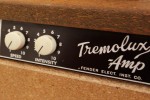
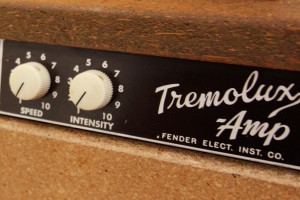
You see a lot of chatter online about the differences between the tremolo circuit Fender used in its early-’60s “brownface” amps and the trem circuit that replaced it in the mid-decade “blackface” models. (Just Google “brownface blackface tremolo” to see what I mean.) The prevailing sentiment seems to be that the brownface version is the ultimate Fender trem—or so you’d conclude, judging by all the boutique amps and pedals offering the brownface version of the effect.
UPDATE, Friday Sept. 23: The contest is now closed! Read the results here. But although the prizes have been claimed, but you can still challenge you ear for fun here!
Listen and win — if you dare!
Ready for some fun, kids? [Evil clown laugh.]
Join the Amps vs. Models Contest! The winner gets a fabulous prize: Any three Seymour Duncan stompboxes. The runner-up gets to pick any two, and third-place gets one.
Just apply your ear to this simple test. I’ve recorded four boneheaded guitar phrases. Each appears twice, once through a real amp, and once through a software model of the same amp. The trick is, I’m not telling you which clips features an amp, and which ones don’t.