Categories
Bass guitar Music

The Bass VI Boss

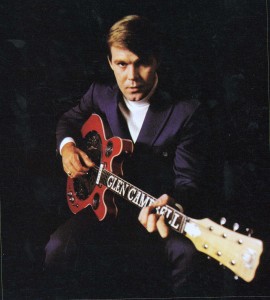
Dang — I wish I had a white turtleneck and a Mosrite electric resophonic!

After some of the long-running contests around here, it was nice having a quickie for a change. San Diego-based steel guitarist Doug Meyer was the first of several readers to correctly identify the four iconic Bass VI riffs in the post on ancient strings. He wins a Seymour Duncan Pickup Booster, a cool clean boost pedal that sound fabulous on 6-string bass, not to mention standard-tuned guitars.

The tunes were, in order of appearance:

1. Glen Campbell’s “Wichita Lineman”
2. Glen Campbell’s “Galveston”
3. Elmer Bernstein’s “Theme from The Magnificent Seven
4. Steve Earle’s “Guitar Town”

Glen Campbell not only sang those two classic Jimmy Webb songs, but played the beautiful 6-string bass parts. As most ’60s pop fans know, Campbell was a leading L.A. session player before becoming a star — he played with Elvis, the Everly Brothers, the Monkees, and on many Beach Boys sessions, including Pet Sounds (that’s him playing electric 12-string on “Sloop John B.”) [CORRECTION IN COMMENTS.]

About the ’90s reissue Bass VI that inspired my original post: I’ve always liked it, and I’ve used it on a zillion sessions, but I never thought it sounded as good as an original. Now I realize that it sounds just like an original — all it needed was the right strings! 🙂
Categories
guitar Music

The Nam Show

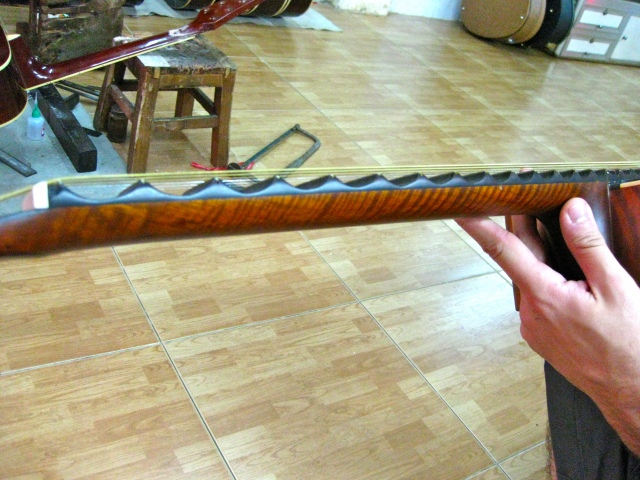
This is not a Swedish guitar. (Photo by Candace Burnham.)

Everyone’s talking about the upcoming Nam show, so I figured I should post something relevant. I’ve never been to Southeast Asia, though everyone I know who has loves the place. And I’ve been floored by the beauty and originality of those Vietnamese electric guitarists who scallop their fretboards not because they love Yngwie, but to replicate the wild swoops and expressive quavering of their indigenous folk instruments. Put it all through a cheap solid-state amp and vulgar digital reverb, and it’s…perfection.

I’m no expert on the style, so I turned to Scott Collins, who’s posted here a few times. He’s a dauntingly knowledgable player and teacher who runs an interesting site called Guitarchitecture. The centerpiece is a comprehensive guitar method he’s created that applies visual metaphors to the process of mastering the fretboard.

Anyway, Scott hastens to point out that he’s no expert on Vietnamese guitar either, yet he’s created a beautiful little piece on the topic. He visited Viet Nam with an eager ear, a respectful attitude, and keen powers of observation. You won’t be bored. —Joe

Categories
guitar Music

Another ’60s Rock Mystery…

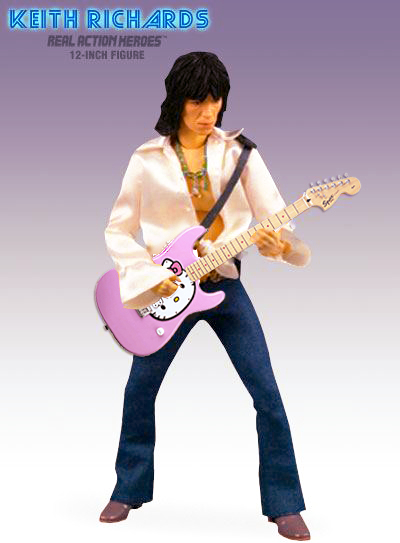
This action figure not available in stores!

It’s hard to discuss the Beatles without summoning their shadow: the Stones. Since posting last week about Randy Bachman solving the mystery of the “Hard Day’s Night” chord, I can’t stop thinking about another 1960s conundrum: Who played the solo on “Sympathy for the Devil?”

There’s one key reason why so many listeners suspect that it wasn’t Keith Richards: It simply doesn’t sound like anything else he ever recorded, and certainly nothing like his solos on the  many live versions of the song.

A couple of years ago a wrote a short piece on the solo for a “100 greatest guitar solos” anthology. Sadly, the project remains unpublished for legal reasons — a pity, since it boasted contributions from many great guitar-centric music writers. But I’m rather relieved my piece never appeared, since I argued that Keith did in fact play the solo. Now I suspect the opposite. Here’s what I wrote:

Categories
guitar Music

Bait for Beatle Bots!

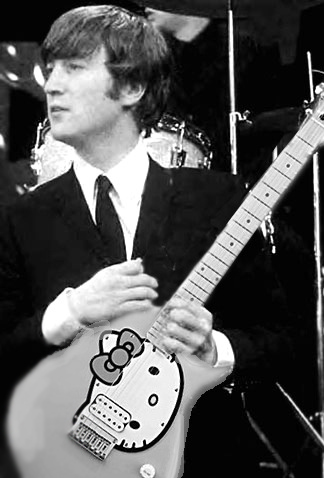
Authentic and un-retouched historic photo.

Okay, I’ve received this link in the last 24 hours from pretty much everyone I know who’s every held a guitar pick.

Guess Who guitarist Randy Bachman claims to have cracked the half-century mystery of the polychord that jump-starts the Beatles’ “Hard Day’s Night.” And I believe he’s nailed it. Enjoy, Beatle bee-yotches!

My favorite Beatle chord is the psychedelic feedback fest that launches “It’s All Too Much.” My fave solo is the screamer on “Taxman,” played by . . .  Paul.

Hey, just for fun: Here, hastily scrawled on a bar napkin, is a one-guitar, no-bass approximation of the “Hard Day’s Night” chord that manages to cram in most of the pitches. No one in the group actually plays it, but it sounds pretty cool when you whack it hard. If your fans scream loudly enough, they’ll never notice the difference! Check it out:

Categories
guitar Music

Hubert Sumlin, 1931-2011

Longtime Howlin’ Wolf sideman Hubert Sumlin died this week at age 80. He played with Wolf on and off from 1953 until the singer’s death in 1976. (The YouTube clip features the two performing one of their greatest tunes live in Europe in 1964, accompanied by pianist Sunnyland Slim, drummer Clifton James, and the great songwriter and bassist Willie Dixon.)

I never met Sumlin, though everyone I know who did described him as a mellow, sweet guy. But “mellow” and “sweet” are the last words you’d use to describe his frantic, abrasive sound. I can’t think of another player who better encapsulates a) what I love about great mid-20th-century blues, and b) what I hate about much blues from subsequent generations. 

Categories
Acoustic Amps guitar Music Recording

A Great Producer Talks Great Guitar

Chicarrelli on Jack White: "He has an attack unlike anyone else. The concussion of his playing is just unbelievable."

Joe Chiccarelli is one of music’s most respected producers and engineers—and one of the most versatile. After making his mark as Frank Zappa’s studio right-hand, he went on to work with such artists as U2, Elton John, Beck, Tori Amos, Morrissey, Dwight Yoakam, Rufus Wainwright, and Jason Mraz. He’s particularly admired for his recent work with guitar-heavy rock bands such as the White Stripes, the Raconteurs, the Strokes, My Morning Jacket, the Shins, and the Killers.

Joe started out as a bass player in his native Boston. He only plays a bit of guitar, but he knows more about getting great guitar sounds that almost anyone I know. I’ve been lucky to enough to record several albums under his supervision, and each time I’ve been floored by his superb taste, vast tech knowledge, superhuman work ethic, and mind-boggling attention to detail. He can be a real taskmaster! But he’s also one of the most patient, considerate, and just plain sweet guys I’ve ever worked with.

Joe is the polar opposite of those technicians who jealously guard their “secrets.” He’s always generous with his knowledge, and was kind enough to take a break from a recent session to let me fire a few questions at him.

Categories
Music Recording

Theft—or Musicology?

Excuse me, Mr. Beatle, but Scotland Yard would like to speak with you about your illicit treble content.

DISCLAIMER: I am not encouraging any illegal activity. Just sharing some observations.

Over the last few years, just about every musician I know has been spellbound by a series of illicitly leaked recordings. These files, sometimes lumped under the name “Multitrack Masters,” feature dozens of classic rock recordings, broken out into individual tracks. You hear isolated Beatles vocals, Queen guitar stems, Bob Marley rhythm tracks, Stevie Wonder keyboards, and much, much more.I don’t know how they came to be leaked in this form, though I’m guessing one or more sneaky remixers did the deed.

Categories
guitar Music

Stop Me If You’ve Heard This Guy Before…


UPDATE, 11.19.11: Dutch reader Rob sent my an obit announcing that Tielman died on Nov. 10 at age 75.

For the last year or so, this video has been ricocheting back and forth among my guitarist friends. It’s a 1960 clip of the Tielman Brothers, featuring guitarist Andy Tielman, an early rock-and-roller justifiably famed in has native Indonesia and in the Netherlands (Indonesia’s former colonial power), but practically unknown everywhere else. (Admit it: When you think of high-octane rockabilly, Surabaya, Indonesia, isn’t exactly the first burg that springs to mind.)