As threatened, the Fuzz Detective video:
WHAT: Twelve germanium fuzz circuits compared and analyzed. These represent the sounds of almost every fuzz pedal introduced between 1962 and 1968.
WHY: A tool to help players identify the circuits most relevant to their musical needs. This isn’t about particular brands of pedals, but the circuits they employ. If you hear something you like, you can either do as I did and build a clone from the schematic, or buy one based on that particular design. (The relative merits of rival clones is another story.) Of course, if you’re rich and you desire an ancient pedal that probably doesn’t sound as good as a new clone, you can always purchase a vintage original. 😉
HOW: I tried to establish a “level playing field” by removing as many sonic variables as possible. I used the same signal chain, the same guitars, the same musical material, etc. (Tech details below.)
WHO:
- Maestro FZ-1 Fuzz Tone
- Sola Tone Bender Mk 1
- Hornby-Skewes Zonk Machine
- Sola Tone Bender “Mk 1.5” (similar to Vox Tone Benders)
- Dallas-Arbiter Fuzz Face
- WEM Pep Box Rush
- Sola Tone Bender Mk II (same as Marshall Supafuzz)
- Mosrite Fuzzrite (germanium version)
- Orpheum Fuzz (germanium version)
- Selmer Buzz Tone
- Sola Tone Bender Mk III (same as Park Fuzz Sound, Carlsbro Fuzz)
- Baldwin-Burns Buzzaround.
WHEN: Like, now, man!
Tech details: In Pt 1, you hear all 12 circuits through the same signal chain:
- all-original 1963 Strat
- Asterope cable
- 1962 Fender Tremolux head
- 1×12 cabinet with Celestion Alnico Blue speaker
- Royer R-121 mic
- Avalon 737 preamp (compressor bypassed)
- Recorded into Logic Pro
In Pt 2, you hear additional guitars (a 1981 Les Paul with ultra-vintage Duncan Seth Lover PAF pickups, a mid-’90s Hamer 20th Anniversary with ultra-vintage Duncan Joe Bonamassa PAFs, and a Fender Hello Kitty! Strat with a screaming-hot Invader pickup), but the other details don’t change. I made no adjustments to the amp settings throughout.
While I often play fingerstyle using flatwound strings, here I opted for a more conventional approach of pickstyle playing with medium-gauge roundwounds. Because some of these effects work best with no buffering between the guitar and the pedal, I played each example separately, as opposed to using a looper or a ReAmp. I aimed for consistent performances.
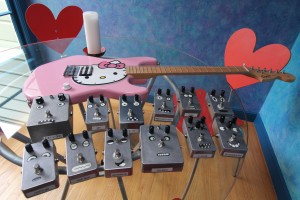
All 12 pedals were built from their commonly available schematics. (I’m not including them here, because I haven’t obtained permission from each of their creators, but you can google them in seconds.)
All 30 germanium transistors heard here are new-production AC-128s from the same vendor, hand-tested for appropraite hFE (gain).
All other parts are modern: carbon-film resistors, mylar box-style capacitors and generic electrolytics, true bypass switching, etc. I used ’60s-style positive-ground wiring. All pedals are powered by fresh 9v batteries, or AA batteries in the case of the Maestro and Selmer clones. (IMHO, all these circuits sound about the same with AC power, good NPN transistors, and modern negative-ground wiring, but I opted for historical accuracy to avoid certain long, boring arguments.)
The is the longest, most ambitious video I’ve attempted. I learned a ton and made some exciting discoveries. I hope you dig it — and I can’t wait to hear your take on some of these circuits!


Leave a Reply