Few guitar pedals can rival the cult cachet of the Harmonic Percolator, a singularly ugly distortion stompbox produced in minuscule numbers in the early ’70s by Interfax, a small company based in Milwaukee, Wisconsin. And guess what? They sound ugly too, though they’re ugly in a cool and useful way.
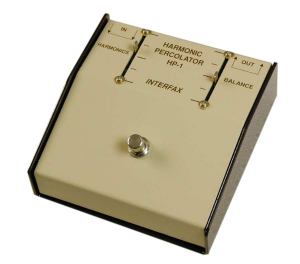
I’ve been wanting to write about these for years, but was hindered by the fact that I don’t have access to one. No one does! Well, except the pedal’s best-known user, producer/guitarist Steve Albini. (Steve has posted several popular YouTube videos in which he sings the praises of the original and evaluates it against modern clones.)
But I revisited the idea recently when Christian Magee, who runs Tube Depot, sent me a couple of old 2N404A transistors from a stash he recently acquired. This rare PNP germanium transistor appeared in the original, along with an NPN 2N3565 (also rare, but not as ridiculously rare as the 2N404A). Yes—this pedal uses both a positive-ground germanium transistor and a negative-ground silicon transistor in the same circuit. (Another Fuzz Face/Tone Bender clone, this ain’t!)
I whipped up several variants:
- • a clone using the original parts
- • a near-clone using more readily available alternatives
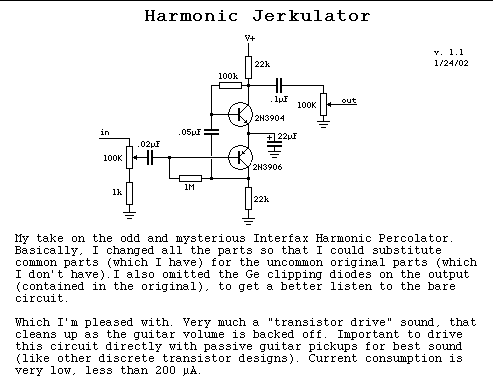
- • a Harmonic Jerkulator, an all-silicon/no-diodes variation created by DIY stompbox titan Tim Escobedo
- • an experimental version with extra controls
Survey the wreckage:
Post-mortem after the jump.
I’ve always found this circuit compelling, and not just because of its weird architecture. It truly has a unique distortion character. Chuck Collins, who makes the cosmetically faithful clone pictured above, talks about the pedal in Tom Hughes’ Analog Man’s Guide to Vintage Effects:
But it was only a matter of time for someone to notice that this pedal does the same thing that tube-type amplifiers do; that is to create even-order harmonics when pushed into saturation or overdrive.
Man, I do not hear what Collins hears! To my ear, the distortion is much more akin to solid-state distortion, like overdriving a tape recorder input. Fortunately, most of us have matured beyond old-school distortion sensibilities (“Tube distortion good, all other distortion bad!”), and many players can put this razor-edged timbre to good use. I totally get why Albini digs it—it has the same uncompromisingly hard edge you hear in his productions. It’s a sound that won’t get lost in the mix! At the same time, it’s as responsive to input dynamics as any number of more conventional transistor distortion pedals.
Regarding parts: Using the exact original transistors matters little, IMHO, and I’d be leery of any product that uses their inclusion as the main selling point. Substituting other germanium/silicon pairs tended to sound at least as good as the original. Same with the diodes: Every diode type sounds a bit different, but there’s nothing particularly magical about the original germanium ones. I’d like to experiment more with silicon diodes and LEDs to see whether the add even more nasty edge.
This circuit is ripe for experimentation. I’m going to play with it more and see whether I can come up with an especially useful and exciting alternative — unless you beat me to it! 🙂




Leave a Reply