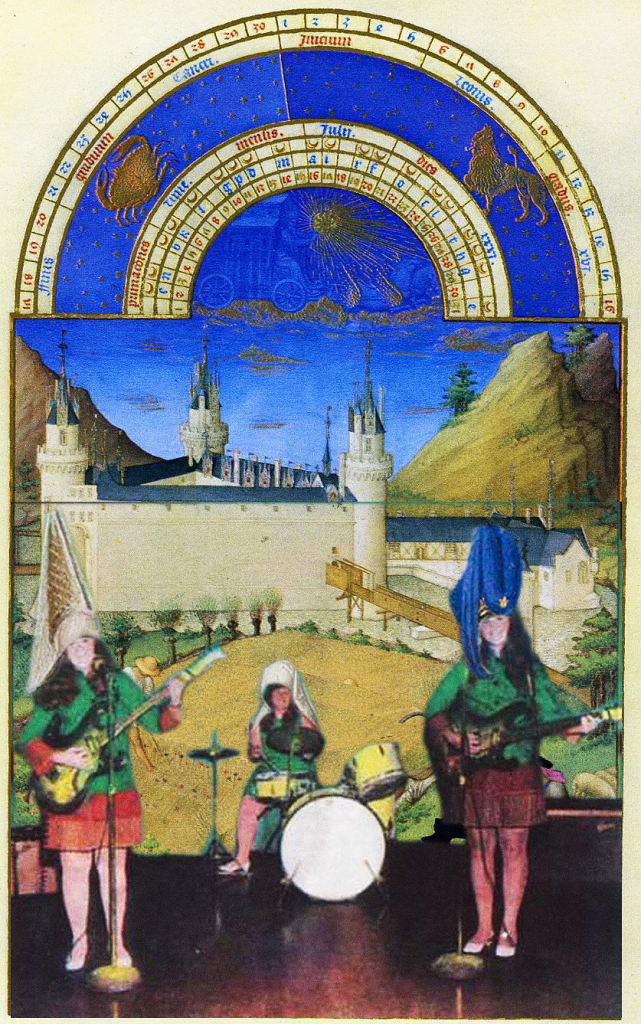
Here’s reader Freddie Lenzel, writing in response to my post on the bizarre late-medieval composition Fumee fume par fumee:
To me, it sort of sounds like The Shaggs from the Dark Ages. But seriously, it’s really interesting. Greetings from Spain, love your blog.
And I love your comment, Freddie! It really strikes a chord (pun intended), because the Shaggs have always sounded medieval to me. And I think I can explain why.
(But first: If you don’t know the Shaggs, stop reading this second and make your acquaintance with the group and their 1969 magnum opus, Philosophy of the World. Kurt Cobain cited it as one of the five-best albums of all time, and Frank Zappa insisted that the Shaggs were “better than the Beatles,” words that inspired this indie-trash tribute album. Meanwhile, NRBQ’s Terry Adams, who launched the Shaggs revival by getting Philosphy re-released in 1980, rightfully compared their homespun sound to Ornette Coleman’s free jazz.)
The Shaggs weren’t the only band to make an album before they knew how to play or write music, but they were one of the best. Many musicians, when first exposed to the Shaggs’ idiot-savant sound, compare it to what might result if you explained music to an alien species unfamiliar with the concept, and then sent them into the studio before letting them hear any actual music. Shaggs songs have no underlying chord structures, no consistent meter, no conventional phrasing, and little harmonization. It’s just odd, meandering “melodies” that stumble along until singer/guitarist Dot Wiggin happens to require a breath. Why, it’s practically…medieval!
By their own account, the Shaggs had no knowledge of music whatsoever, let alone any insight into pre-Renaissance aesthetics. But in “inventing” music from scratch, they retraced many of the steps taken by their Dark Ages predecessors when they struggled to conceive polyphonic music.
Most modern music has underlying chord structures. Melodies are strung across these structures like cables stretching between the concrete piers of a suspension bridge. But medieval melodies are more like threads in a cobweb — they connect only with each other, not to any underlying framework. In the Middle Ages there were precise (albeit ever-changing) rules governing how the melodies could be constructed and how they could be superimposed, but there was no chordal “superstructure.” Musical cadences usually occur on unisons or octaves, and sometimes fifths. (In fact, the Fumeux fum par fumee phrases that linger on minor triads are among the piece’s most shocking details.) And just as Fumeux wavers uncertainly between 3/4 and 2/4 time, the Shaggs’ music wobbles along with something resembling a pulse, but one that rarely congeals into a recognizable time signature.
Some of our musical conventions are so deeply ingrained, they can feel hardwired into our brains. But they’re not — they really are merely conventions. For me, one of the big attractions of medieval music is the way it offers a glimpse into how musicians dealt with melody, rhythm, harmony, and structure before those conventions had firmly taken root. And I get exactly the same buzz from the Shaggs. (And if you strip away the drums and electric guitars, songs such as “Who Are Parents?” and “My Pal Foot Foot” sound an awful lot like Gregorian chant…)



Leave a Reply