
Did you ever come across one of those magical guitars? The kind that just seems to cast everything you play in the best possible light? A guitar you never want to stop playing because it sounds so darn good?
Well, this story isn’t about that kind of guitar.
It’s about a singularly uninspiring 1981 Les Paul Custom I picked up a few years ago. Sonically and physically, the guitar delivered everything you think of when you think of your basic, post-vintage Paul, only less. So I call it the Less Paul.
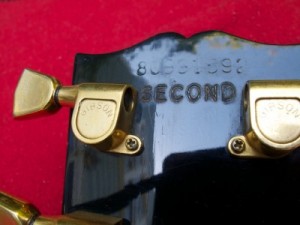
When Gibson made it 30 years ago, they embossed the word “SECOND” on the back of the headstock. But the guitar has accumulated so much cosmetic damage over the years that it’s impossible to know which defect originally earned it this badge of shame.
I confess I’ve never been much of a Les Paul guy. If I was going to play through humbuckers, I’d go with a semi-acoustic, like my beloved mid-‘60s Gibson Trini Lopez, a weird and obscure model that used to sell for a fraction of the price of its better-known cousin, the ES-335. (That is, until Foo Fighter Dave Grohl and Noel Gallagher of Oasis started playing them, elevating their status from “weird and obscure” to “classic.”) Or I’d use some chambered Les Paul spin-off, like the Hamer 20th Anniversary model. To my ears, orthodox Les Pauls were always too heavy, too dense, too lacking in high-end animation.
Sure, I’d heard that original 1950s models had a lighter, zingier sound than later ones. They certainly sounded great in the hands of people like Jimmy Page and Jeff Beck. But come on—have you ever been privileged to spend significant quality time with a ’59 Les Paul? Me neither.
Anyway, I was doing a lot of work creating amp and effect models for Apple and other companies, and I wanted to have a basic Paul around for comparison purposes. It also came in handy when I started building analog stompboxes. I’d learned that if I could fine-tube an amp or pedal—be it real or virtual—so that it sounded pretty good on both a Strat bridge pickup and a Paul neck pickup, chances were it would sound pretty good with most guitars.
But the Less Paul was a mere tool, not a source of inspiration. Whenever a player would swing by my studio and try some guitars, I’d steer them toward cooler instruments. “Don’t bother with that one,” I’d say. “It’s a pig.” Yes, I’m harder on my guitars than most players, and that includes psychological abuse.
Fast forward to a few months ago, when I started speaking with the folks at Seymour Duncan about helping to create a tone-oriented blog for their website. It wasn’t till I’d accepted the amazing offer that I got around to disclosing my dirty little secret:
I had never installed a guitar pickup. I played guitars as they were, or paid someone else to do the dirty work.
Oh, that seems so long ago, after weeks spent trying out every pickup I could get my hands on. I was like a kid in a candy store, except kids don’t usually get paid to take candy. Ah, life can be hard sometimes.
(I’ll discuss my virgin install in a future post, but for now, suffice it to say that installing replacement pickups is shockingly easy, and it gets even easier with practice. I’m planning several step-by-step tutorials aimed towards those who have avoided the process due to fear, laziness, impatience, clumsiness, and lack of workbench skills. In other words, people like me!)
Anyway, back to the Less Paul. It was no longer a pig—it was a guinea pig!
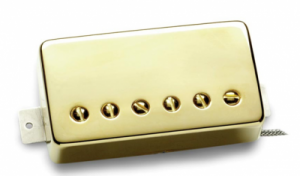
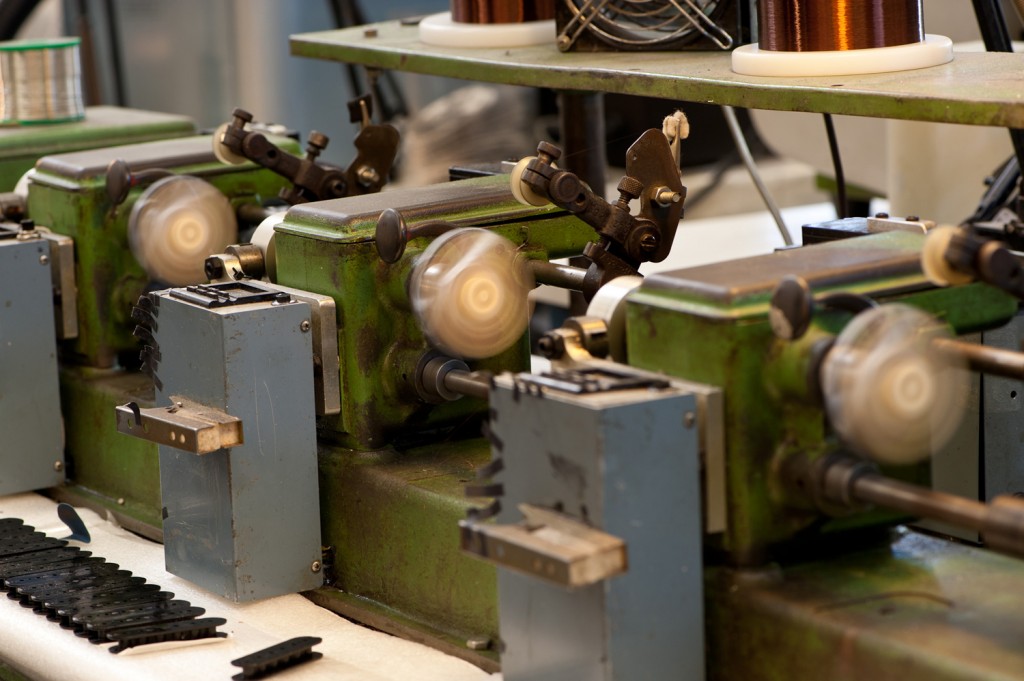
Deciding what to install first wasn’t easy. (See previous “kid/candy store” comparison.) But after visiting Seymour Duncan HQ in Santa Barbara, California, I decided to go with a pair of Seth Lover pickups, extremely faithful replicas of a vintage P.A.F.s, the original mid-’50s humbuckers. They’re named for the man who invented the humbucker for Gibson in 1955. He was a mentor to Seymour W. Duncan, and the two were close friends until Lover’s death in 1997. When the Seth Lover model was released in 1994, Seymour worked from Seth’s original notes. And as if that weren’t vintage enough, these pickups are made on an historic Leesona winding machine that once resided at the old Gibson factory in Kalamazoo, Michigan.
It’s worth noting that this model is not some fancy-pants Custom Shop pickup, but a regular production model. In other words, it’s not very expensive.
Seymour’s office is just a few feet from the production floor, so I poked my head in to ask about the Seth Lover Model. Seymour’s lair is an amazing place, filled to bursting with the antique tools and collectibles he loves. Metal-stamp presses. Locksmith equipment. Native American arrowheads. A stack of ancient fire helmets. And snapshots of Seymour with seemingly every famous guitarist of the last 40 years.
Seymour explained how the idea was to create a P.A.F.-style humbucker that would sound just like one off 1957 factory floor, as opposed to the Antiquity humbucker, which was designed to sound and like a similar pickup after decades of wear and tear.
Given my tendency to avoid humbuckers in heavy-bodied guitars, I was also tempted by a pair of Seymour Duncan Phat Cats. These are replicas of Gibson P-90s, a pleasantly rough-edged single-coil pickup that predates the P.A.F., but reconfigured to fit a humbucker-sized cavity. But I was curious whether anything interesting would happen if I mated these ’50s-style pickups with an ’80s axe. Would a May/December romance blossom? Or would I just have a pig with pretty new jewelry?
I’m recording the audio evidence right now. Check back in a few days for the results!
In the meantime: Anyone have any magic makeover stories? Did you ever fall for a guitar you used to hate?


Leave a Reply