The story so far: In Part 1 of this post, I snatched a pair of Seth Lover pickups in an attempt to improve my unlovable ’81 Les Paul. Will they transform the guitar from a pig to a prince? Or am I just casting pearls before swine?
I’m sharing some comparative recordings I made so you can judge for yourself. I distort, you decide!
Now, making genuinely objective comparisons between two pairs of pickups in the same guitar is a tricky proposition. Here’s the best method I could think of:
Before replacing the guitar’s stock pickups, I made a series of reference recordings, monitoring through an amp simulator for feel, but only recording the dry sound of the guitar without the amp emulations.
Next, I replaced the Less Paul’s stock pickups with the new Seth Lovers. (It was surprisingly easy, even though, I admit with embarrassment, I’d never changed my own pickups before.) Then I replayed the same phrases with the same recording settings and amp simulations I used for the first set of recordings.
Finally, I pumped all the recordings through a combo amp using a ReAmp, a box that converts a line-level signal from a mixer or DAW into an instrument-level signal that you can run through amps and stompboxes. I changed amp settings between the clean and crunch sounds, and added an overdrive pedal for the distorted ones. But in each instance, the only differences between the “before” and “after” recordings are the pickups, plus the small variations that crept into my performances. Still not a perfect scientific comparison, but close enough to make meaningful observations.
Here are more geeky technical details. Just skip this bit if your eyes are glazing over from too much tech talk.
Input chain: Avalon 737 preamp, Apogee Symphony I/O
Recording software: Apple Logic Pro
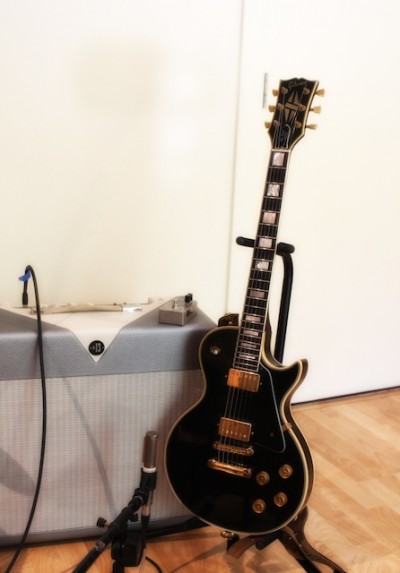
Microphone: Royer R-121 (a warm-sounding ribbon model with a figure-eight pickup pattern that many, including me, regard as one of the best modern electric guitar mics. The mic was positioned on-axis about eight inches from the speaker.
Amp: Divided By 13 CJ11 (a spiffy boutique version of a Fender Deluxe)
Room: The amp sat in an open, open-medium-sized room with a reflective, faux-hardwood floor.
Before listening, a few words about these demo files: They’re bounced down to mp3 format for fast web streaming, and the crummier your listening conditions, the harder it will be to perceive subtle distinctions. If you can’t connect to decent speakers, at least try to listen on headphones. Alternately, you can download CD-quality versions of all the comparative sounds here [34MB dowload]. This .zip file includes the sound as demoed through a combo amp, plus the “dry” files recorded directly from the guitar with no amp simulation or reamping. You can reamp the latter set on your own, or listen through your favorite amp-emulation software.
Let’s start with some clean sounds. Here are the two neck pickups side-by-side:
Original Neck Pickup, Clean Tone
Seth Lover Neck Pickup, Clean Tone
In the words of the old Christmas song, “Do you hear what I hear?”
Even listening through cheapo laptop speakers, I get more sparkle and animation from the Seth Lover pickups. It’s not just a matter of what’s there (stronger highs), but of what’s not there: There’s a lovely low-mid “scoop” that makes those highs shine more brightly.
If you’ve done much mixing, you’ve probably come across the trick of making guitar glisten not by cranking the highs, but dialing out frequencies between, say, 160Hz and 240Hz. Once you do, there are fewer overtones to clutter the top end. You get more sparkle, presence, and “space” without the potentially harsh artificiality of just pouring on more treble. The Seth Lover pickups seem to do something similar. They sound more “open,” with a sweeter shimmer to the high overtones. The difference is probably even more dramatic if you don’t have middle-aged hearing. (Us old guys just don’t hear as many highs as you dang kids, even if we practice “safe listening.”) And of course, any differences are much more apparent if you listen on serious headphones or speakers.
“Hmm,” said my ears. “Interesting.”
Now let’s take it to the bridge. Compare the two bridge pickups:
Original Bridge Pickup, Clean Tone
Seth Lover Bridge Pickup, Clean Tone
Now I hear all the previously mentioned qualities, only more so, given the naturally brighter tone of the bridge pickup. Not only do the highs glisten more, but their overtones are more harmonious. They just seem to “sing” more. Click back to the original sounds after listening to the Seth Lovers. Don’t they just seem flatter and less engaging?
“Okay,” said my ears. “We’re starting to get excited.”
Next I the cranked the amp to crunch level. There’s no gain control on this vintage-style amp, so you’re hearing both preamp and power amp distortion.
Original Neck Pickup, Crunch Tone
Seth Lover Neck Pickup, Crunch Tone
Original Bridge Pickup, Crunch Tone
Seth Lover Bridge Pickup, Crunch Tone
The differences seem a bit less dramatic here. All those shimmery high freqencies are muted because of the natural high-end roll-off of an overdriven tube amp. Still, I prefer the sound of the Seth Lovers, especially on the bridge pickup. The open low-mids remind me a bit of the attractive phase cancelation you get from a plexi-style Marshall and good 4×12 cabinet.
Now what happens if we floor it? I turned the amp up even hotter, and added a home-built germanium overdrive pedal for greater crunch. I went for an aggressive, almost deliberately ugly sound, with flailing bends and a heavy pick attack. (I more often play fingerstyle, as in all the preceding examples.) It ain’t pretty.
Original Neck Pickup, Distorted Tone
Seth Lover Neck Pickup, Distorted Tone
Original Bridge Pickup, Distorted Tone
Seth Lover Bridge Pickup, Distorted Tone
Again, I’m way more drawn to the sound of the new pickups. They’re every bit as aggressive, but the with clearer highs and that same low-mid openness. Those squalling high notes at the end of the example somehow manage to have more bite, while being less fatiguing. All these examples have plenty of splattering overtones, thanks to the hot amp and thick germanium distortion. But on the old pickups, the harmonics behind the single-note lines just feel random. With the new pickups, they somehow seem more “attached” to the fundamental note. And I dig the extra sizzle on the bridge-pickup power chords. Again, it nudges the tones closer to the sound Marshall plexi than I might have expected from a small, Fender-like combo.
I was just about to power down when I got a call to do a couple of 30-second cues for some video game commercials. They wanted something punky and primitive, with lots of nasty fuzz. I wound up using the Less Paul for all the guitar tracks on two submissions. Survey the wreckage:
30-Second Video Game Cue #1
30-Second Video Game Cue #2
“Hey,” said my ears. “Isn’t it time we discussed your attitude problem concerning this perfectly good guitar?”
My ears were right. In fact, I had to admit that I’d fallen in love with an instrument I used to hate. I felt like Elizabeth in Pride and Prejudice, but with a factory-second guitar standing in for Mr. Darcy. I just wanted to keep playing, so I recorded a bunch of other stuff, some pretty and sweet, some petty and violent. Dang, what a versatile axe!
Les Paul Montage
Lesson learned: If you have a nice, playable hunk of tone wood like this old mahogany slab, chances are you can turn it into something cool.
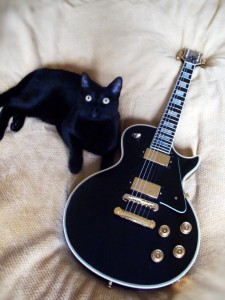
I decided to do something nice for the guitar after all the abuse I’d heaped on it. I took it in for a re-fret, and replaced the corroded bridge and tailpiece with new hardware. But it wasn’t till I brought the Less More Paul home that I realized something crucial that I’d never noticed before: It matches my cat!


Leave a Reply