

Okay, I lied.
In the previous installment of our ongoing mongrel strat series, I experimented with a version of Gibson’s oddball Vari-Tone circuit. I said it was too fussy and complex, and that I wanted to experiment with a simplified version.
So naturally, I built a “parts” Strat with a Vari-Tone twice as complicated as the original — a configuration I’ve dubbed the “Obsessive/Compulsive Tone Control.” I also deployed some of my favorite quirks and wiring tricks from previous strat experiments, plus a few new hardware discoveries. Result: a weird-ass guitar that only a geek could love a cool, one-of-a-kind instrument.
Check out the demo. Post-mortem after.
Yes, I’ve used the same Twangbanger bridge pickup in every single mongrel strat. But I just love the thing! Right now I soooo prefer the explosive, attitude-dripping tone of this Tele-inspired pickup to even the nicest vintage-style strat bridge pickup. I spent a lot of time trying to to get the Twangbanger to play nicely with a Lipstick Tube, and I like the results here, with a middle-position SSL-1 (RWRP) bridging the gap.
I’m also digging the way the Megaswitch E-Model replaces the standard position#3 setting (middle pickup alone) with the sound of the outer pickups together. It doesn’t bother me in the least that the current wiring doesn’t even let you solo the middle pickup. I’m preferring this to the seven-tone option, where a push/pull pot brings in the bridge pickup. There something attractive about having the pure, single-pickup sound on the selector switch’s outer settings, and the three blends in the middle.
Admittedly, I’m still wrapping my head around the wacky, 12-capacitor Vari-Tone. (Quick recap of the the basic Vari-Tone idea: It’s a two-knob tone circuit in which one knob rolls off treble like in a conventional tone control, while the other selects between different input capacitors, each with a different roll-off frequency. Additionally, the circuit includes an inductor, which gives the rolled-off tone settings more of a resonant, notched-wah quality. The circuit is best known for appearing in Gibson’s ES-345 model.)
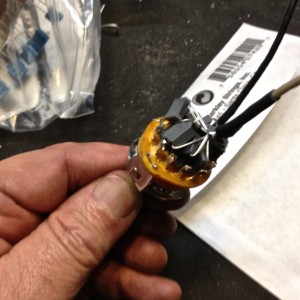
Again, I borrowed the Vari-Tone construction technique from this terrific tutorial at DIY Guitar Mods. My procedure was exactly the same as with my first Vari-Tone strat, except that I populated an entire 12-position rotary pot with capacitors in ascending sizes. (My final choices, from small to large: 102, 222, 332, 472, 682, 103, 223, 333, 473, 683, 104, 154.)
There’s definitely enough complexity here to get you into trouble onstage! But I imagine using this guitar more as a studio tool, especially for overdubbing guitar tracks. I think it’ll be quite useful to adjust the tone filtering to suit the mix. Ask me again in a few months, but for now at least, I feel inspired.
FYI, the neck and body are from All Parts, and I’m delighted with the quality. I also incorporated some recent hardware discoveries, like the cool Planet Waves Auto-Trim Tuners I wrote about here, and the nifty Wilkinson/Gotoh VS100N tremolo, which I’m trying for the first time (though I don’t really demo it in the video). I usually go for more vintage-type trems (if I use them at all), but this sleek, modern model boasts brilliant tone, unbeatable sustain, and a clever design with a single set-screw per string to lock in both saddle height and string intonation. I also went for these crazy-expensive high-tech strap locks. They may be overkill, but bear in mind that my guitar has crashed to the stage more times than I can remember when a strap lock fails during a bout of aggressive playing. (Most memorable incident: In from of 12,000 people during a Bruce Springsteen/R.E.M./Tracy Chapman show.)
BTW, this is my first-ever self-assembled guitar, and I had a blast putting it together. The scariest job was drilling the big holes in the body for the tremolo bushings. The most labor-intensive part, as detailed here, was carving a decent nut. I’m 100% happy with how the current nut feels and sounds — but it looks like crap. I’m going to try replacing it with a prettier one.
Every step of the process went better than it otherwise would have were it not for the guidance of the ever-reliable Dan Erlewine via his books The Guitar Player Repair Guide and How to Make Your Guitar Play Great, both of which reside permanently on my workbench iPad.
Okay, now it’s a good time to take a break from strats and ruin upgrade some Les Pauls for The Pagey Project!


Leave a Reply