I hereby call to order the first meeting of the Tonefiend DIY Club!
Our mission: To attain tonal mastery over our guitars, amps, and effects with the least possible damage to our gear, bodies, homes, and pets. When the smoke has cleared (and all the smoke alarms have been reset) you’ll be able to install pickups, customize your guitar’s electronics, mod and build stompboxes, repair cables, and brag about your technical prowess while waiting in line to file your insurance claims.
Take it from one of the laziest and clumsiest people ever to brandish a soldering iron: Anyone can learn these skills. They’re fun and creative, and they’re one of the best ways to “own you tone,” if I may borrow the Seymour Duncan motto.
As promised, this material will be suitable for absolute beginners. (Though I hope more experienced guitar hackers join in, because we’ll really need your help!)
Read on for lists of what you’ll need to build our first three projects, plus recommended reading while waiting for your stuff to arrive.
And what are the projects, you ask? The first will be a fat-sounding overdrive, then an obese-sounding fuzz pedal, and then a combination buffer/clean booster. All are simple builds, but sound-wise, they’re serious business. Trust me, most players will welcome these great-sounding effects to their pedalboards. (As far as I know, none are available commercially, though many boutique builders have pillaged extensively from some of the same sources I’ve used.)
We’ll start out by building the circuits on a electronics breadboard. That way, you can learn how the circuits work and experiment with custom mods right out of the gate. You’ll only need to do a bit of soldering at this point, and you can keep your valuable guitars far from the danger zone.
Once you arrive at a sound that excites you, you’ll learn to build it into a pro-quality enclosure. (The stompbox hardware tends to be more expensive than that electronic components, so why fork over the cabbage unless you have something you love?) More advanced soldering skills will come into play here.
Once you’ve acquired some chops via the initial projects, we’ll try some work on actual guitars, like control mods, pickup installs, and internal effects. And after that? I’m not sure yet, but I’m thinking globothermal nuclear annihilation (but only of you guys are up for it).
Make sure to read the “Where to Buy” section below before ordering anything! Some items are available in pre-assembled kits.
PART 1: Tools and Supplies
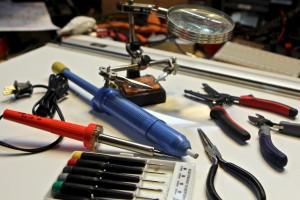
Tools. (Click the links to see examples.)
1. 30-watt+ soldering iron. You could work with a smaller iron, but you’ll appreciate the extra power. If you suspect you might be into this long-term, I definitely encourage you to invest in a high-quality soldering station, which you can read about this superb Soldering 101 article from Beavis Audio Research. Don’t get one of those big soldering guns, which are too powerful and unwieldy for electronic work.
2. Desoldering pump. I’m not saying you’ll make lots of soldering mistakes, but I certainly do!
5. Flush-edged wire cutter (most wire-strippers have a cutter, but you’ll still want the flush-edged cutter for tight spaces)
7. A digital multimeter. The cheaper ones will definitely get the job done, but make sure you get one with a continuity function (basically, a beeper that informs you whether two points in a circuit are connected). Also, if you suspect that you may want to build a lot of fuzz pedals, especially ones with finicky germanium transistors, you’ll eventually want a meter that can read hFE values (these relate to transistor gain). Many cheaper meters don’t have an hFE function. Auto-ranging is another desirable, but not absolutely essential, feature.
8. A helping hand or PanaVise to hold your work-in-progress.
You should be able to find all of the above for around US$40, especially if you shop from a discount house like Harbor Freight. And I bet you already have at least some of these items!
You might also consider the Learn to Solder Kit, from the organization that sponsors the fabulous Maker Faire. This includes a decent iron, some supplies, and a practice circuit board to destroy learn on.
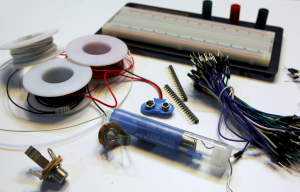
Breadboard rig and supplies. This list includes everything you need to assemble a circuit-testing rig where you can audition things before soldering them into place, plus your soldering consumables.
1. A breadboard and jumper wires. These are sometimes sold together.
2. Two mono input jacks to get your guitar signal to and from the breadboard.
3. 9-volt battery snap to power your breadboard.
4. 24-gauge hookup wire (I recommend getting at least three colors: black, red, and white)
5. SIP socket so you can change components in your soldered-together circuits
Estimated cost: $15 to $25
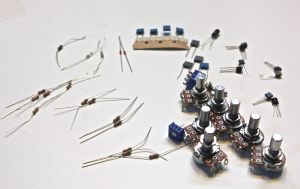
Parts for Projects 1, 2 and 3. Everything you need to breadboard and audition our first three projects.
1. Diodes. One each of the following values: 1N4001 and 1N34A. Two each of the following: 1N914 and 3mm red LED.
2. 1/4-watt metal-film resistors. One each of the following values: 10K, 68K, and 2.2M. Two each of the following: 470R, 4.7K, 1M. Plus three 47K resistors.
3. Capacitors (polyfilm or box-style). Once each of the following values: .001uF, .047uF, .068uF, and .22uF. Additionally, you’ll need four .1uF capacitors.
4. 16V radial-style electrolytic capacitor, value 10uF.
5. Transistors. Two each of the following: 2N3904, 2N5088, 2N5089, 2N5457.
6. 16mm potentiometers with solder-lug connectors. One each of the following values: B5K, B100K, and C10K, plus three A100K pots.
7. Trimpot (25K or 50K)
8. One DPDT switch, on/on style.
Estimated cost: $15 to $20. (The cost can be substantially lower when you buy in bulk.)
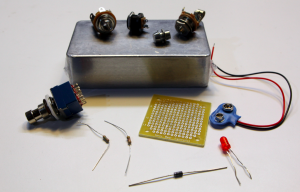
Boxing supplies. Everything you need to move a circuit you like from the breadboard into a permanent stompbox home (with a DC power jack, LED indicator, and true-bypass switching). If you want to box all three projects, you’ll need these things in triplicate.
1. 1590B-style enclosure. These boxes must be drilled to suit the project, but all projects will use common drilling patterns. (See “Where to Order” for more details.) If you have a drill press and know how to use it, you can save a few bucks by drilling your own. Some vendors also offer finishes.
2. 3PDT footswitch. Your basic true-bypass switch.
3. Stereo 1/4-inch jack for input. (The stereo configuration lets you avoid battery drain when no guitar is connected.)
4. Mono 1/4-inch jack for output.
5. DC power jack. (I recommend the washer-on-the-outside style.)
6. 5mm red LED.
7. 5mm LED bezel (the thing that holds the LED in place).
9. 1N4001 diode.
10. 2 1/4-watt metal film resistors, values of 4.7K and 1M.
11. 16V radial-style electrolytic capacitor, value 22uF
12. Small perfboard where you’ll solder the components.
Estimated cost: $15 to $20 (The cost can be substantially lower when you buy in bulk.)
Where to buy. You generally get DIY supplies from two types of vendors: big electronics supply houses (such as Mouser, Digi-Key, Allied, and Jameco) and smaller dealers who specialize in stompbox and guitar parts (such as Small Bear, Pedal Parts Plus, and Mammoth. All are US-based, and all are reliable. I don’t know much about overseas vendors, though I hear good things about Germany’s Banzai Music. The big suppliers have larger stock lists, but often lack the obsolete specialized parts guitar geeks want.
Harbor Freight sells incredibly inexpensive tools. Obviously, this isn’t top-of-the-line stuff, but it will generally get the job done.
The initial DIY Club projects are breadboard- and stompbox-based, but once we start poking around inside guitars, you may need the services of a guitar parts supplier like Stewart-MacDonald or All Parts.
Meanwhile, the folks at Mammoth have helped us out by assembling all the non-tool essentials into three special kits:
• The Tonefiend Breadboard Rig and Supplies Kit ($21.43).
• The Tonefiend Parts Kit for Projects 1, 2 and 3 ($16.87).
• The Tonefiend Boxing Kit ($15.76). Mammoth gives you the option of getting a pre-drilled enclosure for a couple of bucks extra, which I recommend, unless you own a drill press and know how to use it. Each of our first three projects calls for two knobs, so select the “Vert 2 Knob/Toggle, 1LED, 1FS” option when checking out. If you have an advanced sense of style, you may also choose a custom paint job or upgrade the included knobs to something fancier.
I can’t guarantee these are the lowest prices you’ll find, but I know they’re competitive, and that you can get everything you need with a couple of clicks, including a pre-drilled enclosure. Also, those pesky small parts will be clearly labeled—a big advantage when you’re just starting out. (Disclosure: Neither I nor Seymour Duncan have any financial stake in these packages.)
Meanwhile, if you suspect you may become a regular builder, I encourage you to stock your workbench with the cheapest components I’ve found anywhere: the Futurlec Value Packs. If I were you, I’d order everything on this page except the Voltage Regulator, 1/2-watt resistors, IDCC Connector, and IC Socket Pack. The only catch: really slow shipping. It can take three weeks or more for your parts to meander from Asia to the US.
PART 2: Recommended Reading
Here are three fine “electronics for beginners” books:
Getting Started in Electronics by Forrest M. Mimms III
Electronics for Dummies by Cathleen Shamieh and Gordon McComb
Make: Electronics Book by Charles Platt
But to be honest, most of you self-education is likely to take place online. I particularly recommend three stompbox-building sites as great places for beginners to learn.
diystombboxes is probably the largest online builders community. Their forum is a great place to ask questions, and the FAQ section of the diystompboxes wiki is so helpful you may want to print out a hard copy, if not tattoo it on your forearms.
My favorite DIY writer is Dano from Beavis Audio Research. Sadly, his site is dormant, but his many fine articles are still posted there. He’s funny and pragmatic, with a knack for zeroing in on the crucial info. I recommend everything in his Tech Section, especially this, this, this, this, this, this, this, this, and this. And be sure to archive copies, in case this resource ever vanishes.
Gaussmarkov DIY Effects is more sober than the fun-loving Beavis site. But in addition to hosting many fabulous stompbox projects, Gaussmarkov boasts a fine tech section with articles dedicated to all the key components.
PART 3: If you just can’t wait to get started…
Order and build a kit! It’s a great way to learn on the fly, and the projects from Build Your Own Clone, General Guitar Gadgets, and Guitar PCB (distributed by Mammoth) include newb-friendly directions. Start with a nice, simple booster or fuzz clone. In fact, if I were to recommend one beginners project, it would be Build Your Own Clone’s E.S.V. Fuzz (Germanium version). If you don’t burn your house down, you’ll emerge with a superb-sounding vintage Fuzz Face that matches any boutique version, and surpasses most of them.
PART 4: The sadly necessary disclaimers.
Proceed at your own risk. Read all instructions. Protect your body parts. Don’t try to sue me, Seymour Duncan, or anyone else if you do something dumb. Don’t work on expensive things till you’re confident of your skills. If in doubt, consult a qualified guitar tech or psychiatrist. Look both ways before crossing. Don’t mix grain and grape. Never start a land war in Asia.
Also: I’ll try to walk folks through these projects clearly and carefully, but there simply aren’t enough hours in the day to offer personal tech support to all participants. My hope is that we’ll establish a nice, cooperative community where we can pool our talent (or at least dilute our lack of talent). I’ll help out as much as I can, but please don’t hate me if I can’t personally inspect all your solder joints.
This is going to be a blast! We can discuss further in the comments below. I’ll roll out that initial overdrive product in a week or two after folks have had time to assemble their tools and parts.


Leave a Reply