Categories
Acoustic guitar Recording

How Nashville High-Stringing Works

You don’t have to be high in Nashville to enjoy Nashville high-strung.

Nashville high-strung tuning is one of the guitar’s great magic tricks. It has a delicious, “secrets of the Guild” quality — you feel like an insider just knowing what it is.

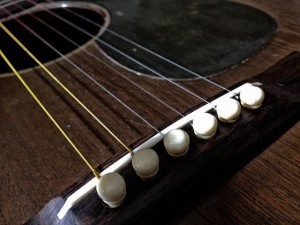
Not that I did know what it is until embarrassingly late in life. For the sake of my fellow late-bloomers, I’ll explain: You replace your guitar’s lowest four strings with thinner strings tuned an octave higher than normal.

You can think of it as using the higher-pitched of a each pair in a 12-string string set. (Or the top two strings of a normal set, and the top four strings from another normal set, with the first string as the third string, the second string as the fourth, etc.)

I love how this tuning can work subliminal magic, or step front and center for marquee riffs. Nashville session players conceived it as a way to add stereo shimmer to doubled acoustic guitar tracks. But rock players have used it to great effect as a foreground sound, as heard on the Stones’ “Wild Horses,” Floyd’s “Hey You,” Kansas’s “Dust in the Wind,” and Tracy Chapman’s “The Promise.”

Here’s a quick little demonstration, both solo and in a mix:

Categories
guitar Music

This Charming Riff

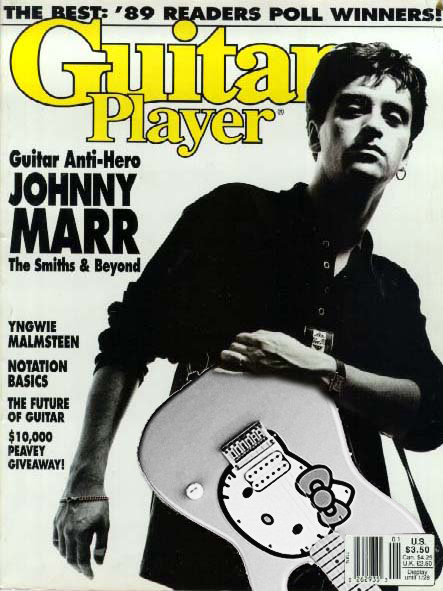
Weird — back when I wrote this GP cover story, I never even noticed the Hello Kitty guitar!

Maybe it’s because of the crescendo of chatter about a Smiths reunion, but I’ve had Johnny Marr on the brain lately. (Full disclosure: I am a total, drooling fan.) I keep coming back to how deceptively simple his parts are, with an emphasis on the “deception” part. There’s always much more happening than initially meets the ear.

Perfect example: “This Charming Man,” the band’s first single. It’s always been my favorite Smiths guitar performance — even more than the apocalyptic tremolo and harmonizer work of “How Soon Is Now?” Maybe it’s because I’m still astounded by the originality and sheer chutzpah of the young guitarist, who was all of 19 when the track was released.

“This Charming Man” is a perfect little pop guitar part, with an African highlife-inflected head and lots of pretty open-string chiming throughout. But the deeper you dig, the more you uncover. And you won’t believe what I uncovered during my latest Smiths geek-out:

Categories
Acoustic Amps Effects Gigs

Amped-Up Acoustic Guitars

What could possibly go wrong?

There are two ways to approach amplifying an acoustic guitar: trying to duplicate the natural sound, only louder, and NOT trying to sound naturalistic at all. This post is about the second approach.

I love playing acoustic through an electric guitar amp (as opposed to a dedicated acoustic amp). True, the tubes and speakers amputate all high frequencies. But if you think of the instrument not as an acoustic guitar, but an idiosyncratic electric variant, it opens up amazing possibilities.

More often than not, I prefer to play acoustic gigs that way. I did a fun benefit show last year playing rock and R&B covers with a band consisting of Flea, Tracy Chapman, and drummer Dawn Richardson. Tracy had a beautiful, ultra-hi-fi acoustic tone, and the ratty, rumbling sound of my acoustic through a small combo was — well, let’s just say it was a very strong contrast.

Admittedly, relatively few  players exploit this technique. One notable exception is Daniel Lanois. He’s best known as a producer (U2, Peter Gabriel, Bob Dylan, etc.), but he’s also a phenomenal player who does amazing things with an acoustic guitar, an inexpensive magnetic soundhole mic, and small vintage Fender amps. I’ve watched him play up-close a few times, and he’s incredibly adept at conjuring a variety of tones and controlled feedback from this setup.

It’s definitely a white-knuckle playing experience. You have to listen carefully and nix unwanted feedback with quick damping technique. But it can be so expressive!

I’ll talk more about the technique in a bit. But first, check out this short video demo featuring distortion and other stompbox effects, controlled (and not-so-controlled) feedback, and a lot of awkward twisting and turning as I grapple with the tone: