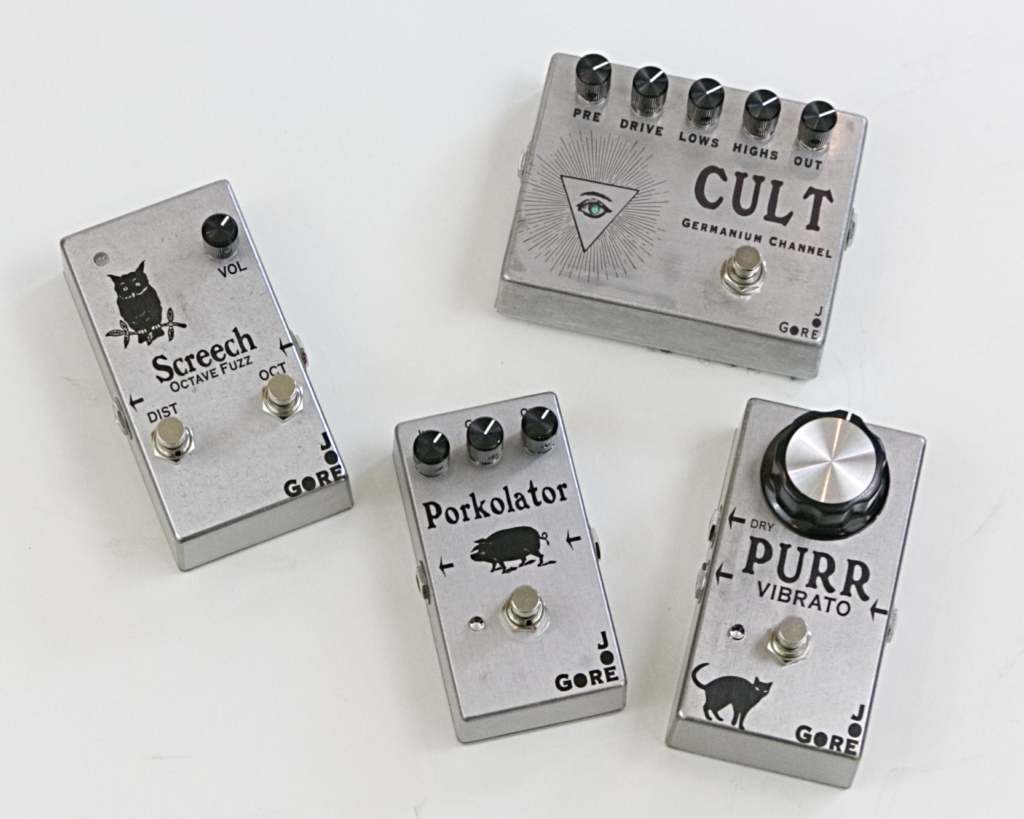
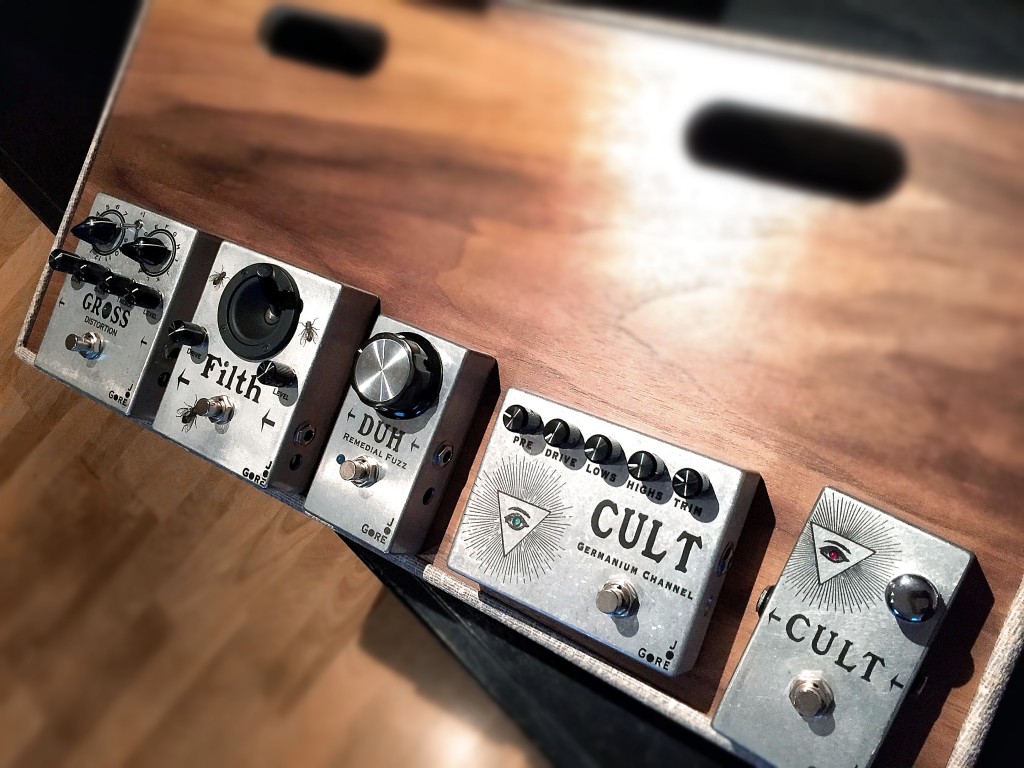
I’ve just tested the first final production model of my long-promised Cult Germanium Channel. As usual, it sounds even better than my funky hand-built prototypes. These will be available in just a couple of weeks from my distribution partners, Vintage King.
There core circuit is the same as in my Cult overdrive. I’ve added a great-sounding active EQ, tuned to just the right frequencies, plus a new input stage with variable capacitance (translation: a sort of “crisp vs. fat” control). There’s much more info on the Joe Gore Pedals product page.
My apologies that this release has taken so long! I hope some players find it worth the wait.
NAMM was fun, though I’m paying a price with this dreaded flu I came home with. (“NAMMthrax,” they call it.) A highlight was getting interviewed on camera by my friend and frequent editor, Shawn Hammond.
Admittedly, there are some cringeworthy moments, especially when my entire Porkolator demo crashes and burns thanks to a funky cable. (I’ve played Shawn’s role at other tradeshows, and trust me, those guys sprint from booth to booth at speeds you wouldn’t believe — definitely no time for do-overs!) But you’ll get a decent idea of the other three. Soon I’ll have proper demos of the new releases, and I’ll share them here.
I was showing my stuff in the brand-new pro audio hall, miles away from most of the guitar stuff. That’s because my distributors, Vintage King/M1, work mainly in the high-end studio/audio realm. (I was set up right next to those magnificent Shadow Hills compressors.)
Still, I managed to see a few old friends and make some new ones. One reunion was with producer Matt Wallace (Faith No More, Maroon 5, Replacements, etc.) who I hadn’t seen in over 35 years, when I was his frickin’ “Intro to Music Appreciation” TA at UC Berkeley. Another was a middle-school friend with no connection to the music industry — his daughter just got a gig at Fender.
And when I wasn’t demoing, schmoozing, or contracting diseases, I was watching the nearby Mix With The Masters stage. That company sells online recording/mixing lessons featuring famed producers and engineers, many of whom gave live presentations in which they walked the audience through their productions. I saw my old pals Joe Chicarelli and Jacquire King, and I got to meet several others whose work I’ve long admired: longtime Nick Cave & the Bad Seeds accomplice Mick Launay, mastering legend Howie Weinberg, and Sylvia Massy. In addition to recording everyone from Tool to Johnny Cash to System of a Down to Julio Iglesias, Sylvia authrored the coolest book ever on creative recording.)
Totally off-topic: While driving from SF, I finally finished the audio book version of Alan Moore’s 1,255-page magnum opus, Jerusalem. Fuck me — the most amazing book I’ve encountered since David Mitchell’s Cloud Atlas over a decade ago.
Happy new year, all. Sorry I’ve been so scarce — mostly, I’ve been practicing guitar! I’m trying out lots of challenging new things (for me, anyway) and I’ll share some of them as videos very soon. I’ve also been finalizing the four new Joe Gore pedals I’m debuting at NAMM 2018. Lookit!
They’ve already gone into the production, and they’ll be available via Vintage King very soon. I have yet to make demo videos and detailed spec sheets, and we still haven’t finalized the prices. (It depends how much the damn germanium transistors in Cult Germanium Channel and Porkolator wind up costing.)
In the meantime, here’s the info sheet I’m distributing at NAMM. Also, Premier Guitar is scheduled to record a demo video at the show and post it on their site. (I’ll share the details when that happens.) I hope I sound less like a squirrel on meth than I did for last year’s show-floor video.
If you’re attending the show in Anaheim, please visit me at booth #15517. (It’s a huge booth run by my distributors, M1. I’ll be crammed behind a tabletop somewhere within.) I’d love to say hi.
Oh man — my friends at Premier Guitar just posted a video of me demoing four of my new pedal prototypes at NAMM. I didn’t even think I’d have these ready by showtime, but I powered out at the last minute. (Maybe ’cause I needed something to take my mind of the inauguration.)
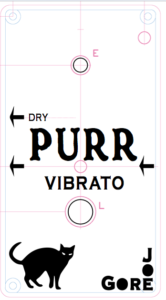
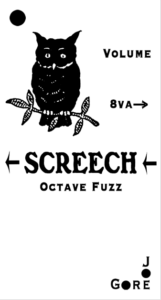
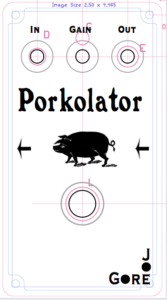
It’s been a busy month since we filmed this. We’ve settled on names, graphics, and specs, and everything is in development. (Though they’re still a few months away from shipping.) I’ve included the first-draft enclosure graphics as well.
Purr is a minimal one-knob optical vibrato. Yep — one knob, which means no independent rate and depth controls. Sound crazy? I agree. But it just sort of works! (I explain my questionable reasoning in the video.)
It’s not a deep, wobbly pitch-shift effect — more like cross between a really warm, pretty tremolo and a subtle optical vibrato. It’ll have the same large knob as my Duh pedal, so you can make adjustments with your foot, assuming you’re not as clumsy as I am.
It’s my fave modulation circuit, one I’ve used on a number of my YouTube videos. Here it’s on throughout at a very subtle setting.
In this video it’s set more strongly, though I toggle it on and off as I loop additional layers.
Screech, a mutant spinoff of the Octavia and Green Ringer octave fuzzes, is an outgrowth of the experiments I did did a few years ago, when I built models of every major octave fuzz design, and then attempted a variation of my own. (It’s not too far removed from the final pedal in this video, which appears at the 10-minute mark.)
It’s got the most extreme octave effect I’ve ever heard from an analog octave fuzz, and unlike on an Octavia or Green Ringer, the effect works in all neck positions and at all pickup settings. You can also bypass the octave portion of the circuit for a straight distortion sound. (That’s not a new idea—it’s a popular Octavia mod. But that non-octave Octavia sound is dull as dirt, whereas this, I think, has a bit more character and impact.)
Porkolator also springs from a video demo/experiment of a few years back. It’s my oddball spin on the Interfax Harmonic Percolator, which is already pretty odd to begin with. It uses the same weird combination of negative- and positive-ground transistors for that sort of gravelly, decidedly non-tube-like distortion that Steve Albini loves so much. But all the part values differ, and the gain stages work very differently. There’s also an independent boost stage that can generate tons of extra level if desired. Again, it’s not that far removed from the final example in my octave fuzz video. (It appears starting at 5:55.)
Unlike the other three pedals, Cult Germanium Channel is pretty much finished. (We were originally going to include it among the 2016 releases, but decided that three new products were enough.) Its heart is the same primitive germanium overdrive circuit as in my Cult pedal, but with lots of added doodads: a tone-shaping pre-gain control, great-sounding active 2-band tone control, and an output trim. You can read more about Cult Germanium Channel here.
The NAMM video also features a demo of Kitty Boy, my imaginary vision of a germanium fuzz that should have existed in the 1960s. It’s sort of a cross between a Maestro Fuzz Tone and a Tone Bender Mk. I, which can go from lightly overdriven “Satisfaction” tones to hyper-saturated Ziggy Stardust glory. (It’s inspired by a conversation with Lyle Workman, so thanks, Lyle!)
I hope folks dig these. I’ll keep you posted about release dates and final prices.
Thanks, Jason Shadrick and Perry Bean, for doing such a nice job with the video and squeezing me into a brutal production schedule at the last minute.
Jet and Kaiju say: “When Joe plugs in those horrible fuzz pedals, we hide in the closet. But that new Purr pedal with the black cat on it isn’t so bad.”
UPDATE: I just posted detailed pedal descriptions at gorepedals.com
Anyone going to the big LA Amp Show this weekend? I’ve never been, though I’ve heard it’s a blast. (Literally: Unlike at NAMM, exhibitors set up in separate hotel suites, reportedly without noise restrictions.) I always like geeking out at musical instrument trade shows, but this one is special for me: It’s my pedal premiere, the public debut of my next four stompboxes. They’re not shipping quite yet (except Duh, available here), though they’ll be out in time for a crunchy-as-hell Kwanzaa.
The pedals pictured may look like my usual sketchy handmade stuff, but they’re actually slick factory-made versions, painstakingly styled to look like sketchy handmade stuff. (Michigan’s Cusack Effects is my manufacturer.) They sound like my handmade prototypes, but are less likely to break every 15 minutes.
I’ll be showing them off in the Vintage King suite. (They’re my production partners, and for now, my sole retailer, though the pedals will eventually make their way to hip guitar shops.) Magnatone, Jackson Ampworks, and Moog pedals will also share the VK suite, so my pedals will be in lofty company.
I’ve already written about Filth, Cult, and Cult Germanium Channel, though I haven’t yet finished their demo videos. (If you’ve spent any time on this site or my YouTube channel, you’ve heard them.) But I think this is the first time I’ve mentioned Gross Distortion, a twisted new take on a cool old crunch circuit. Here’s a demo I just made:
… and here’s how I describe it on the upcoming product page:
There’s never been a distortion pedal quite like Gross—so it needs an explanation.
At its heart, Gross is a simple, one-transistor distortion from the same family tree as the Electra circuit. This simple yet powerful effect was built into Electra guitars in the late ’70s, and was later adopted by many boutique stompbox builders. For good reason: It’s a lively, dynamically responsive circuit with less compression than most modern IC-based distortion pedals. The transistor boosts the level, and then the signal hits a pair of clipping diodes, which provide the signature distortion.
Every diode combination sounds slightly different. In fact, several boutique pedal companies have based their businesses on creating Electra derivatives with slightly varied diode choices. (Just Google “Electra distortion clone.”)
Gross isn’t an Electra clone. I’ve changed parts and values for a fatter sound and even greater dynamic response. I also added an active 2-band tone control—something seldom, if ever combined with primitive distortion like this. The distortion isn’t too “gainy.” It’s more about definition than sheer power—one reason it pairs well with other gain pedals. The character of your guitar and fingers always comes through.
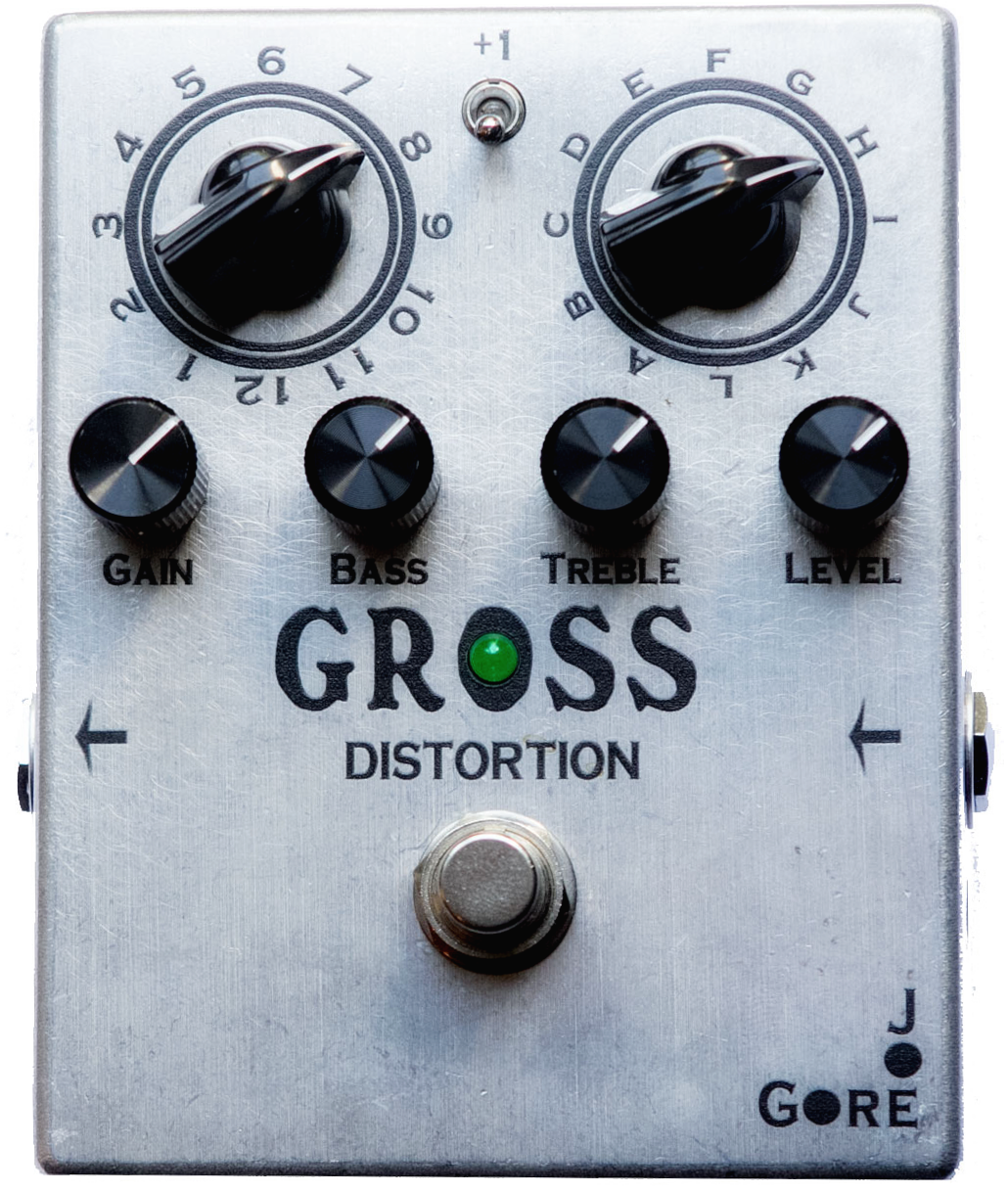
The oddest feature is the diode section. Instead of a fixed diode pair, two 12-position rotary switches select from 24 diodes for 78 possible diode combinations! An additional switch adds a third diode for asymmetric distortion, which makes156 possible shades. My target number was 144—that’s why I called it Gross, though that may have happened the other way around.
Some combinations are as different as night and day. Others are only as different as noon and 12:05. But this network of germanium, silicon, and LED diodes provides many crunch colors.
With its labeled and detented selector knobs, you can call up favorite settings onstage. But for me, Gross’s forte is as a studio tool. It’s great for “texturizing” guitar overdubs—just spin the dials till you find a tone that sits perfectly in the track. It’s especially useful for doubling.
Gross Distortion was created in San Francisco and is built in Michigan by skilled craftspeople earning a fair wage. Available soon from Vintage King!
TO USE: Set the desired gain and level. Grab the big knobs and start spinning. Toggle the +1 switch frequently for asymmetric distortion—the changes can be dramatic! When you hear a cool tone, refine it with the bass and treble knobs. (Note: the higher the gain setting, the more dramatic the diode-tone contrast.)
Awesome! I just received production prototypes for my next three stompbox releases, in the wake of last month’s launch of my Duh Remedial Fuzz. I’m still making minor tweaks, but these should be available in just a few weeks. Whee!
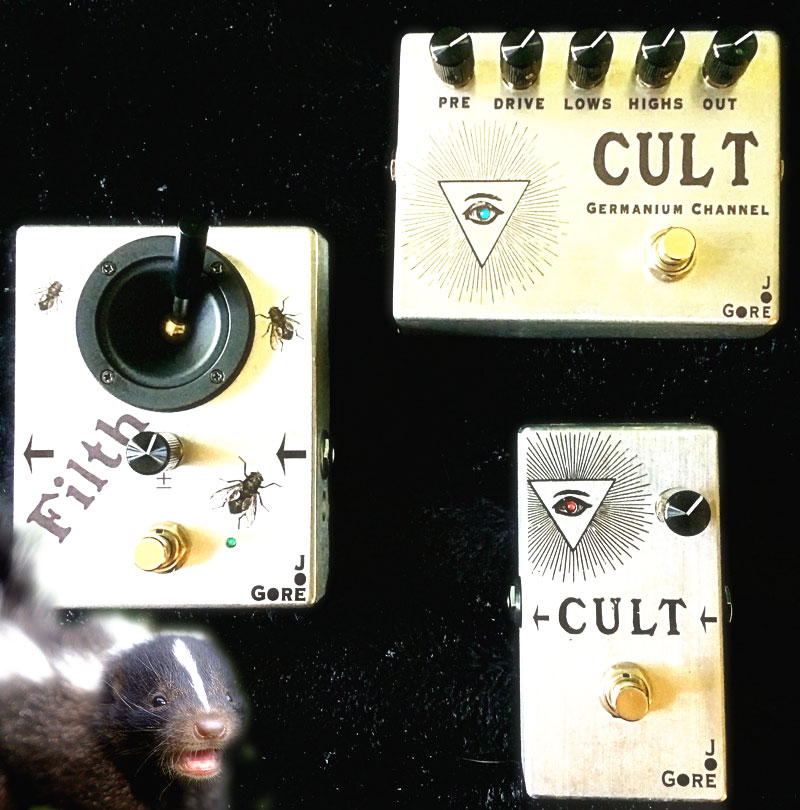
Filth is a freaky joystick fuzz. Cult is my oddball take on Rangemaster-style single-transistor overdrive. It’s my absolute favorite distortion device, and the same one heard in many of my videos and gear reviews. The Cult Germanium Channel supplements this simple but deadly circuit with extra controls and an active EQ stage. (Baby skunk sold separately.)
Filth. I love whack-job fuzz boxes like the Z. Vex Fuzz Factory and the countless “sick fuzz” pedals it’s inspired over the last two decades. But here my goal was to create one with a higher percentage of “likely to use” settings — I wanted to make it easier to find the good stuff. Topologically, the circuit’s nothing tricky — basically a Fuzz Face descendent coupled with an extra JFET boost stage (though it doesn’t sound remotely like any Fuzz Face you’ve ever heard). The main innovation is the x/y control, which jiggers the transistor biasing, producing a broad array of timbres. It’s not a conventional tone control, though it’s arranged so that it’s easy to summon smooth, chubby tones or angry, brittle ones.
There was a lot of interest in this a couple of years ago when Fuzz Box Girl posted a demo (apparently no longer online) of one of my handmade ones. She focused on the pedal’s maximum-gain, My Bloody Valentine side, which was fine — Filth can definitely make your amp melt like a Salvador Dali timepiece. But now it’s easier to dial in crisp, lower-gain tones.
I’m making two Filth versions: the joystick model [pictured], and one with three conventional knobs. They sound identical — only the interfaces differ. The three-knob is good if you want to mark an exact setting for use onstage, while the joystick is more fun when concocting new sounds. (I don’t know the exact pricing yet, but the joystick model will cost more, because that’s an expensive part!)
I’m far from the first builder to create a joystick stompbox, but you usually encounter them on crazy noisemaker effects, or deployed as conventional EQ controls. I’m not aware of another pedal where it regulates the fuzz’s fundamental timbre this way. But then, I don’t get out as much as I should.
Cult. If you’ve seen my videos or heard my audio demos, you’ve probably heard Cult. I’ve built it into several guitars (while others have a built-in Duh fuzz). It’s a one-germanium-transisor boost descended from the Dallas Rangemaster of the 1960s, though the apple has rolled far from the tree: All part values differ, the EQ profile is modernized, and the gain control works in an unconventional way. But like a Rangemaster, it boasts spectacular dynamic response and electrifying tones that crackle with presence.
To my (admittedly odd) ear, no other distortion sounds as bitchin’ as a single-transistor boost between a good guitar and a great amp. The weird thing is, while most players know the countless ’60s rock tracks produced with such primitive boosters, many have never tried this sort of circuit. I love faithful Rangemaster clones, and I love many of the variations I’ve explored over the last five years. But Cult is my very favorite recipe.
Cult Germanium Channel. This one pairs the Cult circuit with relatively modern active EQ/boost stage, with proper tone controls that don’t suck tone. The added circuitry sacrifices a touch of Cult’s explosive presence, but it provides a greater range of tones. There’s also more gain on tap, so it’s better for those high-testosterone rawk tones that I’m far too much of an prissy, effete San Franciscan to use myself.
Thanks a Lott. As mentioned, these are manufactured by Cusack Music in Michigan, under the expert eye of engineer Tony Lott. Cusack builds pedals for numerous boutique brands you know, many of whom prefer to keep the fact a secret. But I’m proud of the relationship, because Tony and his team improve everything I submit. (More about the collaborative process below. It’s fascinating stuff, assuming you’re a geek — which I do assume, since you’re here.) (more…)