Categories
guitar

The Latest in Guitar Prosthetics!

Ever wish your finger was a little bit longer?

I just procured some clever new gizmos designed to help unfortunate players who were born without 12-inch fingers and five-foot arms.

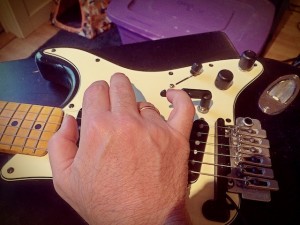
First up: The VKnob from Option Knob, an angled plastic lever that replaces standard volume and tone knobs. It’s worth investigating if you’re interested in pedal steel-style swells, “manual tremolo,” or wah-flavored tone-knob manipulation. There’s a half-inch notch in the lever, perfectly position for resting your picking-hand pinky and spinning the knob without having to stray too far from the springs. It takes getting used to, and it may collide with some whammy bars, but it’ll be a cool solution for many players. FWIW, I tend to play fingerstyle, and I’m accustomed to spinning knobs with my pinky while picking strings with my thumb. Even so, the VKnob makes the technique easier, and it may be a godsend for pickstyle players. (Price: US $13.)

Option Knob also created the OKnob, a Y-shaped replacement knob for stompboxes. It lets you manipulate pedal knobs by “kicking” the OKnob’s arms or resting your foot in the fork where they meet. I’ve enjoyed using OKnobs to control the cutoff frequency on filter-type effects, especially when playing The World’s Nastiest Stompbox™. Like so:

Uglyface Demo

But now the OKnob has competition in the form of the KickDisk, a circular, clear plastic replacement knob.
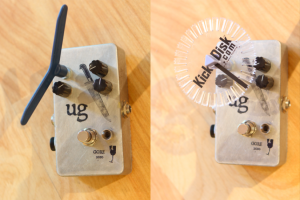
The OKnob (left) and KickDisk (right).

Both knobs work great, and each has its advantages. The OKnob doesn’t force you to position your foot at a specofic altitude, and it looks freaky-cool. But it can be awkward to manipulate from some angles, especially when the arms are positioned north and south. The KickDisk is easier to operate from all angles, and its transparency prevents it from obscuring stompbox LEDs. I like both options. (OKnobs are ten bucks each, or $12 for the glow-in-the-dark model. KickDisks go for $7.50.)

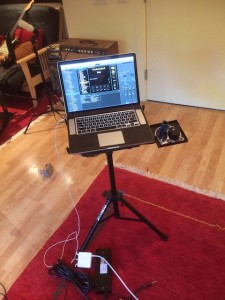
Obviously, your stompboxes must be secured to a pedalboard or other surface, or you’ll just kick everything over. But while knocking pedals over is a drag, it’s not nearly as bad as toppling your laptop. That’s why I was eager to replace the flimsy stools and utility tables I’ve been using for laptop gigs with my band Mental 99.
Don't tread on me.
Don’t tread on me.

There are several stage-worthy laptop stands, though most are tabletop models aimed at laptop-lugging DJs. I opted for the Quik Lok LPH-003, a sturdy metal tripod when a laptop shelf plus an extensible mousepad surface, which works great as a holder for picks, slides, EBows, and street drugs.

The LPH-003 weighs a lot more than my old stands, but it’s far less likely to get knocked over, even by a hyperkinetic klutz like me. Particularly reassuring are the four adjustable, rubber-tipped arms that secure your leptop, even at steeply slanted angles. So far, I’m digging it. I’ll let you know how it works at gigs. (I paid a little under $100 for mine.)

Have any of you tried these? Or can you share info on any other clever, simple, and cheap guitar prosthetics that help you do what you do?


Categories
Digital Effects guitar Technique

MIDI Guitar Meltdown

Okay, I promise: tonefiend is not going to become an all-digital blog. I’ve got two new DIY analog pedal projects in the pipe, plus a piece on that delightfully retro technology, the book.

But while there’s more to life than MIDI, for the last few months my particular life has been all MIDI, all the time. I worked on the documentation for the Fishman TriplePlay MIDI guitar system, then demoed the product at MacWorld and Musikmesse. And now that the smoke has cleared and I’m off the Fishman clock, I’m still obsessed with the musical possibilities here. In fact, I’m just getting to the fun part: bending the technology to taste and making weird-ass music for weird-ass people compelling new sounds.

I’m posting two new pieces spun off from my Musikmesse demos. Technical and musical comments after the videos.

In my first TriplePlay demo, I used simple, recognizable acoustic instrument samples. For the second one, I focused on aggressive/distorted sounds. But now I’m getting into what really interests me: solo guitar arrangements featuring hybrid colors, deployed so that it’s often difficult to tell the guitar sounds from the synths and samples.

Categories
Digital guitar

Analog Schmanalog

Ever notice how most analog vs. digital battles discussions boil down to two basic questions?

1. Can digital sound as good as analog?
2. What are the practical benefits of digital?

They’re good questions, but they tend to overshadow another important (and probably more interesting) topic: What are the musical benefits of digital?

Everyone loves great analog guitar sounds. But there’s lots of cool stuff that you can only do in digital. Here are a few of the ones I enjoy.

A partial list of the strictly digital sounds and techniques heard here:

• looping
• granular synthesis and delay
• pitch-shifted delays and reverbs
• impulse-response reverbs
• subharmonic sysnthesis
• Realtime MIDI control

You heard it here first!

Hey, I’m totally guilty of fostering simplistic analog vs. digital arguments. After all, I launched this blog over a year ago with an Amps vs. Models listening contest. (The prizes have long since been claimed, but you can still take the test.) But maybe we should spend a little less time arguing about how faithfully that amp model mimics the sound of an amp from 1965, and a little more time exploring the cool and meaningful musical applications of post-analog tone production?

Categories
Digital guitar Pickups

Synth Guitar:
Did They Finally Get It Right?

Anyone here ever owned a synth guitar? Not a Keytar, but a guitar fitted with a hexaphonic pickup that transmits MIDI data to external devices? And if so, do you readily admit it?

The synth guitar has had one of the most checkered histories outside of, well, checkers. Since the ’70s, many brilliant minds have tried to bridge the gap between the plucked string and the external tone generator. But despite a few notable exceptions (mostly in the prog/fusion realm), guitarists have been reluctant to embrace the technology.

I’ve had a Yahama synth system (basically a clone of the Roland GK-2) for many years, though I rarely use it. Like a lot of players, I balk at the installation hassle and the ugly, cumbersome hardware. (Plus, I’ve played keys longer than I’ve played guitar, so I don’t really need a guitar to conjure synth sounds.) Also, those systems are expensive! Many players have been disappointed. Many businesses too — the Avatar guitar synth probably killed off the ARP company.

But I’ve been thinking about guitar synth again since last January’s NAMM show, where Fishman previewed their Triple Play system, a new take on MIDI guitar which I mentioned at the time here. (Here’s much more info from the company’s Summer NAMM press release.)

I finally got to play a late-stage prototype this weekend. But before I discuss the experience, I need to confide that a) Larry Fishman is a pal of mine, and b) I may be working with his company on the product’s documentation and marketing. (My words of praise are 100% sincere — but as always, consider the source.)

Categories
Digital guitar Music Recording

A Loop-Oriented Laptop Guitar Rig

I haz a band.

My ol’ pals at Guitar Player magazine interviewed me for an instructional article on looping for next month’s issue. It was especially flattering to be invited, because the interviewer was Barry Cleveland, a fine guitarist and a leading figure in the looping community.

I put together this little video to demo the digital rig I use onstage with my duo band, Mental 99, and I’ve cross-posted it here. It covers software, hardware loopers, looping techniques, and the like. Have a listen.