Categories
Acoustic guitar

Strange, Strange Strings

No longer ridiculously expensive — just REGULAR expensive.
No longer ridiculously expensive. Now they’re just very expensive.

I spent last week covering the Musikmesse musical instrument trade show in Frankfurt, Germany, for Premier Guitar. I had a blast, and Chris Kies and I posted details and pics of more than 70 new products. (Here’s the short list of our personal faves.) Kies shot lots of video, and will be posting more than 50 demo segments to the PG site in the coming weeks.

But Messe is hellishly loud, far noisier than NAMM. When I finally got home and picked up a guitar, it was an acoustic. I was trying something new, based on info I obtained from Mary Faith Rhoads-Lewis, CEO of Breezy Ridge, a company that distributes several brands for acoustic musicians, including John Pearse strings.

I’d previously geeked out here about about the strangest and most expensive guitar strings I’d ever tried: this “rope core” set from Austria’s Thomastik-Infeld. Reader/cool guy Al Milburn turned me on to them, and I wrote about them here. And I recently posted this video demonstrating how the transformed my old Martin 0-17 into a compelling steel/nylon hybrid with a unique and expressive voice.

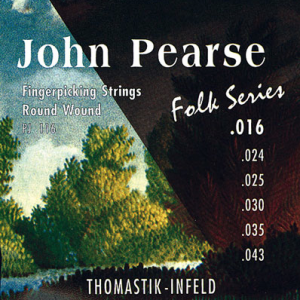
Anyway, Ms. Rhoads-Lewis told me that the late John Pearse originally created this set for Thomastik, and that the John Pearse Folk Fingerpicking set [PJ116] is identical to what the Austrian company sells. Best part: You can get them in the States for under $20, as opposed to a walloping $35 for the Thomastiks. She also told me that their magic works in reverse: You can put this relatively low-tension set on a classical guitar for a very different sort of hybrid steel-string sound. (This, she said, is exactly what the great Brazilian player Bola Sete used to do.)

I popped a set on my old Yairi classical. The feel was — totally strange, and in precisely the opposite way as on the Martin. The tone was edgy and exciting, but the tension seemed a little too extreme. If just seemed a little too … high-strung, in every sense. Then I tried lowering the entire tuning a whole step, with the sixth dropped all the way to C.

And … oh, my. Check it out:

Summary: Holy cannoli, I love how this sounds. And there’s something psychologically satisfying about the transformation too. See, this guitar has always been a bit … tragic to me. I got it when I was 16. My classical guitar prof at UCLA said I needed a better instrument, and my every-supportive folks, bless ’em, helped me buy this Alvarez Yairi for around $700 (in 1970s dollars). It was a top-tier model for Alvarez, signed by luthier Kazuo Yairi, and boasting lovely Brazilian rosewood backs and sides. It was a huge upgrade for me, but as I got deeper into classical playing, its shortcomings emerged. Had I not shifted my studies to composition, I’d have needed to upgrade again. I envied the Igancio Fleta y Hijos models my two teachers played, but at around $3,000, they were beyond my budget, even with parental help. (Pity — their current value is approaching $50,000.) So I’ve used this instrument as a limited but decent-sounding model suitable for pop work, if not serious classical concertizing.

Categories
guitar Music

Behind the Bridge:
Hendrix, Korea-Style

This is perfectly awesome:

Luna Lee is playing a gayageum, a Korean zither related to the Japanese koto, Vietnamesese dàn tranh, and the Chinese guzheng. She’e got other fun blues and rock covers posted on her YouTube page. Lee’s version of “Voodoo Chile” is the internet hit, but I dig her “Bold as Love” because the canned backing tracks are less intrusive, plus it’s my fave Hendrix song. 🙂

The drumstick as bridge.

Like many guitarists exposed to Asian zither players, I find myself envying the movable bridges they have on each string. By positioning the bridge relatively close to the center of the string (and not, as on guitars, near one end), they can pluck notes or generate vibrato on either side of the bridge.

Lee and Thurston from Sonic Youth achieve related effect by placing drumsticks and screwdrivers between the neck and strings of their guitars near the 12th fret. (It’s not like those guys are Asian music scholars or anything, but another similarity is their use of tunings with closer-than-standard intervals between the strings.)

But no one took the notion further than the late Hans Reichel, whose beautiful, handmade instruments used center-positioned bridges to elicit eerie sonorities and startling portamento and glissando effects. This video is a nice showcase for Reichel’s radical re-imagining of the guitar. (Reichel also demonstrates his dachsophone — literally, “hedgehog-o-phone” — which, depending on your perspective, is one of the most expressive, amusing, or just plain irritating musical contraptions ever conceived.)

Anyone ever explored similar ground? (FWIW, I took a semester of koto back in the Triassic Era college. I sucked.)

Categories
Acoustic

Acoustic Strings: Bronze vs. Nickel

Like Talos the Giant from Jason & the Argonauts, most modern acoustic strings are made from bronze. Like him, they can be cruel and inflexible.

UPDATE: I’ve updated the audio examples to include 80/20 bronze strings, as detailed in this newer post.

Can I share my steel-string psychodrama?

I’m lucky enough to own many electric guitars, but I’ve played one steel-string acoustic almost exclusively for many years — a small-bodied Lowden with a tone that a very famous manufacturer of acoustic pickups once described as “like a f%^$ing cannon!” Its sizzling-bright treble and modest low-end make it a great recording instrument. (Engineers often boost highs and roll off lows when processing acoustic guitar, but this model is practically “pre-EQ’ed.”)

But it’s not an easy guitar to play. It seems to amplify string noise, flubbed notes, and all other playing imperfections. “This is a ‘tough love’ guitar,” muttered one singer/songwriter friend.

So when I bought a second steel-string recently, I wanted something warmer, softer, and more flattering, and I found it in a pretty old small-bodied Martin. The day I bought it, I restrung it with treble strings to record my recent Nashville high-strung demo, then popped on a set of the phosphor-bronze strings I’ve been using for years on the Lowden.

And I was seriously bummed out by the tone, as I lamented over at the forum.

The problem was, my sweet, soft antique suddenly sounded a hell of a lot like the Lowden, with blistering treble and cruel string noise. And I realized in a flash that a lot of the qualities I’d attributed to the Lowden were, in fact, a result of the modern, coated phosphor bronze string I’d been using. So I ordered some alternatives and made a few test recordings to demonstrate how dramatic the differences are.

Have a listen:

Categories
Acoustic guitar Recording

How Nashville High-Stringing Works

You don’t have to be high in Nashville to enjoy Nashville high-strung.

Nashville high-strung tuning is one of the guitar’s great magic tricks. It has a delicious, “secrets of the Guild” quality — you feel like an insider just knowing what it is.

Not that I did know what it is until embarrassingly late in life. For the sake of my fellow late-bloomers, I’ll explain: You replace your guitar’s lowest four strings with thinner strings tuned an octave higher than normal.

You can think of it as using the higher-pitched of a each pair in a 12-string string set. (Or the top two strings of a normal set, and the top four strings from another normal set, with the first string as the third string, the second string as the fourth, etc.)

I love how this tuning can work subliminal magic, or step front and center for marquee riffs. Nashville session players conceived it as a way to add stereo shimmer to doubled acoustic guitar tracks. But rock players have used it to great effect as a foreground sound, as heard on the Stones’ “Wild Horses,” Floyd’s “Hey You,” Kansas’s “Dust in the Wind,” and Tracy Chapman’s “The Promise.”

Here’s a quick little demonstration, both solo and in a mix: