Last weekend I went to a memorial service for a music pal I hadn’t seen since the ’80s. Judging by the pictures I saw and the stories I heard, Brett remained the gentle, generous music lover I’d remembered till he died in his sleep a few weeks ago.
I ran into lots of old music friends and bandmates, and we alternately smiled and winced as our old photos and concert videos flashed on the big screen. Were we really that skinny? Did we actually wear that stuff without being coerced at gunpoint?
Like we tend to do at such moments, I left brimming with resolutions: Appreciate life. Cherish friends. Remember that music is a joy as well as a job. And do something nice for my sad old Strat, the guitar in all those old photos and videos.
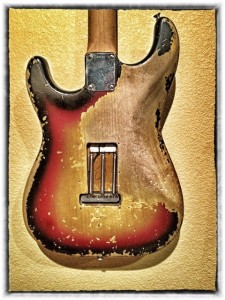
See, back then I only had one guitar — an all-original ’63 Strat I’d picked up in 1980, when pre-CBS Fenders were still perched on the precipice between collectible and affordable. (I paid $450, a staggering investment for me at the time.) It remained my only serious guitar for a decade. It was in near-perfect condition when I bought it, and it was a battered ruin by decade’s end. (The ’80s were a tough time for guitars, what with all those studded belts.) I was a young player with a bad attitude and little concern for collectibility, as opposed to the middle-aged player with a bad attitude and little concern for collectibility that I am today.
I’ll some thoughts about Strats then and now. But first, have a listen:
I was playing a lot of African-influenced music back when I knew Brett, as was he. (I wrote about those days here.) He was passionate about the bubbling, major-key music of Southern Africa, so the first part of the demo, a looper-based cover of Miriam Makeba’s “Pata Pata,” is for him.
I haven’t played this guitar much in recent years. The last time I performed with it in public was at an Apple developers conference, where I demoed Native Instrument’s then-new Guitar Rig software onstage alongside the late Steve Jobs. (And that’s a very different story.)
Why did I drift away from it? Partly because I could — as I got older, I was able to afford some of the alternate guitars I could only dream of when I was young. Also, I found myself increasingly drawn to mongrel guitars that deviated from the classics. (I preferred the quirky Gibson Trini Lopez to a straight ES-335, for example, or the chambered Hamer 20th Anniversary to a stock Les Paul.) The Strat was just so normal. Another factor may have been a phone conversation with Tom Waits before I played my first of many sessions with him: “No strats,” he growled succinctly.
It was especially interesting to revisit the guitar now, after experimenting with and writing about so many Strat variations over the last year. Some observations, in no particular order:
- This isn’t exaclty a news flash, but man, an old alder body can have such zing to it. The guitar really feels alive in your hands and against your body.
- The flip side of that is, of course, the unapologetically bright tone, especially from the bridge pickup. I’d forgotten all the ways I’d used to moderate that explosive treble — most often by avoiding pickup position #1 altogether! As you can hear in the demo, I don’t always succeed at reining in glassy top-end. You definitely need a lighter pick touch to get get a sweet sound. (I doesn’t help that I’m not playing fingerstyle in the demo, because I tore off a nail to the quick last week while photographing a man in a gorilla suit.)
- But despite my issues with Strat bridge pickups, I dislike most alternatives even more. I’ve never dug any of the hotter/louder/darker replacement pickups, at least not when paired with vintage-style pickups in the other positions. The only alternatives I do love are the Tele-inspired bridge pickups with a metal plate at their base, as made by Fralin and Duncan. If this guitar weren’t a vintage model, I’d install one of those in a flash.
- The other two pickups sound great — but really, any number of high-quality replacement pickups sound as good. The humble Duncan SSL-1 stands up really well against these 50-year-old relics.
- The sixth string sounds like crap about the 7th fret or so.
- The old tuning peg design remains one of the best ones ever. They have a split shaft, a hole for securing the end of the string, and a slightly conical shape that encourages tight, clean string wrap. Simple and brilliant!
- For the demo, I installed old-school nickel-wrapped strings, which tend to sound a little warmer and darker than most modern formulations. But sheesh — the guitar is still really frickin’ bright!
- Many years ago I replaced the original bridge with a stainless steel model and heavier bridge block. As part of the restoration, I reinstalled the original bridge and block. (It’s amazing that I located it, given the state of my garage. Trust me, saints have been elevated on the basis of sketchier miracles.) Again — maybe a touch less brightness and sustain, but not all that much of a difference.
As you can probably tell, the guitar is like one of those old friends you love even though they drive you nuts sometimes. I don’t think we’ll ever feel quite the same bond we did 30 years ago, but it felt good to hang out again — especially after my Strat received a desperately needed grooming session! (More on that in an upcoming post.)


 That leaves us real men
  with that nasty bugger near the bridge. A tone control would be nice, tough.


Leave a Reply