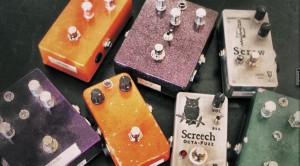
I had no idea I had so many octave fuzz pedals! I had no idea they sounded so different! And after spending way too much time auditioning and recording them, I have no idea when I’m ever going to be able to stand listening to them again! 
Naw, just kidding — I had lots of fun putting together this octa-fuzz fest. It features no name-brand pedals, just DIY clones based on old circuits. But hey, most of today’s octave fuzzes are also clones of old circuits.
In fact, imitation has always been the name of the game here. The Roger Mayer Octavia used by Jimi Hendrix was inspired by a circuit found in a British mixing console. The US-made Tycobrahe Octavia was a ripoff of Mayer’s circuit, though tone snobs tend to regard it as the superior unit. It’s certainly one of the rarest and most valuable stompboxes ever. The name “Octavia” has also been slapped on many other variations of the circuit, including some particularly dismal models. The Prescription Electronics Experience and Lovetone Ultimate Octave are based on the Foxx Tone Machine. The Dan Armstrong Green Ringer was based on the Ampeg Scrambler, and I used the Green Ringer circuit as a jumping-off point for some of my own designs. The sincerest form of flattery abounds here.
If you make it through this seven-circuit survey, you’ll encounter most of the major players, and if you hear something that particularly interests you, you can build it yourself using readily available schematics, or buy a nice kit or boutique clone.
Now, don’t confuse this effect with modern digital devices that actually transpose the notes you play. Octave fuzzes use an electronic trick to cancels out much of the fundamental of each note, making the octave overtone stand out more prominently. The process is called full-wave rectification, and ever-knowledgable reader mwseniff explains it far more capably than I in a comment following my previous post on this topic. It’s an odd, glitchy effect that tends to require specific playing techniques for the best results. And for better or worse, it’s an effect that has so far been difficult to mimic digitally. Sure, some of the modeling boxes out there have interesting-sounding octave-fuzz effects, but they tend to score low on the analog-realism scale.
Check out the video. The post-mortem comes after, as post-mortems usually do.
So who wins? Tough call! My favorites as-is are the Tycobrahe Octavia and the Foxx Tone Machine. The Octavia is a wild and crazy anarchy box full of sonic surprises. The Foxx Machine offers perhaps the most solid octave sound, plus an aggressive and startlingly modern distortion sound (if by “modern,” you mean 1994).
But even more intriguing to me are the circuits that could be derived from these originals. For example, the Green Ringer sounds rather anemic on its own, but preceded by the right boost stage, it’s a monster, as heard in the video’s final demo, where I paired it with a silicon-transistor Fuzz Face derivative. And I swear, someone somewhere is going to create an amazing update of the Ampeg Scrambler. Maybe you — unless I beat you to it!
Also: D’oh! I neglected to include one significant sound: The Univox Superfuzz, which also inspired the Z. Vex. Octane. It’s a loud, aggressive circuit with some of the muscle of the Foxx Tone Macine, albeit with a slightly less well defined octave effect. Some great players swear by it. Maybe I can do an addenda after my ears heal and I can discern pitches above 1kHz again.


Leave a Reply