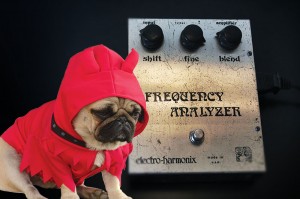
No disrespect to Chuck Berry, but I seriously doubt Johnny B. Goode played guitar just like a-ringin’ a bell unless he was using a ring modulator. That’s the only effect that can give you the complex, clangorous harmonics of a bell or a cymbal. Or make you sound like a ravenous horde of mutant robot ants.
Theoretically, Johnny could have used one. By 1958, when Berry documented the guitarist in song, the effect was already being exploited extensively by avant-garde classical composers, notably the late Karlheinz Stockhausen, who used it to terrifying effect in his Gesang Der Jünglinge [1956].
This post drips with perverse ring-mod love, including a demo of a rare vintage Electro-Harmonix Frequency Analyzer, and another featuring Roswell Ringer, a wicked ring mod plug-in.
As explained by this excellent Wikipedia article, ring modulation multiplies two audio signals — usually, a simple waveform modulating whatever the hell you feed into the input. Moderate frequencies generate eerie, bell-like tones that sound awesome beneath oceans of reverb. Higher frequencies produce ear-shredding shrieks. Meanwhile, ultra-low frequencies (under 10Hz, say) can create pretty, pulsing tremolo effects.
Guitarists have shied away from ring modulation, despite such notable exceptions as Devo, who duct-taped Electro-Harmonix Frequency Analyzer pedals to their guitars, and Sabbath’s Tony Iommi, who reportedly used a touch of ring-mod tremolo for the wobbly trem-fuzz on “Paranoid.”
I can’t fathom why so this bitchin’ effect is so unpopular. Must be because it tends to transform everything you play into incomprehensible noise guaranteed to alienate 98.7% of listeners. (Like that’s an excuse!) So the effect is usually consigned to that final resting place of avant-garde music techniques, the sci-fi soundtrack. (Paging Dr. Who!) And if Johnny B. Goode had played one, his audience probably would have said, “My, that little country boy can make a goddamned racket! Let’s get the hell out of here before the sun goes down.”
Ring-mod stompboxes have been around since at least the early ’70s, when Electro-Harmonix debuted the first Frequency Analyzer. What did they sound like? Well, I just happen to have a circa-’74 model right here:
As noted in the video, this pedal has some serious problems: It’s noisy, and merely plugging in neuters your volume and presence, even with the pedal bypassed. It’s a perfect example about why modern pedal makers place such emphasis on true bypass switching.
Modern ring-modulators nix this problem with better components and switching, and there’s much to like about latter-day Electro-Harmonix ring mods, as well as such boutique variants as the Way Huge Ringworm and the Moogerfooger Ring Modulator. Some versions add fuzz (including the ultra-rare Lovetone Ring Stinger, which I’ll feature in an upcoming Museum of Lost Effects installment).
But IMHO ring modulation is one of those effects that works better in the digital realm. A good plug-in ring modulator (like the Roswell Ringer, from Apple’s Logic) lets you get all the classic usual tones, and then some. It’s easier to home in on specific frequencies, or sculpt those pretty, fluttering tremolo effects. Best of all, you can automate the controls for mind-bending swoops and glides. Here’s what I’m talking about:
So: Are there any other audio perverts out there who love this unlovable effect? Can you think of any good examples of ring mod in rock besides the ones mentioned above? Anyone have good things to say about any particular hardware or software versions? Clang away!


Leave a Reply