

Almost all of us are guilty of it: repetitive, auto-pilot vibrato.
Can you blame us? Between choosing the right notes, and trying to play them in tune and in time, we don’t always have surplus brain cells to shape each note individually. So much simpler to stamp each one with the same prefab wiggle!
One of the wickedest observations about shred guitar came from one of the greatest shred guitarists, Paul Gilbert. In a conversation many years ago when he was a youngster, he noted that a lot of players seem to have pilfered their vibrato technique from Ethel Merman.
For 50 years Merman deafened electrified Broadway with her remarkably loud voice and, um, distinctive brassy style.
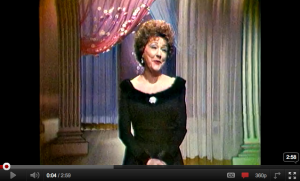
Okay, just imagine a hyper-distorted guitar instead of a woman’s voice, and shred licks instead of a Cole Porter melody. (You don’t really need to visualize different hair.) Doesn’t that relentless eighth-note-triplet vibrato evoke memories of those idyllic weekend afternoons at Guitar Center?
As a point of comparison, consider the relatively spare vibrato of Miles Davis and John Coltrane:
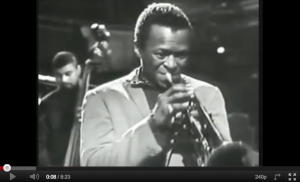
According to jazz legend, Miles’s trumpet teacher, Elwood Buchanan, would rap the young trumpeter’s hand with a ruler whenever he played with gratuitous vibrato. “You’ll shake enough when you get old!” he’d scold. (He was wrong, though—even late in life, Miles applied vibrato only minimally.)
I’m not arguing that vibrato is bad, or even that it’s better to sound like Miles Davis than Ethel Merman. The issue is whether we’re truly shaping each note to suit the musical context, or thoughtlessly forming them with the same cookie-cutter.
Here’s another humbling clip:
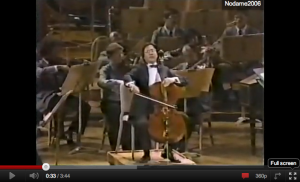
Dig the intensity Yo-Yo Ma brings to the simple, slow melody. Every single note is positively sculpted from scratch. I pains me to realize how rarely I inhabit my notes this way.
Obviously, this is personal stuff, and I’m not about to dispense a one-size-fits-all solution. But I do have a few ideas to think about and try:
- Experiment with different vibrato speeds. Play whole-notes to a slow click (that is, long notes sustaining across four clicks), alternating between two pulsations per click, then three, then four, then six, then eight, then back down again.
- Experiment with different vibrato styles. Try alternating between B.B. King-style, pivot-from-the-wrist vibrato, “vertical” vibrato in which your fretting hand moves perpendicular to the strings, and “horizontal” vibrato, moving parallel to the strings as bowed-instrument players do. Try all three techniques with your thumb anchored to the back of the neck, and also with your thumb floating free from the neck. (The latter approach usually yields a stronger, potentially wilder vibrato.) Note that in most cases, pivot and vertical vibrato alternate between standard pitch and slightly raised pitch, whereas horizontal vibrato can both raise and lower the pitch relative to standard.
- Experiment with deliberately omitting vibrato. Try playing quarter-notes against a slow click (that is, one note per click). Try applying vibrato only to every other note. Or every third note. Or every fourth. Remember, while vibrato adds interest and variety to your notes, sustained notes do interesting things over time even when no vibrato is applied.
I promise you that a mere five minutes invested in any of the above exercises will have a massive effect on your subsequent playing session. You’ll be vastly more mindful of your vibrato and its effects. And whichever choices you make, they’re likelier be choices, not reflexes.
BTW, who are your picks for players with great, deliberate vibrato? Jeff Beck is always going to be near the top of my list . . .


Leave a Reply