
I’ve said it so many times, I feel like the parrot of pickups, but here goes again: These days the weakest links on inexpensive Asian and Mexican guitars are invariably the pickups. Upgrading them often yields a princely axe at a pauperly price.
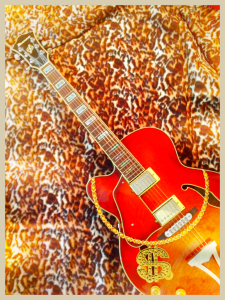
A perfect example is the Ibanez Art Star archtop I just upgraded for my friend Dusty. These aren’t especially sought-after models — they seem to sell used here in the States for for between $400 and $500.
The guitar looked cool and played well, but the pickups were murky and undistinguished. I replaced them with a pair of Duncan ’59s, and man — a merely decent guitar suddenly became very good.
Dusty’s not really a jazz player — more a cool indie-rock-pop guy — so I figured he’d like the option of a brighter, single-coil sound. I requested the ’59 model with four-connector cable (plus chrome covers to maintain the retro look), and used push/pull pots from StewMac for humbucker/single-coil switching. That was also my rationale for choosing “vintage-style” wiring, which keeps the tone relatively bright, even when rolling back the tone pots. Dusty also wanted to keep the guitar’s flatwound string as a departure from his usual roundwounds, which was all the more reason to keep the tone as bright as possible.
Just one disclaimer before you view the demo: Dusty is left-handed, and I am not. I foolishly bravely recorded the performance playing the guitar upside-down without restringing. So you’re going to have to imagine how it would sound played confidently and comfortably! (It was an interesting experience, to say the least, one I wrote about it here.)
Check it out:
Even though I almost never play “normal” jazz, I love having an flatwound-strung archtop at sessions. Many modern players find flatwounds to be to dark and lifeless, but they have helped me nail the right tone in countless overdub situations. An archtop with flatwounds can be short on treble animation, but man, does it impart mass! It’s often a great way to thicken a track without clashing against vocals, keys, and brighter guitars. Even single-note lines can have incredible density. I highly recommend the technique to anyone who likes stacking guitars in the studio.
Many non-jazz players are attracted to the idea of owning an archtop, but can’t afford the luxury for a once-in-a-while color. But I’m now convinced that an inexpensive import archtop with decent pickups can deliver big-body bling at a pawnshop price.
The rewiring for this project was pretty easy — I followed the scheme here, except I “vintage-ized” it by connecting the tone pots to the lug 2 (the middle lug) of the volume pots rather than to lug 3. This, BTW, was the first time I’ve ever rewired a full-depth archtop. The easiest way to do the work was to disconnect all the pots and pull everything out, much like (I imagine) gutting a carcass. Here’s the victim, mid-operation:
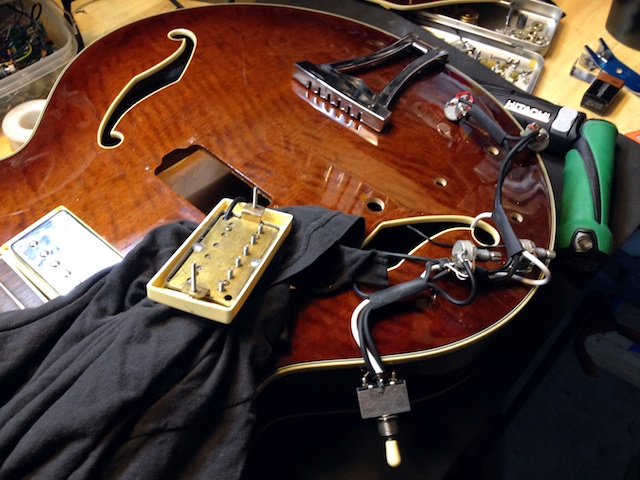
The hardest part was getting the pots back into those little holes. My initial strategy was to panic. My second was to look for someone with hands small enough to reach through the pickup rout. My third was smarter: I threaded a guitar string through the holes, tied it around the posts of the pots, and drew them though. My trusty pair of bonsai tweezers helped my nudge the pots into position.


Leave a Reply