
Multiple readers have asked some variation of that question since I launched this blog last month. I’ve been wondering myself as I prowled the local music emporia, searching for a fun, but seriously funky guitar to experiment on.
Veteran pickup-swappers are aware of what I call the “Squier Syndrome”: Some budget Asian guitars are remarkably playable, but come stocked with low-performance pickups. Replacing the pickups can deliver a huge sonic upgrade. If you find the right cheapie at the right price, you can create an instrument that rivals a U.S.-made model from a major manufacturer at something like half the cost. In fact, I’ve got a fine example in my studio right now, which I’ll write about soon.
But that is not today’s subject.
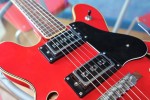
Nope, I wanted something weird and wild, a real “character” instrument. So when I spotted this egregious ES-335 knockoff at my local cool guitar store, I snatched it for $300, case included. (Everything’s expensive in San Francisco—chances are you can find the equivalent for less in your neck of the woods.) It was made in Japan by Tempo some decades ago. (Online info is sketchy because, well, no one really cares.) It’s pretty, it’s in great condition, but let’s face it: It’s a cheap-ass piece of molded plywood with a tentatively bolted-on neck and some seriously microphonic pickups, which I wrote about here. Here’s what they sounded like:
Unbelievably Microphonic PickupWhy buy this thing? Because it feels comfy, and since it’s a hollowbody, it has lots of odd little acoustic possibilities, like strumming behind the nut and bridge. It practically plays in tune, so long as you don’t confront the fake Bigsby tailpiece with anything more than a mild wiggle.
Plus, I “needed” a cheap guitar for jingle work. As anyone who’s worked in that field recently will confirm, just about the only stuff anyone buys these days are tracks that sound homespun and “indie,” preferably with a slightly out-of-tune, amateurish feel. The Tempo’s time has come!
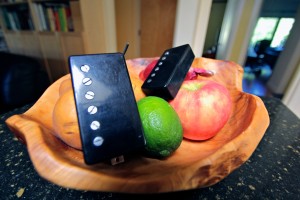
Before installing swapping out the pickups and doing a basic setup, I tracked a few clips using the guitar in its original state:
Original Tempo Neck Pickup Original Tempo Bridge PickupNot exactly tones for the ages, are they?
Next question: What to install instead?
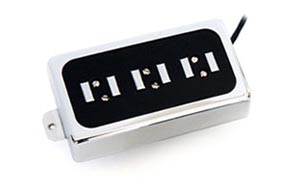
Easy! A gorgeous pair of Seymour Duncan Custom Shop Phat Staple pickups. I’d never tried staple-style pickups. I’m not sure I’d even heard them! Created for Gibson in 1954 by Seth Lover, these single-coil pickups use individual Alnico 5 pole piece magnets, as opposed to the bar magnets of Gibson’s earlier P-90. But the model was lost in the shuffle of history thanks to the introduction of the P.A.F. humbucker the following year. I’d heard the sound described as a slightly twangier P-90, as you’d expect given the individual pole pieces. The SD version has been reformatted to fit a humbucker-sized rout, but like the original, there are honking-big screw mechanisms on the underside of the device, barring its installation in some guitars. But they fit the Tempo perfectly.
Changing pickups in a hollowbody can be a challenge for the clumsy and inexperienced (AKA “me”). A real guitar tech probably would have replaced all the pots and wires, but I took the lazy way out and simply snipped the wires close to the pickups and grafted the new pickups to the old wiring with solder and heat-shrink tubing. Worked fine!
Here’s how the Tempo sounded post-surgery:
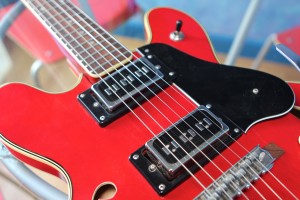
Tempo Guitar with Staple Neck Pickup Tempo Guitar with Staple Bridge PickupOkay, before drawing too many conclusions about staple pickups, remember that I’ve installed them in a truly funky instrument—the results would be quite different with a less laughable specimen of luthiery. But even so, the changes are dramatic. I hear higher highs, lower lows, clearer fundamentals, and less of the ugly, nasal resonance that marked the originals.
Yep, they do indeed sound a bit like twangier P-90s, and yes, they are a bit noisy. (There’s a reason, after all, that the humbucker was such a hit!) The tone reminds me a bit of the Dearmond/Dynasonic pickup I wrote about here, though it’s hard to make direct comparisons based on my audio clips, since I put the latter pickup in a high-quality archtop with flatwound strings.
But enough analysis—let’s hear the noise! Everything here except the bass and drums was recorded using the Tempo guitar with Phat Staple pickups and a buttload of plug-ins in Logic Pro.
Tempo Track Rough MixWell, for better or worse, my tawdry dreams came true. I’m definitely going to whip out this instrument the next time an artist or client wants something a little less slick-sounding!
Buoyed by enthusiasm, I slapped some guitars on a track from an album-in-progress by my pal, producer and Violent Femmes drummer Victor DeLorenzo. How cool is Victor? Cool enough to let me post this exceedingly rough mix, featuring my Tempo guitar tracks slapped onto a two-track rough mix featuring his drums, voice, and bass synth. (That’s a rough mix on top of a rough mix, which makes it exponentially rough!)
Carry Me (VERY Rough Mix)And in case you’re curious, here’s a bounce featuring only the guitars. There are percolating, afrobeat-inspired lines played through stingy little filters, lots of spacy, behind-the-tailpiece plucking routed through delays and pitch-shifts, and an obnoxiously loud, realtime-backwards solo.
Carry Me (ugly guitars only)Sounds trashy. Sounds amateurish. Sounds out of tune. That makes it a triple-crown winner!
Okay, show-and-tell time: Let’s hear YOUR trashy guitar tales. Preferably with pics and audio!


Leave a Reply