
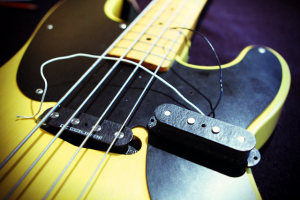
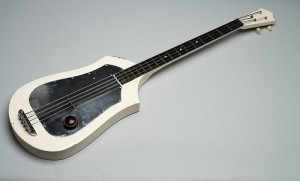
The original P-Bass is a fascinating instrument. It’s wasn’t the first electric bass guitar—inventor and owner Paul Tutmarc claimed that title with the instruments he created and sold through his Seattle, Washington, music shop in the 1930s and ’40s. But the P-Bass, released in 1951, was the first electric bass that really mattered—the one that made the instrument a fixture of our musical landscape.
The P-Bass has evolved much over the course of its 60 years. In fact, its creators instigated the first big makeover back in 1957, when Fender abandoned the original Telecaster-inspired styling and single-coil pickup in favor of a sleeker, Strat-type look and a split-coil pickup wired in humbucking mode. (The earlier P-Bass style resurfaced in the late ’60s as the Telecaster Bass, and in Fender’s ’51 P-Bass reissues.)
The original P-Bass has a modest, unassuming sound. It’s not so much loud or bottom-heavy as compact and midrangy. But I love using my Japanese-made 1951 Precision reissue anytime I want a rootsy, old-fashioned sound. While many insist that great bass parts are felt more than heard, the instrument harkens back to a time when parts were often heard more then felt, since ’50s pop records have little if any low end.
I was skeptical when I swapped out the factory pickup from my resissue ’51 for a Duncan Quarter Pound for Single-Coil P-Bass. Not that I thought it would sound bad—I simply suspected that it would make the instrument sound too much like any old modern Fender bass. So I was delighted to discover that, yes, the pickup changed the sound, but the instrument lost none of its charmingly humble character. The tone simply became more defined, with a stronger fundamental and sweeter overall resonance.
Frank Falbo, Seymour Duncan’s VP of Product, explained the change to me: “The bigger magnets in the Quarter Pound ‘hear’ a slightly larger segment of string. That’s why you get such a strong, unambiguous fundamental. It’s almost as if it’s the size that bass pickups were supposed to be, to match the longer scale of the instrument.”
Check it out: Here’s a cue I made for a project that needed a trashy, swamp-rock vibe. The drums are distorted, and the guitar are slathered with scuzzy reverb, but the bass cuts through loud and clear.
Swamp Trash BassI dig it. But still, I’d really like to get my hands on a Tutmarc some day.


Leave a Reply