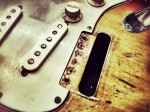
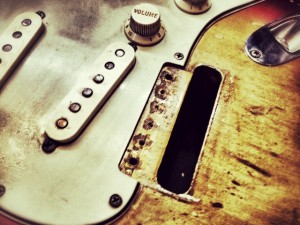
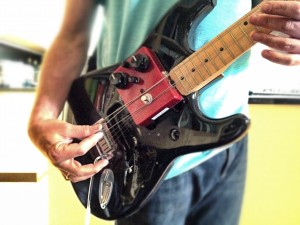
This photo was digitally altered to make the guitar look even dirtier than it was — but not by much.
Sometimes only the threat of public exposure can inspire a proper clean-up job. Case in point: I hadn’t groomed my battered ’63 Strat in years, and when I pupped it from the wall for my recent post on the instrument, the fact that I was about to show it to the world you guys made me finally admit how gross it had become.
Now, it’s not like I wanted it to sparkle or anything — seems to me that an old guitar should look old, and removing 100% of the grime would be a little too much like those octogenarians with preternaturally white teeth. I mainly just wanted to remove the sticky crud that had accu
Somewhat embarrassingly, I never got around to changing one of my own pickups until I was knocking on senility’s door recently. I owe part of the inspiration to that fabulous DIY Fest known as the Maker Fair, where each year hundreds of little kids learn to solder craft projects at long picnic tables. Or maybe it was the awesome soldering tutorial by 11-year old W0JAK. Well, after a buttload of pickup installs inspired by this blog, I guess I qualify as some sort of solder “expert,” because Seymour Duncan asked me to make a video designed to walk n00bs through the pickup install process for the first time. It was a lot of fun to prepare, and I learned some important things, like the fact that it’s hard to solder, talk, and operate a camera at the same time. Check it out:
Can we all agree that it’s a good thing when guitarists and bassists cultivate their own style? Even a jaded old cuss experienced music journalist like me still gets a thrill upon discovering a new player with a startlingly original voice.
I am not any of these people —but I pretended to be them.
But there are times when it’s worth pursuing the opposite approach. (And not just for pragmatic reasons, such as the likelihood that you’ll get canned from your cover band gig if you mix it up too much, or the fact that the jingle client can’t afford to license that Black Keys song, but will happily pay you to record something “similar.”) Sometimes disconnecting your ego and completely immersing yourself in another player’s point of view can make you a better, and paradoxically, more original player. (I’m reminded of a Marc Ribot interview I once edited where the brilliant guitarist talked about learning Chuck Berry songs, clams and all — the “bad” notes, he suggested, were as much a part of Berry style as the “good” ones.)
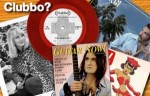
I had a chance to take this idea to an extreme a few years go when writer/composer Elise Malmberg and I collaborated on a massive internet hoax: a bogus website alleging to be the 50-year history of a “legendary” indie record label. Clubbo Records is easily the most obsessive-compulsive project I’ve undertaken. The site features hundreds of pages of music, bios, photos, and memorabilia memorializing dozens of fictitious artists. Even many external links are fake — we just made a lot of little mini-hoax websites.
(Example: We licensed a photo of a beautiful ’60s blonde in a leopard-skin coat, which inspired a story about Ava & the Avalanches, the best known group of the Swiss Invasion. We wrote a story about how wearing the coat for the photo shoot horrified her, and launched her on a life path of animal activism. Where would she be now, we wondered? Running a big cat rescue charity, of course! Which inspired more than a few queries from journalists, including one from the BBC, asking to put us in touch with the non-existent Ava. And Ava’s signature “hit,” “Ski Baby Ski” has been licensed over and over, most recently for the silly Jonah Hill comedy The Babysitter.)
You know the origin of the word “sinister,” don’t you? It’s the Latin word for “left,” which, according to etymologists, became associated with evil, thanks to the medieval belief that left-handed people were deceitful and probably possessed. Meanwhile, “dexterous,” which means adept with your hands or brain, is from the Latin “dexter,” meaning “right.”
What are the odds that a right-handed person came up with those ideas? 😉
Lefty guitarists have it tough. They have fewer instruments to choose from, and they usually can’t just pick up any old guitar and start jamming. When I wrote for Guitar Player, we tried hard not to be “side-ist,” and would always refer to the “picking hand” and “fretting hand” rather than the left and right when discussing technique. But still.
I have left-handedness on the brain because I upgraded a left-handed guitar for a friend. I threw caution to the wind and recorded a demo video upside-down, without restringing. It ain’t pretty — but it sure is interesting! I’ve never undergone any sort of neurological testing, even though I look like the sort of person who should have electrodes permanently attached to his skull. But after playing upside down for a few minutes, I could practically feel parts of my brain pulsating with unaccustomed energy. I held a wine glass in my right hand, and it felt wrong. Then in my left, and it still felt wrong. And man, was it tough typing! It was a weird, disorienting mental high. (more…)
UPDATE:I’ve added a page listing all the “How To” posts on this site. Just click the cleverly titled How-To Posts Are Here! box at upper-right of each page.
There’s got to be a better way!
Several readers asked for more specific tech advice on how to wire up battery-powered effects inside a guitar or bass, so I created a step-by-step tutorial, which you can download here.
Some historical background: Since the ’60s, many guitar companies have toyed with the notion of installing battery-operated effects inside guitars.
And “toyed” is probably the perfect verb for it. Onboard effects have earned a reputation as cheesy, low-budget products. In many cases this reputation is justified. (And sometimes it’s not — the Electra guitars of the ’80s were never particularly popular, but their simple onboard distortion circuit has generated hundreds of “boutique” clones, not to mention our own Bad-Ass Distortion project).
And why would you want to put an effect inside a guitar or bass? You can use a stompbox with any electric instrument, but an onboard effect is married to one axe till solder-do-they-part.
I have an ironclad rebuttal to such concerns: (more…)
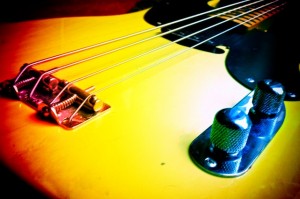
After auditioning so many different tone-control schemes over the course of the Mongrel Strat Project, I wound up with more tone circuits than I have Strats, so I figured I’d victimize a bass — specifically, a 1954 Fender P-Bass reissue with a Seymour Duncan Quarter-Pound pickup, which I’ve written about here. It’s a minimalist one-pickup model with basic volume and tone controls.
I was eager to audition a multi-capacitor tone control like I wrote about here. (Actually, it’s literally the same tone control — the guitar where it used to reside now houses the Stellartone ToneStyler tone pot covered here.) And while I had the patient on the operating table, I figured I’d also install the Black Ice distortion cube I wrote about here. (My friends in the medical profession assure me that patients always appreciate it when surgeons indulge in improvisational operating-theater mods.)
After the frantic soldering fest that was The Pagey Project, I figured it might be time for a nice, simple DIY wiring project. At the suggestion of tonefiend reader JH, I played with variations on the 2-band tone control that appeared in some G&L guitars. And I am over the moon with the results!
This circuit, sometimes called “PTB” (for “passive treble and bass”) combines a standard treble-bleed tone knob with a bass-cut control. The latter has a huge effect on the way distortion pedals and amps respond to the pickups, especially with humbuckers. Cutting some bass makes the pickups sound cleaner, airier, and more dynamic (i.e., less compressed). To my ear, the bass pot is not so much a tone control as a clarity knob.