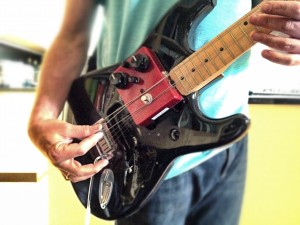
Yay! The first 100 Screech pedals just got into stock at Vintage King. Again, the very first production model went to Blake Mills. He immediately started doing thing I didn’t even know it could do. Damn.
Here’s the info from the product page at gorepedals.com. Pardon then obnoxious use of the third-person.
OVERTONE OVERDOSE
The Joe Gore Screech is descended from vintage octave fuzzes like the Ampeg Scrambler and Dan Armstrong Green Ringer, but it’s not a clone. It provides much clearer octave overtones, and you don’t need an extra booster for great results.
Most octave fuzzes work best when you play near the 12th fret using the neck pickup. But Screech provides potent octaves regardless of neck position or pickup setting. It also does fine non-octave fuzz. A common mod for octave fuzzes is to add a switch that switches of the diodes, removing the octave effect. The problem is, the resulting sound is dull as dirt. Here, though, though non-octave fuzz is sufficiently fiery and dynamic to stand on its own.
Unlike most things Joe Gore makes, Screech is not especially dynamic. It needs consistently heavy gain for its powerful octave effects. But as on many vintage octave fuzzes, you get freaky harmonics and other interesting noises when you lower your guitar’s volume control.
Screech runs on standard 9-volt batteries or power supplies. It was created in San Francisco by Joe Gore and is built in Michigan by skilled craftspeople paid a fair wage. It comes with a lifetime warranty.
TO USE: The single knob is a master volume. (There’s no gain control because this circuit demands high gain to generate such strong octaves.) When you hit the DIST footswitch without the octave (OCT) engaged, the LED glows red. With the octave on, the light is yellow. (You can’t use the octave section without DIST activated.)
When Screech is bypassed, you can specify whether the octave will be engaged when you activate the pedal. If the LED glows green, the octave will be engaged when you hit DIST. If the LED isn’t glowing, you’ll get non-octave fuzz when you step on DIST.
BACKGROUND INFO FOR PEDAL GEEKS: Here’s an article and video I put together a few years ago, demonstrating all the classic octave fuzz circuits. Toward the end I show an early prototype of the circuit that would become Screech. It’s evolved since then, so don’t consider this a proper demo. It’s just some amusing pedal geekery. 🙂