Categories
Technique

True Guit! A Master Class with Joe Gore & Adam Levy

On Saturday, July 7th, 2018 I will be co-hosting True Guit, a day-long guitar workshop, with my friend Adam Levy at the Blue Bear School of Music in San Francisco.
You can find all the needed details — including cost — at trueguit.com.

I’ve been contemplating such a return to teaching for several years. I taught professionally from ages 13 to 29, but gave it up when I first became a Guitar Player editor. Until I got the editor gig, I’d never filled out a W-2 in my life! (Jim Campilongo, then a fellow San Franciscan, inherited my teaching practice.)

I’ve written many instructional articles in the ensuing years, so I suppose I was a sort of “guitar teacher to the masses.” But I’ve been aching to return to face-to-face contact with students. (It’s in my blood — my parents were both educators.)
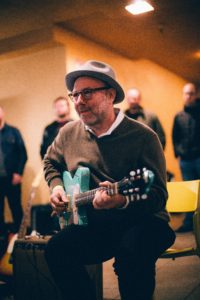
Adam Levy: Scholar, gentleman, and world-class guitar educator.

And man, what an honor to collaborate with Adam on True Guit! You may know Adam’s work with Tracy Chapman, Meshell Ndegeocello, and Ani Di Franco, and on his many fine solo albums. Or you might have read the lessons and interviews he’s contributed to all the leading guitar magazines. Not all great players are great teachers, but Adam is brilliant on both fronts. He has profound musical wisdom and a well-honed knack for communicating it clearly. Plus his calm, Zen-like demeanor is a great antidote to my twitchy bursts of neurotic energy.

I had a blast last year conducting master classes for Adam’s students at the Los Angeles College of Music. But this will be the first time we’ve taught side by side, and we plan to make a habit of it.

If you plan to be near San Francisco this summer — or would just like to be — please consider joining us. You’ll be able to hang out in one of the world’s most exciting cities and escape vicious July heat. (Our summers are famously overcast. Sadly, Mark Twain never actually said, “The coldest winter I ever saw was the summer I spent in San Francisco.” But let’s just pretend he did.)

Categories
Technique

Mastur Class!

Happy 2016! I hope everyone’s holidays were epic, and that you got lots of good stuff.

There’s no better way to ring in the new year than to highlight the … um … peculiar culture that somehow got attached to our instrument. You can’t make this shit up.

Screenshot 2016-01-05 18.14.07

Hard to believe, but this mastur class is totally real — at least in the mind of its creator. From the master:

Only a master guitarist and master guitar teacher understand both mastery of these concepts and how to break down complex and advanced ideas into easy-to-understand lessons that you can begin to learn and use right away in your own guitar playing.

I’ve been asked to teach on this topic by students again and again over the years. So I decided to create a 4-part master class video series. In fact, people travelled from all over the world, with great anticipation, to be part of this master class while it was being filmed.

Does it really work? It sure does! 🙂 When I filmed the master class, I called up several volunteers (all students of mine) to come forward and try the concepts I shared with everyone. And, as you will see for yourself on these videos, whenever any of these students implemented these specialized concepts, every woman in the room was not only paying complete attention, but all were smiling constantly. We could all see the effect it was having directly on them!

But don’t worry, this is not a bunch of childish obscene gimmicks or noises that you make with your guitar. This is about REAL guitar playing mastery! In other words, you won’t get slapped in the face when you play this way for women… but they’ll definitely feel what you are expressing in a good way!

This, apparently, is the sort of music that does the trick.

Categories
Technique

A Funky Fingerstyle Challenge! Mutant Travis Picking

Here’s a fingerpicking idea I’ve been kicking around for a while, though I couldn’t figure out a great way to present it till now.

It’s a challenging series of ultra-syncopated variations on traditional Travis picking — a funky fingerstyle challenge.

I started down this path while trying to create one of those fake-out song intros. You know — the kind that starts with solo guitar, and you think you know where the beat is. But then the drums come in, and your head spins as you realize you were perceiving the downbeat in the wrong place. What if, I thought, you started with Travis picking that, unbeknownst to the listener, was displaced by a 16th-note? That would guarantee a rude awakening when the beat kicked in.

I tried the pattern that way and found it nearly impossible. It took some slow, brain-twisting practice to play those familiar alternating-bass patterns with the rhythmically accented thumb notes falling on offbeat 16th-notes. (And it took even longer for it to feel natural and start grooving.) Maybe the technique comes naturally to some minds, but not mine!

I expand on the notion here when a lesson covering all the possible permutations. It’s more than a mental exercise: The musical implications are vast. As cool as traditional Travis-picking is, and for all the variation it permits, it’s almost inevitably locked into a sort of barn-dance feel with the accents fixed on beats 1 and 3. Learning to shift those accents has many benefits: It develops rhythmic independence. It lets you deploy your thumb in unusual syncopations. And it unlocks a world of funky grooves suitable for Latin and African music, bitchin’ new hybrids, and of course, the fake-out intros that inspired the idea.

I hope you find the concept as compelling as I do. Happy picking!

You can download the notation and tab for these exercises here. It’s a PDF file that you can save and print.

Categories
guitar Music Technique

My Favorite Rock ’n’ Roll Solo (It’s Not on Guitar)

I’ve long been obsessed with Sam “The Man” Taylor’s epic sax solo on the Chords seminal 1954 rock ’n’ roll hit, “Sh-Boom.” But I never got around to learning, transcribing, and analyzing it till now. I heard it about 100 times while making and editing this video, and it still thrills me on every listen.

If you’re like me, you know it’s wise to study performances by non-guitarists, but seldom get around to doing it systematically. For once I followed through, and — at risk of sounding like a pedantic dork — I’ve analyzed what I heard and suggested ways to incorporate the concepts in styles far removed from the original doo-wop context.

You can download my transcription (in standard notation and guitar tab) here.

The final part of the video is a rant about how segregation shaped the course of early rock and roll, in which I piss all over the Crew Cuts’ tepid cover version of “Sh-Boom.” (Spoiler alert: It blows.) This was partially inspired by recent despicable comments from musical felon Pat Boone. I’ve linked to the following videos before, but I’m posting them again because the cost of quality music is eternal vigilance against sonic shit-shovelers.

Holy crap! It’s the coolest man in the universe! This foreshadows Hendrix, Prince, and the Beatles. Even lip-synched, it’s everything badass in one minute and 50 seconds. (And it speaks volumes about segregation in midcentury America.)

And then there’s this:

Unholy crap! It’s the least cool man in the universe. And this foreshadows nothing except the worst music of the last 60 years (though it too speaks volumes about race in 20th-century America).

Why beat this dead horse? Why pick on ol’ Pat 60 years after the fact? Maybe he regrets his musical misdeeds. Maybe he’s even developed a more nuanced view of race and racism.

Naw. When self-avowed white supremacist Dylann Roof murdered nine African-American churchgoers on June 17th, 2015, Boone leapt into action, penning an angry editorial that condemned … politicians who dared to refer to the atrocity as “racist.”

FUPB. There’s no statute of limitations on your crimes.

Categories
Digital guitar Music Technique

Less-Boring Looping (“Pumped-Up Kicks” Cover)

For a while I’ve been playing this loop-based cover of Foster the People’s “Pumped-Up Kicks” at solo gigs and with my duo band, Mental 99. At risk of sounding like a pompous dick, I’ve annotated the performance, highlighting techniques I’ve found useful for making loop-based performances livelier and less predictable.

I’ve covered some of this ground before, particularly in this Premier Guitar looping-technique article. But here I call out the techniques mid-performance, and I’ve included a few new ones. I hope you find some of them useful.

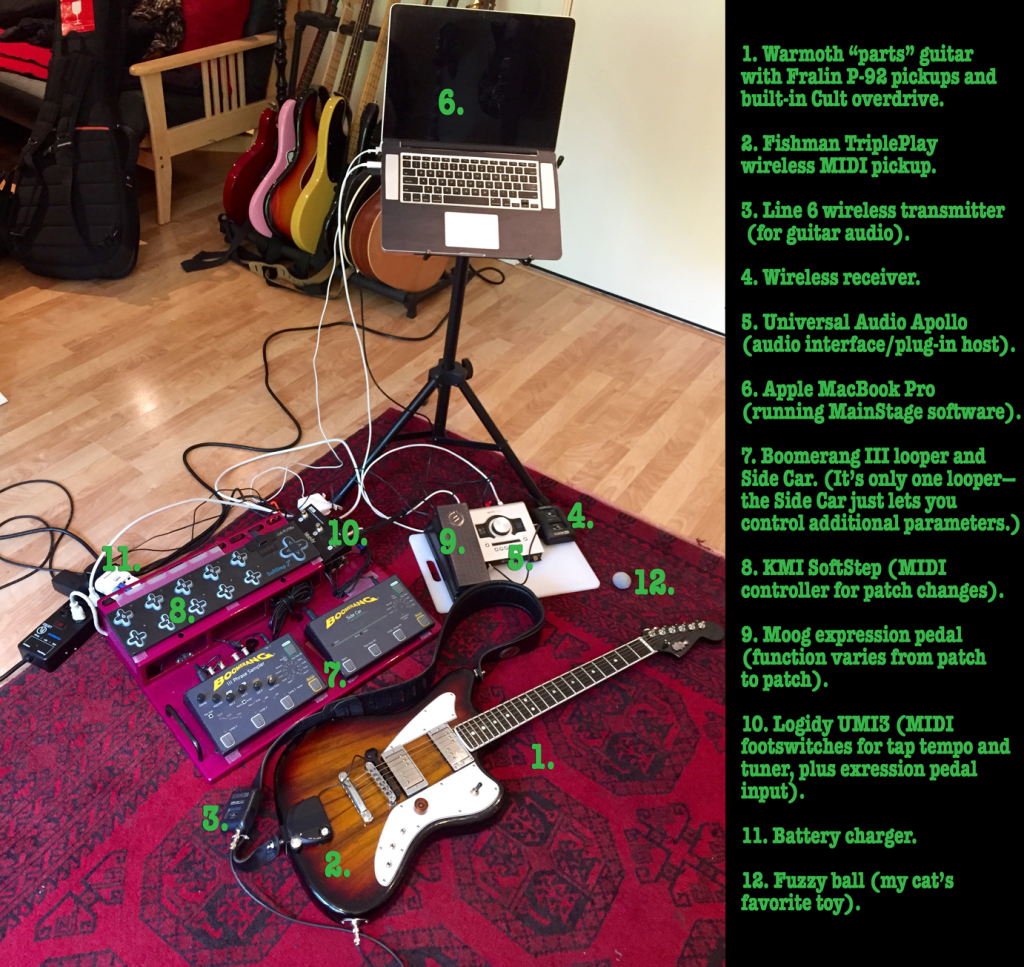
Likewise, I’ve already written about my live looping rig, but it’s changed a bit since then, and I’ve recently integrated a Universal Audio Apollo Twin interface (plus the stellar plug-ins it allows me to run). An updated overview:

Pedalboard-Diagram

The arrangement perform nicely, and I dig the individual components. But I dislike the system’s Rube Goldberg complexity—it’s a royal pain to set up and schlep. I’m always looking for ways to simply. (Other than, you know, just plugging the guitar into a frickin’ amp.) I’m open to suggestions for streamlining!

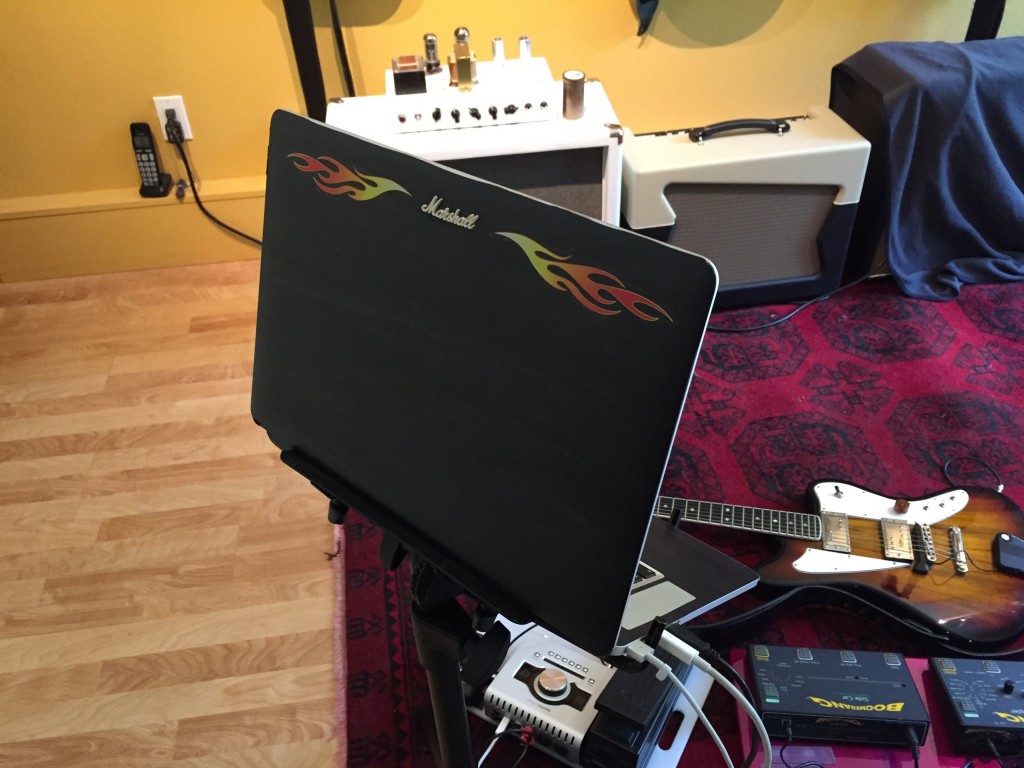
Black Mac
I love Apple products, but I hate having Macs onstage (mainly ’cause they’re so much better looking than me). Covering it in black wrap makes it less obtrusive. The Marshall logo is from one of those “toy” stacks (which, of course, can be far more than toys in the studio).
Categories
Digital guitar Technique

Cue the Drummer Jokes!
Playing Drums with MIDI Guitar

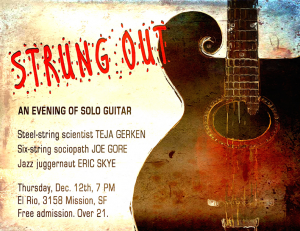
strung_out_121213_small

I’m thrilled to bits about a show I’m playing Thursday eve in San Francisco featuring two guitarists of impeccable skill and taste, plus me.

Teja Gerken and I are co-hosting a monthly solo guitar night at El Rio, my groovy neighborhood dive.Our guest is the amazing Eric Skye who, among other things, plays gorgeous solo guitar versions of classic Miles Davis tunes. If you happen to be in cold, cold San Francisco this week, stop by and say hi!

I’ve been doing the digital looping thing with Mental 99 for a few years now, and man, trying to work out solo arrangements with live-looped MIDI drums has been seriously humbling. You know all those jokes we love about how drummers speed up, slow down, drool, and generally disappoint? I can do all those things and everything else a drummer does, except occasionally play a competent groove. Some of the problems have to do with MIDI tracking in general, and some are simply general suckage. Man, it sure makes me appreciate my brilliant musical partner Dawn Richardson, who never speeds up and drools only rarely.

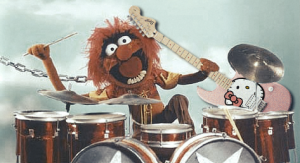
animal_drums

But those who can’t, teach. So I whipped up a little tutorial on playing drums with MIDI guitar. The first half covers the moves, and the second half features a live improv based on my fave afrobeat pattern. (Tony Allen is my rhythm god.) It also includes some of the hybird synth/guitar sounds I’ve been exploring, like double single-not lines an octave lower, mixing trashy guitar and trashy organ, and of course, space pigeons. (I stole the organ line from my pal Robin Balliger.)

In other news: I’ve been speaking to the ultra-knowledgable Rob Hull from Tube Depot about creating a minimalist DIY amp kit inspired by our conversations here. Lots more details to come. Tube Depot has a track record of making real nice amp kits, and Rob’s documentation/build instruction are the best in the biz. I reviewed their cool tweed Champ clone kit here.

Oh — anyone score any good holiday presents yet?

Categories
guitar Music Technique

Guitar Solo Obsessions

Are there any particular guitar solos you’re obsessed with lately?

Here’s one I can’t stop listening to: Jim Hall’s solo on Sonny Rollins’ 1964 recording of “God Bless the Child.”

This may seem like a weird statement, given how much self-indulgent wanking infests this site, but I have a love/hate relationship with guitar solos. (Or more like a hate relationship leavened by occasional stirrings of love.) That’s especially true with singer/songwriter tracks. A good song drags you into its emotional world, and so often it strikes me as emotionally jarring to suspend the drama for a fretwork display. It can be like an ill-timed intermission in a great movie, as if you were watching Citizen Kane or Grand Illusion, and they paused the film two-thirds of the way through to bring out a juggling monkey.

That’s one reason I love this solo so much. Hall just plays beautifully all the way through. He’s like the Loch Ness Monster, undulating continuously just beneath the surface and gently lifting his head above the waterline when his moment comes.

Another is the sheer bravery with which Hall employs silence. Talk about pregnant pauses! It would be fascinating to transcribe only the rhythms of the solo, not even the pitches. The asymmetrical phrases. The late entries. It’s so suspenseful. So poignant. So unpredictable. So frickin’ brilliant.

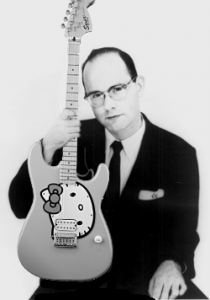
He's such a genius, I almost feel guilty Photoshopping in a joke guitar.
He’s such a genius, I almost feel guilty Photoshopping in a joke guitar.

Equally amazing is liquid blend of chords and melodies. For many players, that’s a binary distinction: Either you’re soloing, or you’re comping. This is just…music.

But the thing that amazes me most of all, I think, is Hall’s mastery of register. Baroque music scholars sometimes refer to a technique known as “compound melody,” best exemplified in the music of — who else? — J.S. Bach. Compound melodies are melodic lines that imply multi-voice counterpoint, even when they’re strictly single notes. A tune might center in one register, then leap high or low, establishing a beachhead in another register before returning to the original one. It then bounces back and forth between the regions, almost as if two tunes were being played simultaneously on adjacent channels, with the listener flicking back and forth between them.

I’m not sure I’ve explained that coherently. But Hall does it.

Jim Hall’s students (including Bill Frisell, whose playing this track so vividly anticipates) report that he kept a sign inside his guitar case that read “Make musical sense.” For many of us, soloing is about practice, practice, practice, and then when the moment comes, we turn off part of our analytical mind and hope that our instincts and muscle memory huck up something acceptable. But I get the sense that Hall, in pursuit of “musical sense,” never turns off his analytical mind. That’s not to say his approach is cold or scientific—he wears his heart on his sleeve here! But he’s always intelligent and thoughtful.

It’s said that improvisation is spontaneous composition. Sure, sometimes. But it’s rarely this spontaneous, or this composerly.

Gotta listen one more time—BRB.

Yeah, it’s still amazing. 🙂

So what are your current guitar solo obsessions? Any style. Any skill level. Anything that makes you feel intense things.

Categories
Effects guitar Music Recording Technique

The WRONG Way to Use a Talk Box

Any talk box fans out there?

Whew. Didn’t think so. I mean, doesn’t everybody hate those godforsaken things? Wasn’t it all downhill after “Tell Me Something Good?”

But did you know that the “talking guitar” has a rather exalted history four decades pre-Frampton Comes Alive? Check out this performance by Alvino Rey, the steel guitar genius who pioneered the technique.

I am TOTALLY going to have nightmares about Stringy for the next 10 years!

Rey worked his magic in tandem with his vocalist wife. She supposedly stood behind a curtain with a mic attached to her throat, the output of which modulated the guitar signal. (That’s what online sources say, though it sounds a bit fishy to me.) A similar technique — or perhaps the same one — was known as the Solovox. In this case, a small loudspeaker attached to the singer’s throat, “playing” the music through the vocalist’s mouth. More amazing/horrifying evidence:

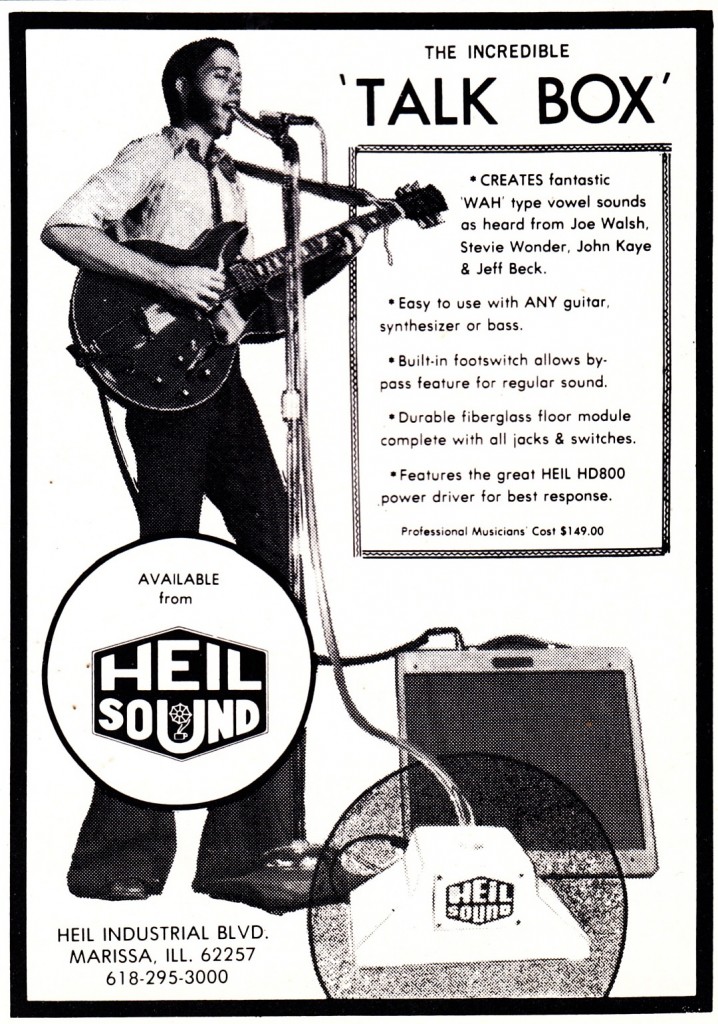
That’s the basic principle behind the rock-era talk boxes, though they rely on a plastic tube inserted into the mouth rather than a mic pressed to the neck. The first commercially available model was Kustom’s The Bag from 1969, “immortalized” on Steppenwolf Live. The Heil Talk Box — the version of the effect most of us know and loath — debuted in 1973. Dunlop is still making them.

But I have a perverse affection for the Rocktron Banshee. It’s incredibly loud. It’s actually a small amp, quite capable of driving a speaker cab, with a blunt-force distortion tone. That extra power is useful for my preferred way of using a Talk Box:

How about you guys? Anyone have anything good to say about the talk box?

Heil_TalkBox_1974

Categories
guitar Music Technique Uncategorized

Tonefiend Book Week 2013
Monday: Theory and Technique

Monday: Theory and Technique
Tuesday: Gear
Wednesday: Repairs and DIY
Thursday: Biography
Friday: Fiction

This week we’re talking about our favorite guitar/music books. The plan is simple: I discuss a few titles I’ve found particularly enlightening, useful, or entertaining, and then you jump in and do the same. I’ve organized the days of this week by subject matter. Today’s topics are theory and technique.

Tonefiend Book Week 2013 is an entirely selfish project. I expect to reap tons of great new info from you, smart readers. So don’t be shy about chiming in.

1. Ted Greene’s complete works

Yes, it's true — I studied guitar with Bigfoot!
This week on Finding Bigfoot, the BFRO team visits Encino, California.

Ted Greene’s jazz guitar books have haunted me since the ’70s. Chord Chemistry, Modern Chord Progressions, and Jazz Guitar Single Note Soloing Vols 1 & 2 remain in print, and are available in both paper and digital editions.

Ted’s books helped me understand the fretboard, tackle jazz harmony, and perhaps most of all, grasp the concept of voice-leading — that is, the ability to perceive chords not as static blocks, but as volatile structures resulting from dynamic melodies. Ironically, even though Ted’s books are divided into chordal and single-note topics, they go a long way toward erasing such distinctions. Melody generates harmony, Ted teaches, and harmony generates melody.

Not that I’ve completely digested Ted’s books. Has anyone? These tomes are dauntingly dense and complex. I just cracked open Modern Chord Progressions at random, and this confronted me:

Categories
Acoustic Amps Bass Digital DIY Effects Gigs guitar Music Pickups Recording Technique

Tonefiend Book Week is Coming!

Tonefiend Book Week 2013

Next week at tonefiend we’ll be talking about our favorite guitar/music books. I’ll write about some of the titles I find especially useful, inspiring, or entertaining, and I hope you’ll chime in with some of your recommended reading.

Since there’s so much potential material here, I suggest we focus on a different book category each day. Here’s my proposed schedule:

Tonefiend Book Week is strictly an experiment, and a selfish one at that. If the past is any guide, the obsessive geeks experienced and sophisticated players who frequent this site will introduce us to lots of lively lutherie-linked literature. And I’ll do my best to keep up!

So scour your bookshelves, real and virtual. This shit is about to get real promises to be a most edifying conversation.