Man, I’ve been wanting to do this experiment for ages — and largely because it’s been a black hole off ignorance for me. As mentioned in the video, I used to think they were the same pickup. But as you can hear, they’re quite distinct, and the differences are far from subtle.
Polly’s Firebird is a 1960s original.
Until now I’ve never owned a guitar with either pickup type. My chief experience with mini-humbuckers was when I demoed a set in this sane Strat for my Strat replacement pickups comparison. I liked them there as well, though I was using a set of Seymour Duncans, while these are Lollars. (I’d be cautious about making tone comparisons, since the two videos were recorded using very different tone chains.)
Annie Clark designed her own signature guitar.
I once played Polly Harvey’s original reverse Firebird on a gig, and I wasn’t that blown away at the time. (Though there were many other variables at play.) But I adored the way the Firebird pickups in Annie Clark’s Musicman St. Vincent model sounded, and I gave the instrument a rave review for Premier Guitar. I was struck then, as now, by their extraordinary dynamic response. Small variations in touch yield big tonal contrasts. My hope was that they’d sound like Fender pickups on steroids in a Strat, and to my ear, they do. (By “steroids,” I don’t mean high output — I generally recoil from extra-hot Strat pickups. Tones are simply fatter without neutering the high end as super-hot single coils tend to do.
I liked both pickups sets a great deal, but the Firebirds are a better match for my fingerstyle playing. What do you think?
I’ve been following the story of Fishman Fluence pickups and their radical pickup design for a few years. From the beginning, I’ve thought Fluence pickups sounded great in the hands of some other guitarist, but this is the first chance I’ve had to experiment with my own set.
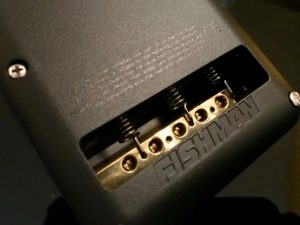
Most of the tech details are in the video. But in brief: These are active pickups with magnets, but no wire coils. Instead, the “coils” are printed on thin pieces of circuit board glued together like plywood. This design removes all noise and hum — chances are these are the quietest single-coil-sounding you’ll find. (Fishman also makes humbuckers and Tele pickups.) They can run on 9-volt batteries or (this is the other interesting part) a separately sold battery pack that replaces the trem cavity back plate. (There are other battery configurations for other guitars.) Another marquee feature: Each Fluence set includes a push/pull pot to switch between vintage voicing and a hotter “modern” sound.
This technology originated at an aerospace company. Someone there realized that their printed coils might work on musical instruments, and they contacted a leading pickup manufacture, who passed on the idea. Next it went to Larry Fishman, who was all over it from the get-go. He refined the idea and came up with lots of clever engineering to make it work in guitars. [DISCLAIMER: I have been paid in the past as a freelance contributor to Fishman products, but no one paid me to post this.]
To my ear these sound perfectly authentic, though the fact that they’re active is problematic for me personally. (That’s because I use so many retro stompboxes that don’t play well with the active pickups, which are buffered. The same goes for most of the pedals I sell.)
Killer, indeed!
While installing this in my much-abused MIM Strat, I also added a heavyweight bridge, trem block, and claw from Killer Guitar Components. I’m not kidding when I say “heavyweight” — it’s a formidable piece of metal, beautifully tooled. It feels like a major improvement on the standard design, and I think it sounds great as well (though it’s hard to be definitive about that without side-by-side comparisons). My favorite feature is the way the string inserts are chamfered — strings pop in correctly every time, which. as any Strat player can tell you, it not always the case. Killer, indeed!
Despite being obsessed with Charlie Christian for decades, I’ve never played a Gibson ES-150, the guitar he made famous. I’ve never even messed with a “Charlie Christian pickup,” even though it’s been a fairly common retrofit ever since the late Danny Gatton installed one in his Tele’s neck position. But I’ve always wondered: Could the C.C. pickup work in styles other than jazz? How would it sound in the bridge position? (The ES-150 had only a neck pickup.) And most of all, how would it sound with nasty fuzz?
Lollar Pickups helped me answer those questions with a loaner of three humbucker-sized Charlie Christian pickups. These differ cosmetically from the originals, lacking the cumbersome mounting hardware and the ornamental top plate. But they’re convincing sound-alikes, with similar magnets, wires, windings, blades, and modest output. (Their DC resistance is just under 3k ohms). Here’s what I discovered!
Clearly, it’s not a pickup for every rock guitarist (though it’s perfect for a swing-era jazz sound). Still, I found its non-jazz sounds strange and compelling, and I can definitely imagine using them in the studio. What do you think?
While making comparisons, I spend hours reacquainting myself with Charlie’s recordings, of which there are only a few dozen. His career was absurdly brief — it was less than three years from his first recordings with Benny Goodman through his death from tuberculosis (and probably other bad stuff) at age 25. But that was long enough to forever alter the guitar’s history. (more…)
I should have been out buying nice presents for you all. Instead I sat around inhaling solder fumes. When the smoke cleared (mostly, anyway) I’d tested ten unusual Strat pickups in the same poor guitar.
Verdicts? I dig them all, and not just ’cause I’m too polite/chicken to say otherwise.
I love the Lollar Gold Foils so much I’m assembling a new parts guitar to surround them. I’m going to keep the Fralin Big Singles in the demo Strat, at least till the next Mongrel Strat Project. I’m going to try putting the mini-humbuckers in a “parts” Tele at some point. I originally reviewed the Lollar P-90 set for Premier Guitar (where I evaluated them the “right” way: in a Gibson guitar), so they go back to manufacturer, though I’d sure like to own a set someday. Meanwhile, the Allparts set isn’t in the same league as its high-end competitors, but at a mere $30 per pickup, it costs about 1/4 the price of its expensive rivals. You could definitely do a lot of lo-fi damage with a pair of these surprisingly solid-sounding pickups!
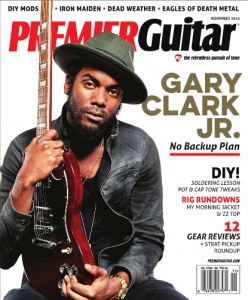
I’d like to call out several items of interest in the November issue or Premier Guitar. The first one is personal: As head honcho Shawn Hammond mentions in his monthly editor’s letter, I’m changing roles at the magazine. After two years as a part-time senior editor, I’m going part-part-time as a contributing editor.
It was a tough call for me — it was a fun gig working with awesome people on subjects I love. But I’ve felt an increasing need to dedicate more time to my own projects: playing, recording, writing, developing gear, and trying to make my tonefiend.com blog and YouTube channel seem a bit livelier than something you’d encounter at Urban Ghosts. (It’s one of my favorite websites, but not the attitude I’m aiming for here.)
If you’ve enjoyed the articles I’ve contributed to PG, well, first of all, thanks! And second, note that I’ll actually be contributing more columns and reviews than before. That may sound contrary to the laws of physics, but it’s possible because I will no longer be editing material by other writers. (I’d been processing an average of 35 stories per month in addition to my bylined pieces.) Picking up the slack will be new hire Ted Drozdowski, a fine writer and player, a lovely guy, and one of the music journalists I looked up to when I got into the guitar mag racket decades ago. (Ted was part of the now-legendary Musician magazine of the ’80s and ’90s.) Meanwhile, I’ll be contributing my Recording Guitarist column and at least three major gear reviews per issue.
Also in the issue are several tech-oriented pieces that I found particularly interesting. My old pal Frank Falbo — a leading pickup designer and master luthier — contributed a great piece on pot and capacitor substitutions. More than anything I’ve read, Frank’s article nails down exactly what changes to expect when swapping out part values, documented via audio files.
For me, the most fascinating part is how varying tone-pot values change your guitar’s tone, even when the tone knob is wide-open. Yeah, a lot of us would expect some change, because pots of varying resistances exert different loads on your pickups. But as far as I know, no one has ever nailed down the exact differences the way Frank has.
Others generalize. Frank Falbo nails it down.
Spoiler alert: The differences are massive — it’s a far bigger deal than I’d always assumed. Check out Frank’s first set of sound clips and prepare to be impressed.
It’s not a new idea that you can shift the overall tone of a guitar “bright-ward” or “dark-ward” by swapping pots, but Frank makes explicit how dramatic such changes can be, and what to expect from the likeliest substitutions.
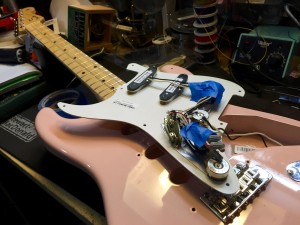
I also learned much from two articles I wrote. The first is a shootout between five sets of ultra-vintage-style Strat replacement pickups, featuring models by Amalfitano, Fender, Klein, Manlius, and Mojotone. (Spoiler alert #2: They all sound pretty great, though the Kleins and Mojotones were my personal faves.)
I only realized after evaluating tones that the two sets I loved most don’t deploy a hotter pickup in the bridge position, while the other three do. (I don’t mean some blazing-hot bridge pickup, but one just a tasteful tad louder than the others, an approach many Strat players seem to love.) In the Klein and Mojotone sets, the middle pickup is loudest. Food for thought.
There are good reasons why few guitar mags run serious pickups reviews, and almost never compare models directly: It’s labor-intensive, and it’s damned hard to establish a level playing field. Here, I tried to remove as many variables as possible, installing all the pickups in the same test guitar, scrupulously measuring everything from pickup height to mic position, and laboring mightily to create identical demo performances for each set. My favorite part appears on the final page of the article, where you can directly compare each pickup from each manufacturer side-by-side.
This poor pink Strat got one hell of a workout.
Finally, you might find interesting the audio clips in my latest Recording Guitarist column. It’s about is direct recording, a topic I’ve been covering since this blog began. I got cool sounds using a JHS Colour Box (a dumbed-down Neve channel in stompbox form) and especially with the Neve preamp simulations in the latest Universal Audio software. I’m hardly the first to point this out, but wow! Some recent plug-ins are so stupefyingly realistic that they can mimic analog gear pushed to extremes — a longstanding weak link in faux-analog plug-ins. I found it easy to create cool and compelling sounds without amps or amp simulators. Let me know what you think.
Okay, now I’m nodding off from jet lag. I just returned from a two-week trip to Italy, which generated some interesting musical thoughts and discoveries that I’ll share here soon. 🙂
No, I don’t mean like, “What’s better: B-flat or F-sharp?” Rather, is there a single note from a great recording or performance that haunts your dreams?
Here’s what go me on the topic: One of my Premier Guitar colleagues, Gary Ciocci, recently turned me on to El Twanguero (aka Diego Garcia), a brilliant Spanish-born, Argentina-based electric guitarist who’s created a head-spinning fusion of classic Latin jazz and rockabilly guitar. The only thing I don’t worship about the great Afro-Caribbean music of the 1950s and ’60s is the fact that it rarely includes guitar. But in Garcia’s retro fantasia, it’s as if the great Cuban and Puerto Rican mambo kings had migrated to Memphis instead of settling in NYC.
Diego “El Twanguero” Garcia: ¡Bien tocado, señor!
When I explored Garcia’s YouTube channel, I immediately clicked on his version of “Cherry Pink and Apple Blossom White,” a Perez Prado classic that topped the charts in 1955. (You probably know the tune even if you don’t recognize the title — it’s been in a zillion movie soundtracks.) I was eager to hear how Garcia would interpret the famous trumpet slur — perhaps the booziest single note ever recorded. (Yes, theory sticklers — I’m using the word “note” to mean a single articulated note, even when it spans multiple pitches over its duration.)
The tipsy note appears right at the top — it’s the fourth pitch in the trumpet melody. But it gets boozier and woozier with each repetition, and by its dead-drunk appearance at 2’27”, it’s amazing anyone’s still standing up.
Okay, try to convince me that it isn’t the sleaziest note ever! (Just for fun, here’s a live performance, where you can see what Prado looks like when emitting his signature grunt.)
How the hell would you render that on guitar without period-inappropriate distortion and locking tremolo? Take it away, Sr. Garcia!
Love it! ¡Bien tocado, Señor!
That got me thinking about other favorite notes. My #1 choice was easy — it comes at the end of this post. But two others also sprang to mind.
George Harrison’s “It’s All Too Much” used to be considered one of the Beatles’ least important tracks, though it seems to have been critically rehabilitated over of the course of the last few psychedelic revivals. It was cut in 1967 between the recording and release of Sgt. Pepper, just when the Beatles were discovering LSD. (It shows). But it wasn’t issued until 1969, when it appeared as a throwaway on the Yellow Submarine soundtrack — the first album I ever purchased with my own money. (And I’ve never recovered from the horror of discovering that side B features no Beatles material — just George Martin’s twee orchestral soundtrack.) But that blast of sustained feedback carved its way into my consciousness.
The experts say George played it, though I doubt anyone present was coherent enough to recall. I’m not saying it ain’t George, though I can’t help noting that whenever you investigate a particularly ferocious bit of Beatles guitar work, the perpetrator always seems to be Paul. (Examples: “Helter Skelter” and the solos on “Taxman” and “Good Morning.”) I dunno — maybe acid unleashed Harrison’s inner beast.
Another note that’s possessed me for decades is from Miles Davis’s heartbreaking take on Rogers and Hart’s “It Never Entered My Mind.” (From Workin’ — the first jazz album I bought with my own cash, at age 14.) Man, you could write a dissertation on the first eight bars of Miles’ solo, and someone probably has. Even though the notes are few and far between, I dare you to try playing along, matching the trumpet phrasing. But the highlight for me is the sublimely out-of-tune note in the fifth bar of the trumpet head. (It first appears at 0’33” in this clip.)
The performance is in A-flat, and the special note is a very flat E-flat — about halfway to D-natural. Man, how does something so wrong feel so … not just right, but transcendent?
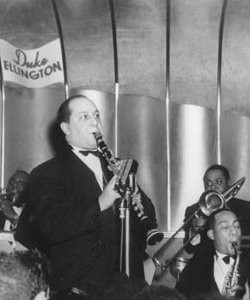
That was my favorite note for many years, until I became a born-again Ellingtonian. Friend/genius Stephen Yerkey turned me on to Ellington’s 1938 remake of his own “Black and Tan Fantasy,” whose original 1927 version is universally regarded as one of the most important early jazz discs. But the 1938 remake is equally brilliant. Duke’s band was at or near the height of its powers. The orchestration is sublime. The piano work is radical. Each solo is a jewel. And then there’s THE NOTE.
Now, there’s nothing I find more musically distasteful than a cheesy, star-searchin’ vocalist wowing the crowd with a long sustained note. I hate it just as much when operatic singers do it (as did many of the great opera composers). And using the national anthem at ball games as a pretext is just plain nauseating.
Did Barney Bigard play the greatest note ever?
Yes, THE NOTE is impossibly long and difficult. But there’s more here than sheer virtuosity. The painfully slow glissando literally makes you dizzy, as if the world were tilting off-axis. (It’s more psychoactive than the Beatles on acid!) It exerts exquisite tension against the backing harmonies, and it lets Duke display his most Debussy-like side in his watery, chromatic piano accompaniment. And the dismount is astonishing: Another wind player would be gasping on the floor, but incomparable clarinetist Barney Bigard (also featured on the 1927 original) concludes with a soft, casual phrase, as if he had all the time and breath in the world. For me, this is the ultimate musical embodiment of “cool” in its most profound African diaspora sense.
Play it, Mr. Bigard! The miracle commences right after 1’15” (but please, treat yourself to the entire performance).
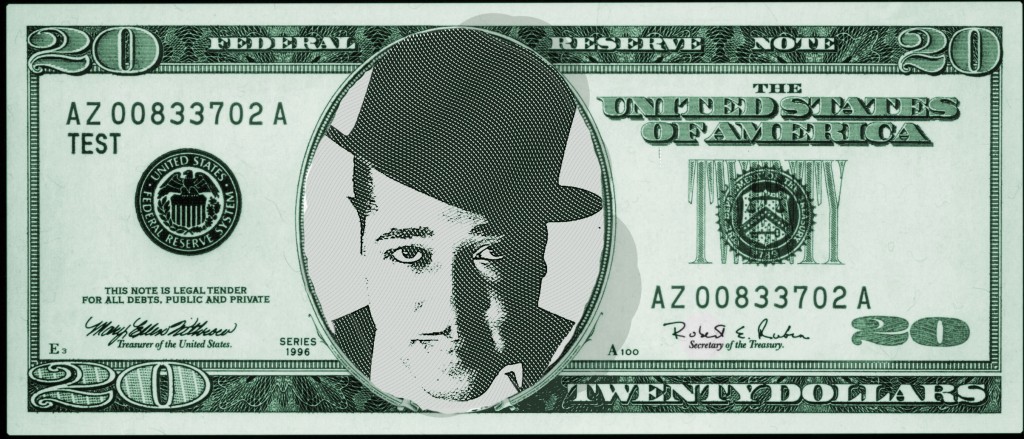
(I know I’ve said this about 50 times on this blog, but I repeat it whenever possible: In much of the civilized world — Europe in particular — the arts are considered precious, and musicians routinely appear on currency. If Americans gave a crap about culture, our greatest composer would grace the $20 bill, not genocidal Jackson. Though admittedly, there’s a strong case for Harriet Tubman.)
Okay, enough of my yakkin’! What’s your favorite note?
Okay, it’s not the ultimate lipstick-tube guitar for everybody, but it probably is for me. It’s my third lipstick-tube pickup experiment — and definitely my favorite.
You may have heard some of these parts before: I used the neck for all my Mongrel Strat projects, and the Strat-sized Seymour Duncan pickups appeared in my previous lipstick-tube experiments. (I love Duncan’s lipstick-tubes. To my ear, they sound way better than the ones in new-school Danelectros.) The new body is Warmoth’s Hybrid Tele model, in purple with butterfly stickers. It’s très macho. (Better not use if for gigs in Indiana and Arkansas.)
My previous lipstick tube experiments used a MIM Strat body, but I wanted something a little more distinctive, and with a built-in battery compartment (because nothing is a bigger pain than changing batteries in a traditional Strat control cavity). Also, I like how the design evokes both Strat and Tele, since the guitar has three-Strat sized pickups and a whammy, but is wired more like a Tele.
About that wiring: The 3-way pickup selector chooses neck, bridge or both pickups, like on a Tele. Meanwhile, a SPDT switch toggles the middle pickup on and off regardless of the pickup selector, so you get six settings: neck, bridge, neck + bridge, neck + middle, bridge + middle, and all at once. It’s a pragmatic variation on “Nashville Tele” wiring with a switch rather than a pot. That means you can’t dial in varying amounts of middle pickup—it’s all or nothing. But on the plus side, I can jump instantly to an out-of-phase sound from any pickup-selector setting, and it freed up space for the other weird crap I put in this guitar. (Yo, electrical engineers: Don’t bother telling me that combined-pickup settings aren’t really out-of-phase True, they’re not out-of-phase electronically, but they are acoustically, and the distinctive “hollow” sound of combined settings is precisely the result of phase cancellation from two pickups at different positions.)
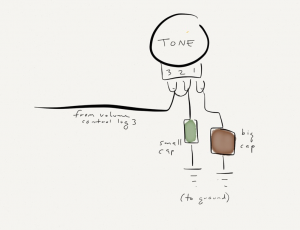
The weirdest detail is what I call a “cap-fade” tone control. It’s an idea I speculated about back in January, and to which many of you contributed cool perspectives. I pretty much followed the scheme in the original diagram:
The idea again: Instead of sending varying amounts of signal to ground via a tone cap, the pot here fades between a small-value cap (which defines the minimum cut when the control is engaged) and a larger one (defining the frequency of the maximum cut). In other words, instead of sending varying amounts of signal to ground, this circuit always sends everything above the cutoff frequency to ground, with the pot determining the frequency. (more…)
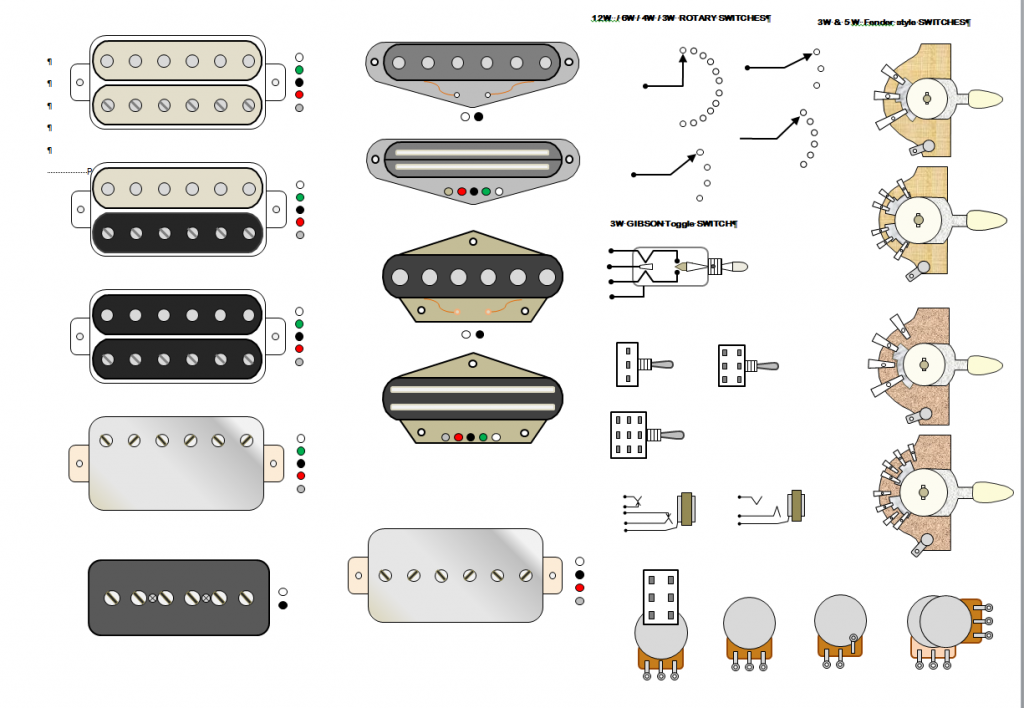
Check it out! Reader Mike Taylor tried to share this cool wiring diagram worksheet in the forum, but sadly, my meager WordPress forum plug-in doesn’t support uploads. It’s so handy and nicely done that I present it here. (Right-click to download.)
It’s an MS Word file, with the graphic elements for pickup wiring diagrams embedded as selectable objects. Mike has included all the most popular components, plus some not-so-popular ones of the sort we like to obsess on here. I’m totally going to use this to create future wiring diagrams for the site and elsewhere.
Some notes from Mike:
It can be used to start laying out wiring diagrams by drawing interconnections in Word, or I guess you could just position the building blocks on a page, print it out, and hand draw the connections. The little dots next to the representations of pickups can be changed to match the colour codes of your pickups. All objects are just simple shapes grouped together and set so they preserve their aspect ratios. Hopefully, shrinking and enlarging shouldn’t be too problematic. Anyone can change or add to it, as it’s unprotected. If anyone finds it useful, I hope they do their own thing with it.
Thanks, Mike! :beer:
Anyone else got cool resources like this to share? Don’t be shy — stand and deliver!
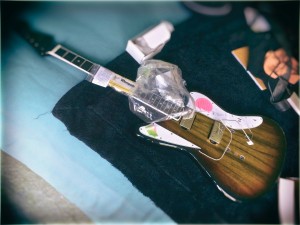
I just received from Warmoth all the parts for my next DIY guitar. I loved testing eight sets of P-90 pickups for Premier Guitar, but I don’t own any P-90-eqipped guitars.I will soon, though!
This one will be a bit of a platypus — as opposed to, you know, all my other other platypi. (The actual plural of “platypus” is “platypuses,” but “platypi” is more fun to type.) It’s built from Warmoth’s “split Jazzmaster” template, with a korina body, bound neck, Tune-o-matic/stop-tailpiece bridge, and a pair of hum-cancelling Fralin P-92s. Yeah, it’s kind of a stab-in-the-dark experiment, and not a inexpensive one. But hope springs eternal. Prepare to be bored with details!
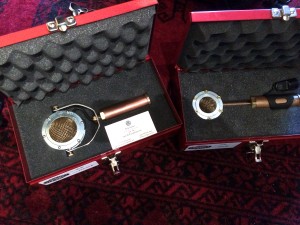
I’ve also just received an amazing-looking pair of condenser mics from Portland, Oregon’s Ear Trumpet Labs. ETL kingpin Philip Graham’s business card identifies him as “proprietor and bricoleur.” Bricolage, of course, is the ten-dollar word for “making stuff out of junk and other found objects.” Dig the steampunk vibe of that repurposed hardware! I haven’t even plugged these in yet (though the reviews I’ve read have been stellar). I just like staring at them! But I’m going to try them out at my monthly Strung Out! show tonight.
Ear Trumpet Labs’ Edwina and Edna models: a higher calling for found objects!
Which brings me another of this week’s highlights: I got to perform last night with my dear friends Teja Gerken and Adam Levy. Teja is an astonishing acoustic fingerstylist and a fine composer. His vocabulary has hints of Bensusan, Hedges, and classical, but he’s molded those influences into a thoroughly unique sound. And Adam, who I’ve known since my Guitar Player magazine days, is equally renowned for his jazz work and for accompanying such singer/songwriters as Norah Jones and Tracy Chapman. (I get to play some of Adam’s cool parts when I gig with Tracy.) These days Adam’s focusing on songwriting, and he his sings his “smart Americana” songs (my description, not Adam’s) in a sweet, soulful voice. Man, what a treat to hear both of them up close. And tonight, Adam, Shelley Doty, and I perform at my local dive, El Rio. Can life get any better?
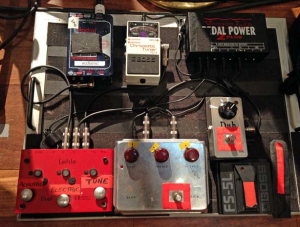
Apparently so! Yesterday Premier Guitar posted John Bohlinger’s piece on the Pixies, which includes a pic of Charles “Frank Black/Black Francis” Thompson’s pedalboard, with my grubby, hand-built Duh fuzz pedal front and center. I’d originally made if for Joey Santiago, the other Pixies guitarist, but I guess Charles swiped it. Hey, I’d be honored if either guy spat on the thing! They’ve been heroes since I first heard the band in a small San Francisco club back in ’88. (Everyone went to hear the Sugarcubes, but left talking about that awesome opening act from Boston.)
Frank Black’s pedalboard: Lookit! I’m Pixies-approved!
It’s funny, because I really was thinking “Pixies” when I sound-designed the Duh. I was going for “bubblegum metal” — a thick, heavy sound, but not a macho one. The tone is too fizzy and funny for 100% sincere heavy rock, IMHO. It’s more of a “greasy kid stuff” distortion. (Note to readers under 45: That was once the tagline for a “dry look” mens hair product, referring to the outdated coiffures that would return with a vengeance when punk broke a few years later.) It’s a vaguely Muff-like sound, but with less compression, less scoop, and one big, stupid knob. I also like building that circuit into guitars. Like this one:
So it’s been a grand week, but a hectic one. Thanks for reading this far. Next week I promise a proper post, and not another collection of … odds & ends.
Just in time for the single-coil holiday season: my comparison review of 16 humbucker-sized P-90 pickups is live at Premier Guitar. This heartwarming holiday fun-fest has it all: Mouth-watering adjectives. Freshly baked audio clips. Irate manufacturers. Don’t miss it!
This was a fun, if challenging project. Comparison pickup reviews are such cans of worms! Not only are they sadistically labor-intensive, but the differences between one pickup and the next are easily overshadowed by other variables in the tone chain.
After much thought about how to create meaningful comparisons, we came up with an intriguing process: I tested all the pickups in the same guitar, with identical setups, and ReAmped them through the same combo amps with identical recording settings. If this were an amp or pedal review, I would have used the same performances throughout, but of course, each example had to be played anew with each pickup, so I spent much time matching performances to guard against misleading variations in touch and intensity. It’s not a perfect solution, but better than most, and in the end quite revealing.
And what did it reveal, exactly? You’ll find out at the link. Beyond that, I can report that:
All the products sounded pretty good.
They sounded more similar than you might expect.
I’m gonna find me a guitar to house a set of my favorites — though I’m not sure which ones are my faves! Really, they’re close enough that, say, the tone of a particular body wood alone would be enough to sway the decision. It’s not so much a case of “better or worse” as “brighter or darker” and “louder or quieter.”
As mentioned in the article, there’s no “gold standard” of P-90 tone — or rather, every P-90 lover has his or her own standard. Gibson’s ’50s original are notoriously inconsistent in their output, even their magnet type. Plus, the mere fact that you’re winding coils around a narrow, tall humbucker bobbin rather than a wide, low P-90 one has sonic implications. So I tend to think of this entire pickup category as either “single-coils that are ballsier than Fender single-coils,” or, in the case of hum-canceling models, “humbuckers with brighter highs and clearer mids.” (Or as my ol’ pal Steve Blucher from DiMarzio calls them, “humbuckers that hum.”)
Funny thing: I love P-90s, but don’t own any guitars fitted with them. Not yet. :satansmoking:
So talk to me about P-90s! Your faves? Beloved P-90 guitars? Fave P-90 players and performances?