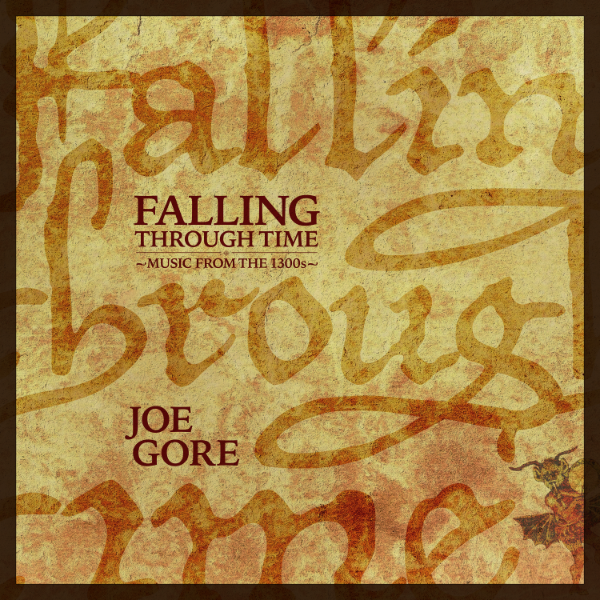
I’ve worked on many projects by many artists, but this is my first release under my own name. And it only took me 50 years!
It’s a back-to-the-roots project for me, though I have some fairly strange roots. When I was a teen I wanted to go into academia, specializing in early music (that is, European classical music from before 1650). Fate choose a different path for me, but I’ve always been fascinated by ancient music, especially the bizarre stuff that emerged toward the end of the Middle Ages. So this is a collection of music composed during the 1300s.
I followed a simple but strict “rule book”: I played only the notes and rhythms the composers specified, but I allowed myself total freedom in applying modern instrumentation and production. (As opposed to when I was young, when my goal, like that of most early music practitioners, was to perform the music as authentically as possible.) The resulting album is surreal, psychedelic, and, for better or worse, unlike anything I’ve ever heard.
This is a digital-only release for now, though I’ll do a vinyl pressing if there’s enough interest.
Me at age 17, playing my 15-string lute at — where else? — a Renaissance Faire. Yes, I was a dork even by 1970s standards.
I could say a lot more about the project, but I already did: I created a little booklet with credits, liner notes, background, and lots of amazing 14th-century images. It’s a free download from here:
Fender’s Telecaster Deluxe has had an interesting and checkered history. Once regarded as yet another mediocre product from the company’s era of CBS ownership, these turn-of-the-seventies instruments now fetch huge prices on the collector’s market. I’ve never owned own. But when singer/songwriter Greer Sinclair loaned me one of Fender’s 2010 reissues, it was time for research — and experimentation.
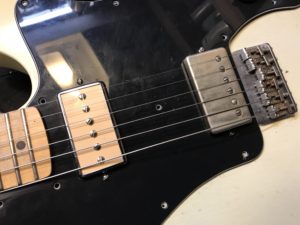
The made-in-Mexico 1972 Deluxe reissue is a cool guitar. It replicates many details of the original: the oversized headstock, the Strat-like belly cut and fixed Strat-style bridge, and the big-ass pickguard. But its pickups are definitely a departure. In lieu of the original’s large-format “Wide Range” pickups, it employs a P-94R (a humbucker-sized P-90 spinoff) at the neck, and a conventional Gibson-style humbucker at the bridge.
The Wide Range pickup was a unique beast. Fender had commissioned Seth Lover, the man who invented the Gibson humbucker, to create a Fender humbucker in hopes of cashing in on the growing popularity of hard rock. With DC resistance in the 10k range, the new Wide Range pickup was a bit hotter than a vintage Gibson humbucker. Wide Range pickups appeared in several of the era’s models, including the Tele Thinline, Tele Custom, and semi-hollowbody Starcaster.
Gibson humbuckers have a bar magnet within, but the pole pieces are not magnetic. But on Wide Range pickups, the pole pieces are magnetic, as on Fender’s single-coil pickups. Situating individual magnets closer to the strings yield a brighter sound with greater note defition and string-to-string separation — characteristics we associate with vintage Fender pickups. So the Wide Range pickup lent a uniquely “Fender” twist to the Gibson design.
Wide Range pickups are slightly larger than conventional humbuckers. Most of Fender’s circa-1970 Tele reissues substitute generic humbuckers of the standard size. Standard humbuckers can sound superb in a Tele, but they’re horses of different colors. Fender has also created some reissues with the larger-sized pickups, but these are also garden-variety humbuckers — the larger format is purely cosmetic. The pole pieces of the factory humbucker on Greer’s guitar don’t align with Fender’s wider string spacing. (But one thing I’ve leaned from my various Fender/Gibson hybrid experiments is that sonically, this can matter very little.)
The P-94R’s cream-colored top looks wicked against the guitar’s finish. It’s a warm, full-sounding pickup from the mellower side of the P-90 spectrum. Actually, it doesn’t sound all the different from a traditional Telecaster neck pickup. (Like that pickup, it works quite well for jazz.) Note, though, that its dimensions differs substantially from those of a Gibson P-90, as you can the in the photo where it sits alongside a historically accurate Lollar P-90. When you change the size of a pickup’s components, you inevitably alter the sound. The tones can be for better or worse — but they will be different. (more…)
I haven’t posted any new video in months and months. It’s not just laziness or business, though I suffer from both. I’ve just been locked away in my studio, trying to create a new live looping system.
I still haven’t nailed it down, so I’m not going to get into a complete run-down yet. But here are the basic ideas.
• I’ve moved from a hardware looper to software looping. When I started this godforsaken looping project years ago, I’d just finished a lot of work on Apple’s then-new MainStage software. At the time, the program’s looper simply wasn’t reliable enough for live performance. Also, my intense signal processing was pushing my MacBook Pro to its limits. But since then, the program has gone through many upgrades. Meanwhile, after years of relative stagnation, Apple finally issued a major MacBook Pro upgrade in 2017. Between the more powerful computer and the refined software, I could finally shift looping and signal processing to the computer. Yeah, there are a couple of disadvantages. For one thing, MainStage’s looper lacks a “copy” function, something I’ve come to rely on a great deal in my arrangements. But it sure is nice not having to run the entire mix through the relatively cheap hardware looper convertors — just the snazzy ones in my Apollo interface. (Of course, now that I’ve transitioned, Electro-Harmonix has just announced a compelling-looking 6-track looper. I’ll have to check that out…)
• I’ve put aside for now the Fishman TriplePlay MIDI pickup. I have no complaints about TriplePlay, which is far and away the best MIDI pickup ever created, and a product I recommend without reservation. But I wanted to be free from the hardware setup. This way, I can plug in any guitar, any time. (I’ve been experimenting with acoustic looping — more on that soon.) I’m still using MIDI sounds, but again, it’s all in software via Jam Origin’s brilliant MIDI Guitar plugin. It works incredibly well without a MIDI pickup, but it’s not nearly as fast as TriplePlay. It’s fine for doubling, or for melodic and textural stuff, but it’s just not speedy enough to play MIDI drums at even moderate tempos. Which bring me to the other big departure …
• I confess: I’m playing to a drum machine. I’m triggering and changing patterns using a KMI !2 Step foot controller. I really wrestled with this decision. I loved the idea of using no machine tempos — it all came from the hands. But at some point I realized that the main reason I was committed to that approach was for bragging rights: “No prerecorded tracks, and no machine rhythms” I could boast. But who cares except geeks like me? Anyway, I still have misgivings about the change, but I’m going with it for now. I think that means, though, that I’ll create more arrangements without percussion, just so I’m not locked to the machine for an entire set.
Meanwhile working with a tempo clock lets me do fun stuff with synchronized effects. I’m especially besotted with Sugar Bytes’s Effectrix, a mind-bending multi-effector that lets you activate and edit effects on a note-by-note basis. You hear it a lot in the “solo” in this video.
I’ve played a few shows with the new setup. The first one was flawed but promising. The second was an unmitigated disaster. Then I doubled up on practicing and (not kidding) started meditating again, which helped a lot. Last time I tried this live, it went really well! We’ll see how it goes at my gig this week.
Anyway, it’s still a work in progress. I’ll keep the curious updated.
I played this cover tune with no irony whatsoever. I love the original.
Okay, the funky gold foil pickups found in cheapo Japanese and American gutiars in the 1950s and ’60s are popular again. And trend slut that I am, I’m smitten with them. But they do this one really weird thing ….
It has to do with the capacitive relationship between the guitar volume knob, pickups, and downstream pedals and amps. If you don’t use your guitar’s volume knob as an expressive device, this behavior probably doesn’t matter. But if you do, this is potentially a big deal, one worth considering before purchasing a pair of gold foils.
I first realized this as I was preparing my Gore Pedals demo for the NAMM show. Many of my pedal designs depend on the ability to alter tones from the guitar — it’s how I get away with using relatively few knobs. It’s the quality you hear in the first minute of my Cult pedal demo:
You just can’t do that with gold foils. Apparently, the rubber magnets in gold foil have a different capacitive relationship with downstream gear, relative to conventional alnico- and ceramic-magnet pickups. Some of the peaky, high-resonance sound you get when rolling back the volume knob on a guitar with gold foils are pretty cool, and I can certainly imagine using them. But I definitely have to modify my technique when using gold foils.
I recently reviewed one of the bitchin’ new Supro guitars for Premier Guitar. Their pickups are based on a different historic gold foil model, but they exhibit the exact behavior demoed in my first video above. After writing that review I spoke with Ken Calvet of Roadhouse Pickups, who created the excellent-sounding Valco-style gold foils for Supro. He acknowledged the unusual volume knob behavior and attributed it to the rubber magnets used in historically accurate gold foils.
My first video above demonstrates this property using a capacitance-dependent vintage-style Fuzz Face. Not only do you encounter the same thing with many non-buffered (i.e., cool) fuzzes and boosters, but also when plugging directly into an overdriven amp. You can’t summon clean sounds from a dirty amp via the guitar volume knob the way you can with most conventional passive pickups.
But despite all of that, I’m still crazy for the Lollar Gold Foils in my DIY Resistocaster:
Has anyone else noticed this quirky characteristic?
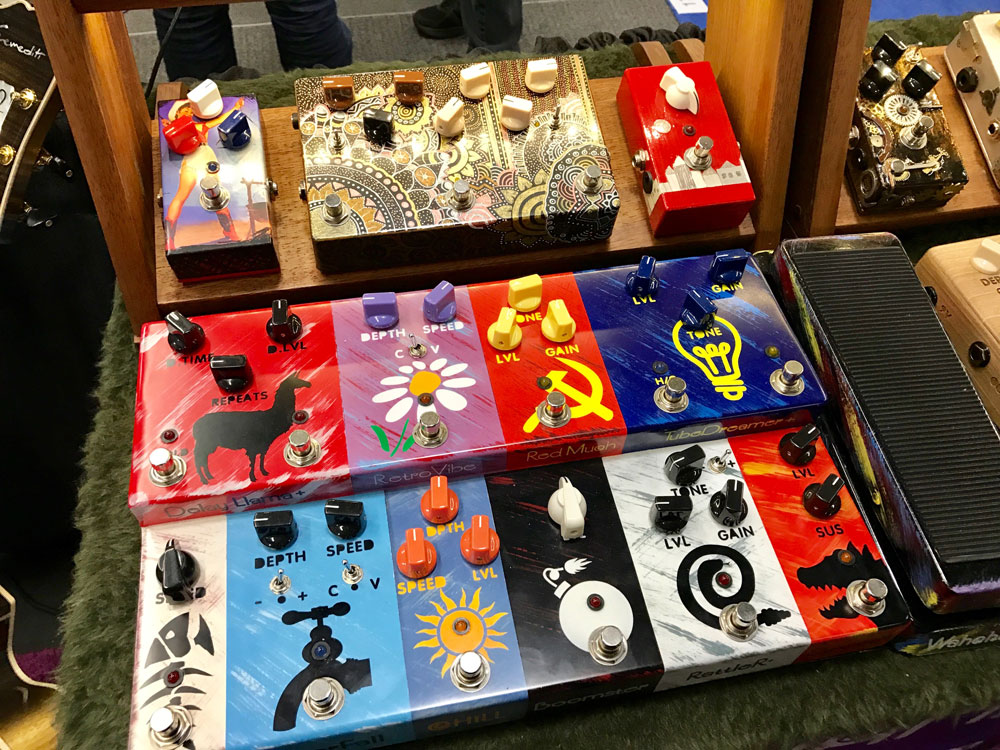
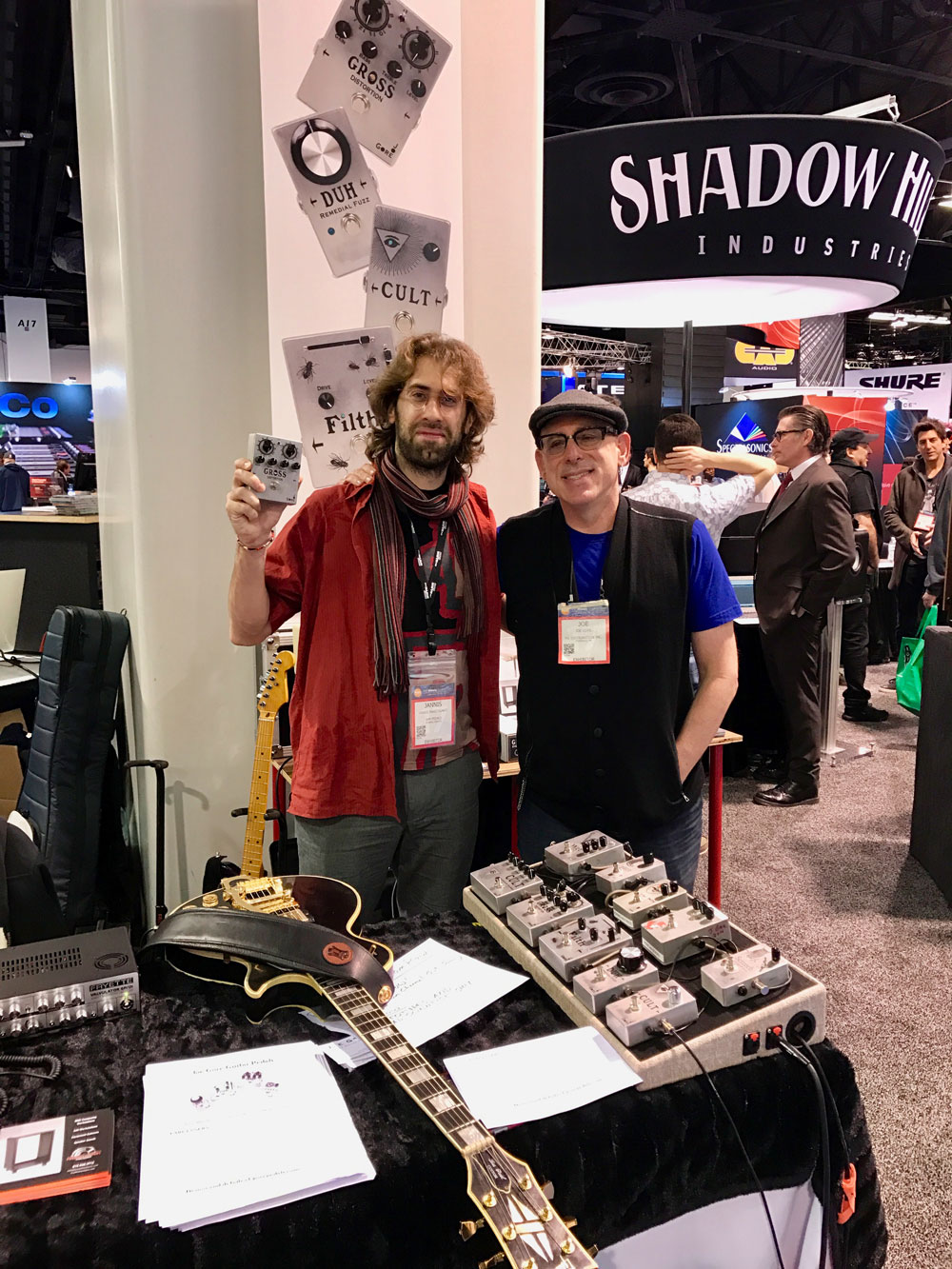
You know what sucks about attending NAMM as a manufacturer rather than a gear writer? I was epoxied to my booth all day, and I barely saw anything other than my guitar pedals. But on one rare break, I got to hang out with Jannis Anastasakis and his crew from JAM Pedals of Athens, Greece. (I highlighted some of their beautiful work in my pathetically skimpy “NAMM report.”)
Happily, there’s more to celebrate here than great visuals. JAM builds lovely versions of many classic analog effects. Their sounds and production quality are stellar, and JAM often adds modern updates such as realtime expression control, extra knobs, and internal trim pots for customizing tones. It’s quality stuff, used by many a guitar star.
And guess what? Jannis loaned me one of his magnificent Custom Shop analog pedalboards. Γαμώτο!
Sadly, I must now pack up and return this pretty pedalboard. But I’ll be getting my own JAM Delay Llama Supreme, an expanded version of the analog delay heard here, with tap tempo, a cool modulation section, and the almighty infinite-hold switch. (I reviewed it for Premier Guitar a few months ago.)
In the meantime, this experience makes me want to try my own DIY pedalboards. Not as an item for sale — just as a way to group related effects in a single enclosure for stage use. Gears are spinning ….
Here’s a new guitar I put together using Warmoth parts and Lollar Gold Foil pickups.
Around the time I started assembling the Resistocaster, I reviewed the cool new Supro Westbury — another guitar with gold-foil pickups — for Premier Guitar. It was an interesting juxtaposition, because the Lollar pickups are cloned from the models in vintage Teisco guitars from Japan, while the nouveau Supro pickups are based on the gold foils made in the ’50s and ’60s by Chicago-based Valco and used in several of the brands the company produced.
While the two sets don’t sound identical, they have much in common. Both provide full-frequency tones, with warm, cushy bass and open-sounding highs. Like vintage lipstick tube pickups, they have an attractively “hollow” character that always reminds me of an acoustic guitar. Gold foils are gorgeous for clean sounds, while overdriven tones are big and buttery, albeit it rather loose-sounding. (Though adding a bass-cut circuit to this guitar let me dial in tighter sounds.)
Another odd property: With almost all pickups, pulling back the guitar’s level cleans up tones on overdriven amps and dynamically responsive distortion pedals. (That behavior is pretty much the entire premise of my Cult pedal demo.)
But with gold foils, that just doesn’t work! As you lower the guitar volume when playing through distortion-producing gear, tones don’t clean up — they get a little quieter, then sputter out in the pot’s lower range. This isn’t intrinsically a good or bad thing, but as a player who tries to exploit the tonal shifts produced by varied guitar output, I was startled by this property.
At NAMM, I mentioned this behavior to Ken Calvet of Roadhouse Pickups, who created the Valco-style gold foils for the new Supros. He nodded in acknowledgement, and said it was due to the idiosyncrasies of the rubber magnets used in gold foils. (I probably wouldn’t understand the science even if he’d had time to explain it to me.)
But while it took me a while to get comfortable with the gold foils’ unusual dynamic behavior, I needed zero time to fall in love with their warm, character-rich tones. (This, by the way, is the same set of gold foils I recently demoed in my alternative Strat pickups video.
I love how this guitar turned out, and I expect to use it a lot this year. 🙂
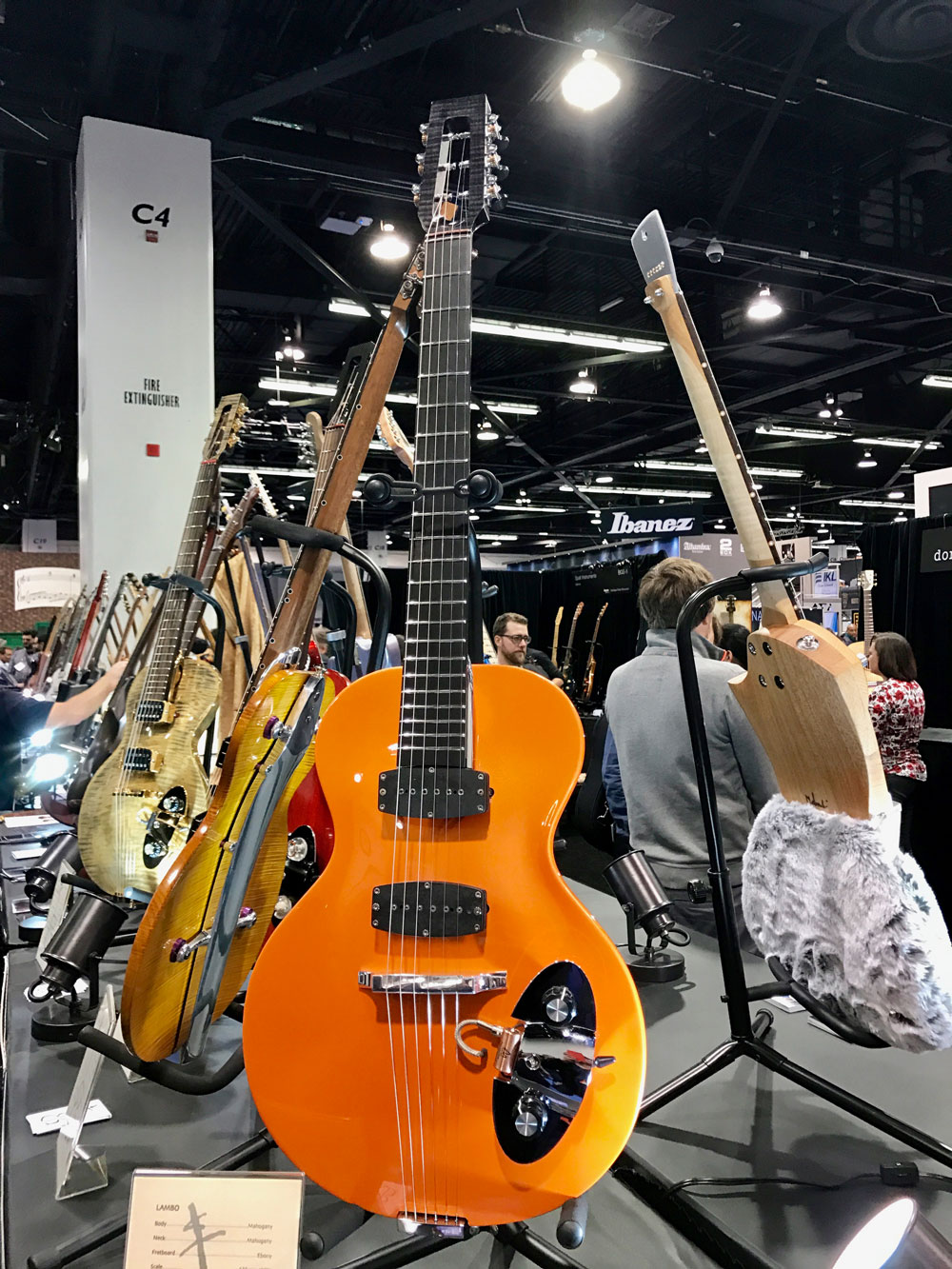
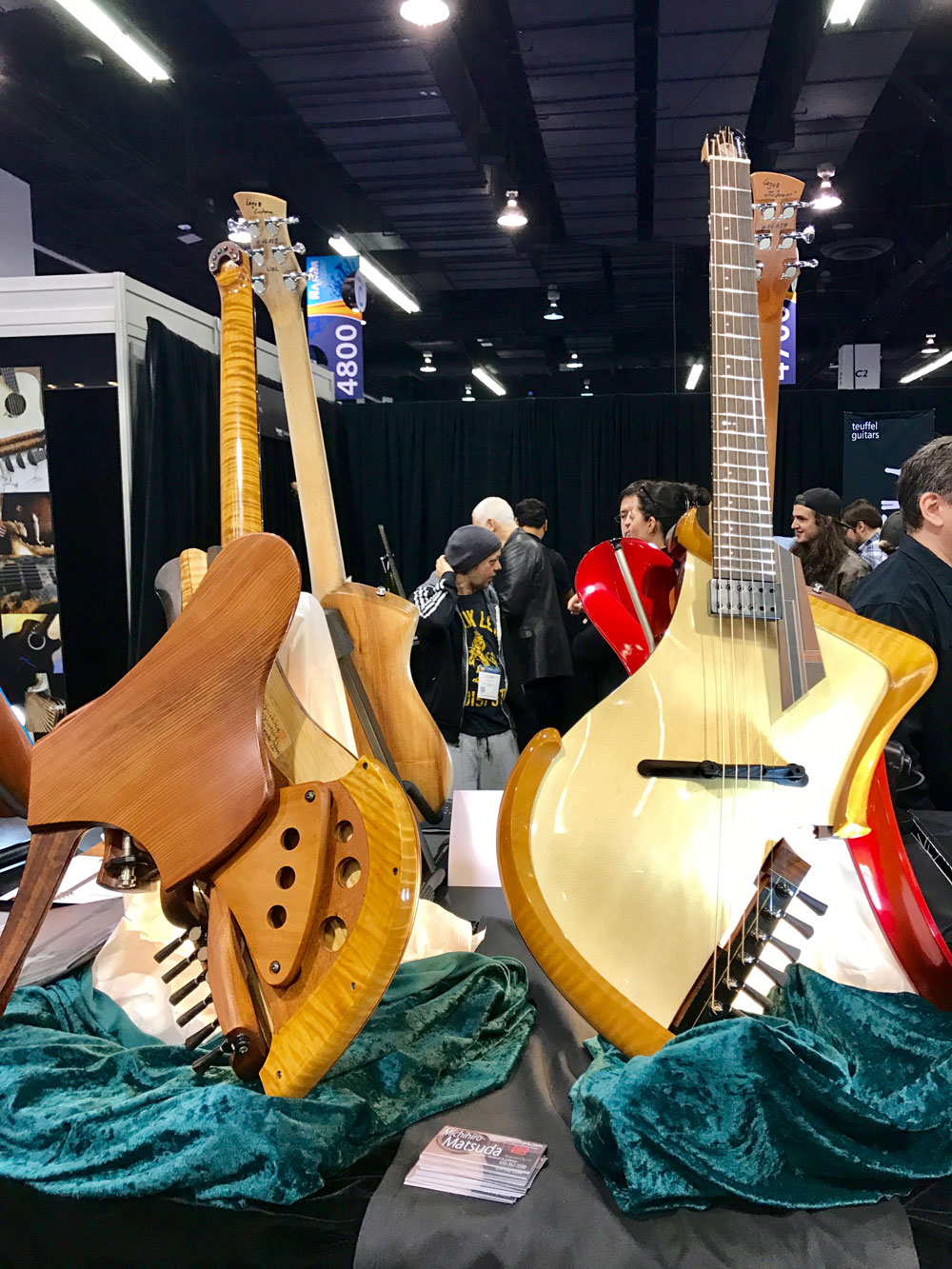
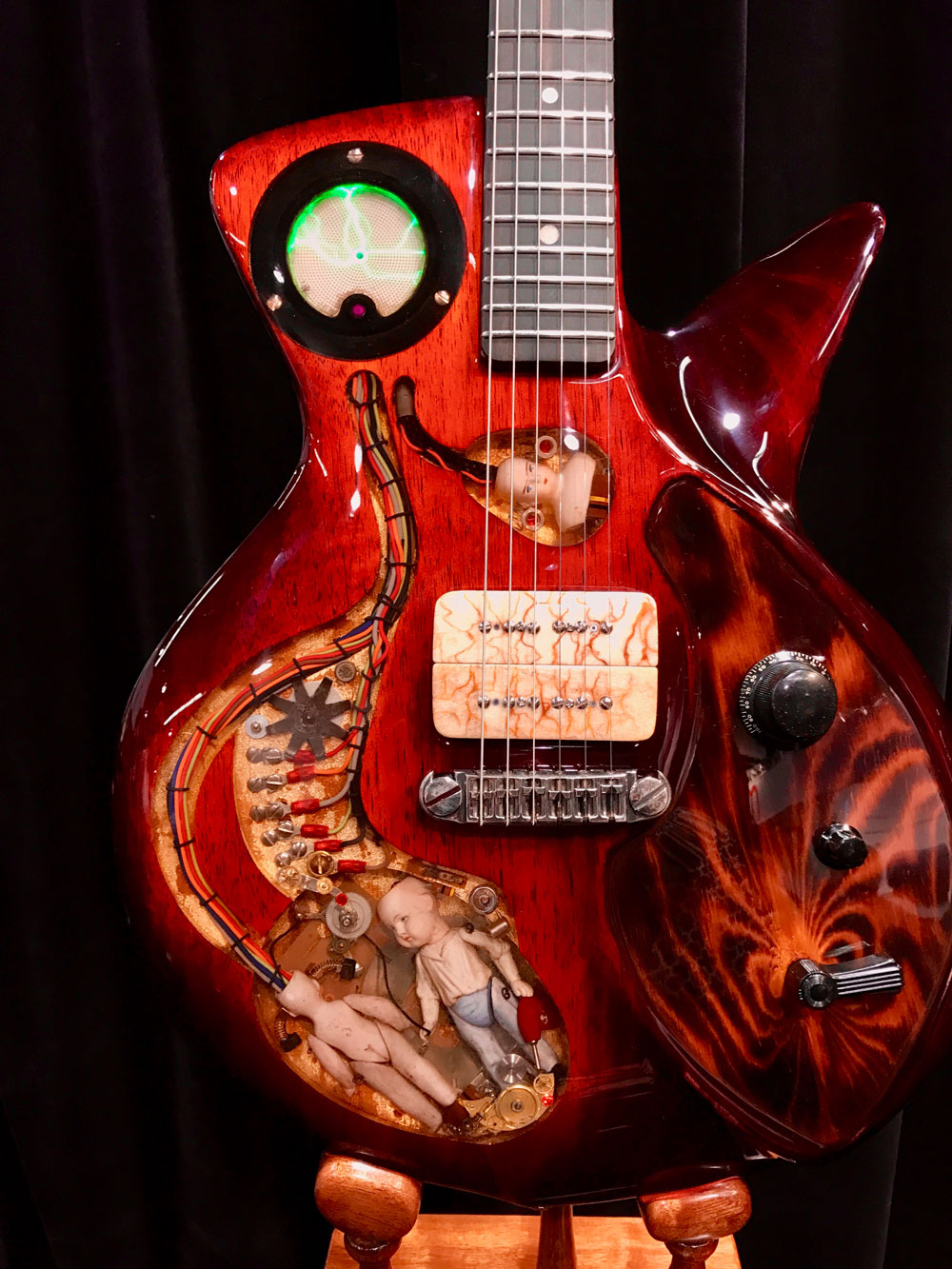
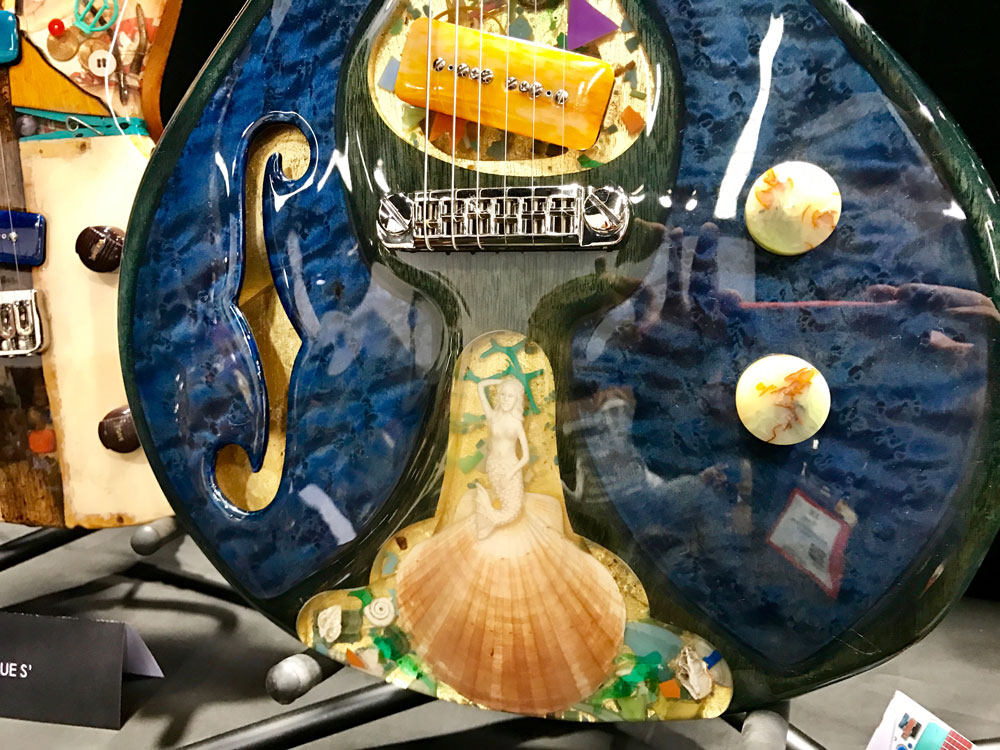
This doesn’t qualify as any kind of NAMM report. I was imprisoned behind the desk at my Gore Pedals booth, relieved only for bathroom breaks and a couple of visits with old friends. Even so, I saw some lovely and inspiring things, especially the visionary instruments at the Boutique Guitar Showcase and the ravishing stompbox visuals from Greece’s JAM Pedals. (JAM pedals sound great too.) Plus a few old friends dropped by. It was so fun, I went minutes at a time without thinking about the inauguration.
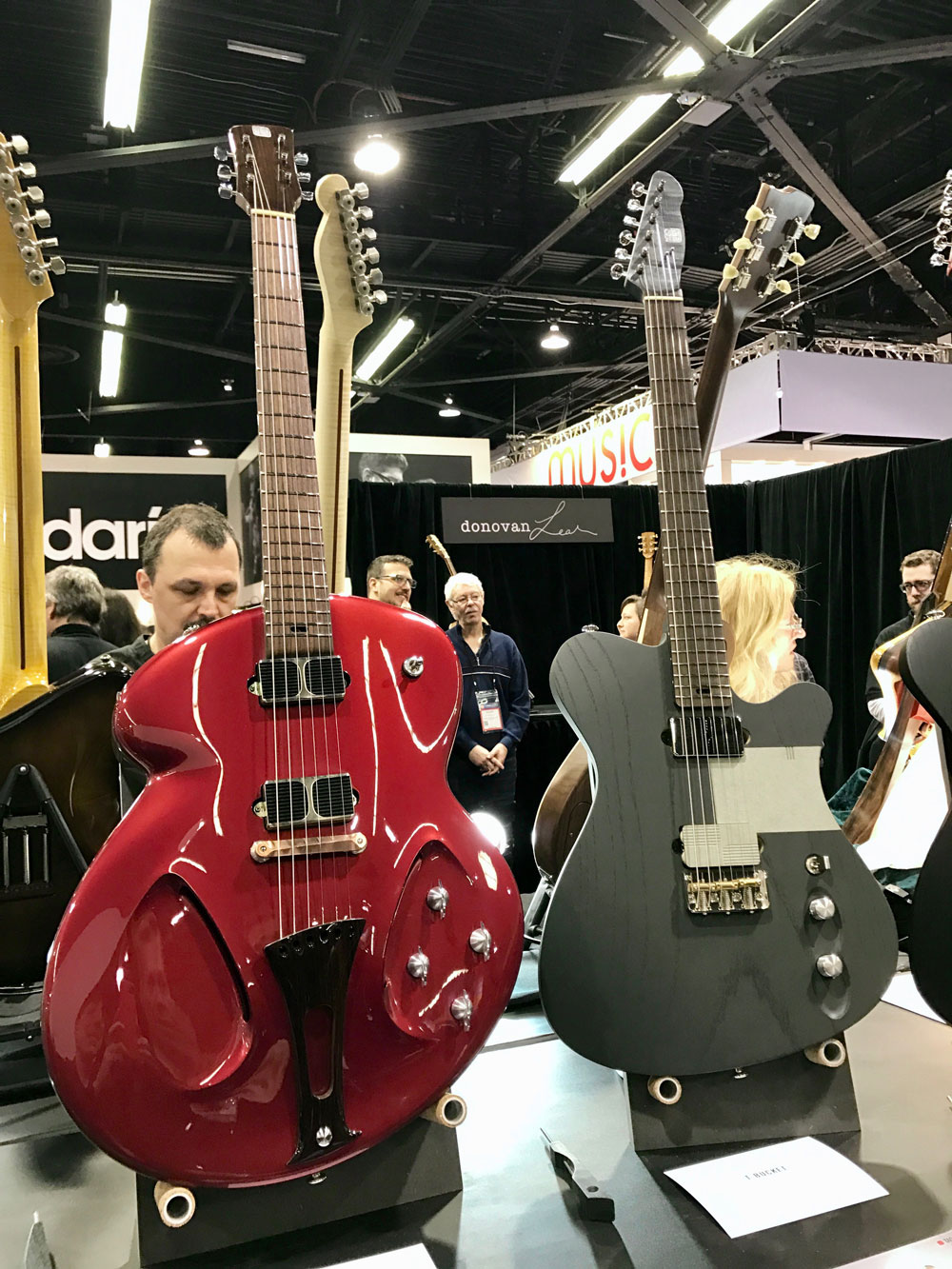
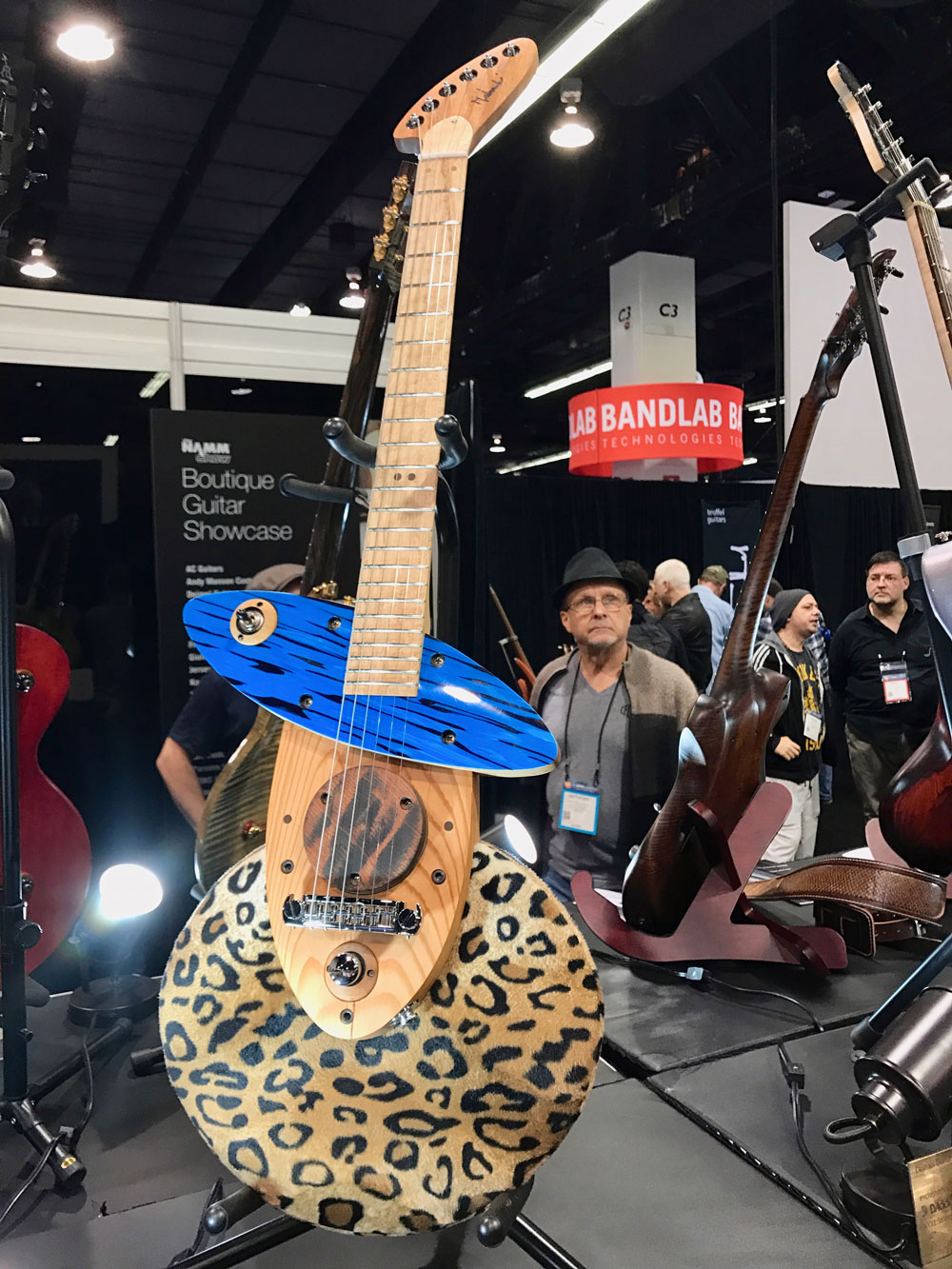
A modernist vision from luthier Pete Malinoski.
Pancake-thin perfection from Venice, Italy’s Di Donato Guitars.
Spalt’s Frankenstein Music Machine, a genuine show-stopper.
Whimsy unchained from Vienna-based luthier Michael Spalt.
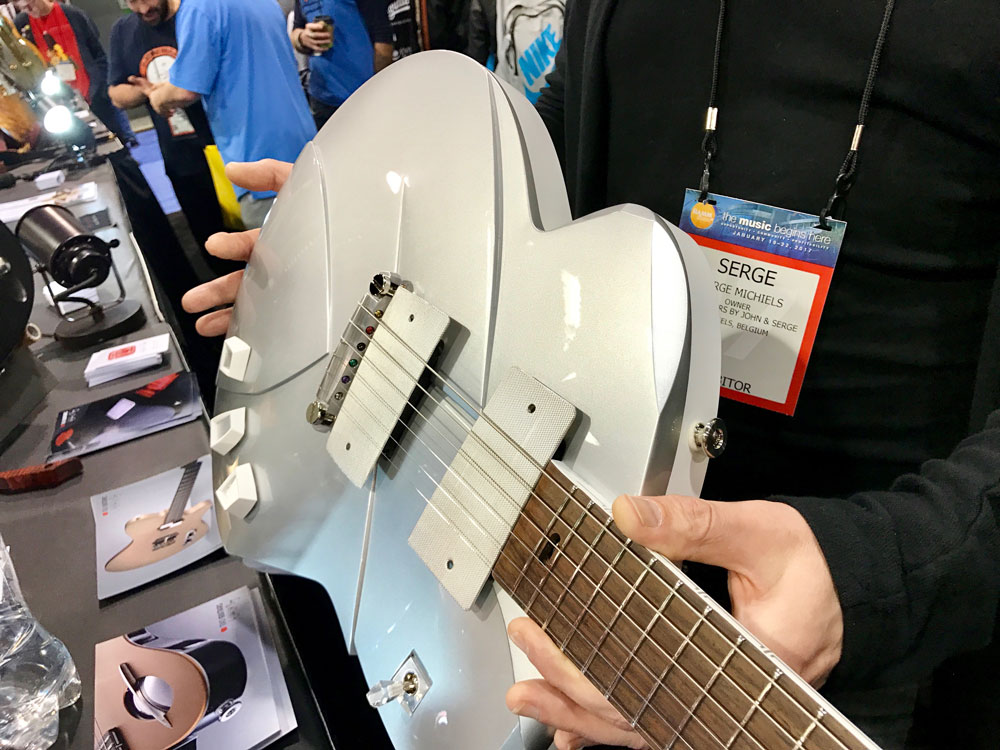
Serge Michaels of Belgium’s TAO Guitars shows off his magnificent Phaeton model.
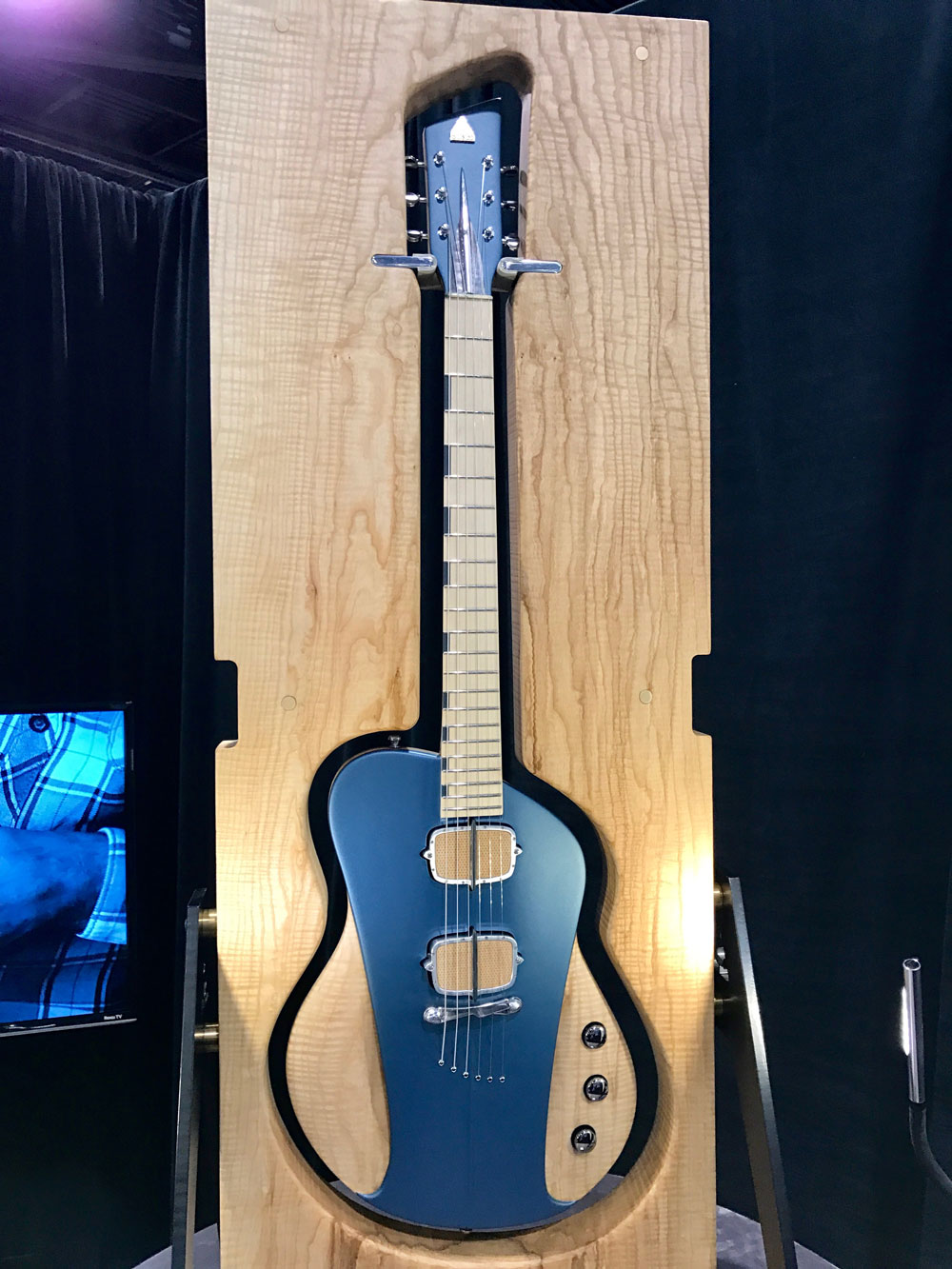
Like its name promises, the One-Piece Master from Sauvage is carved entirely from a single block of wood.
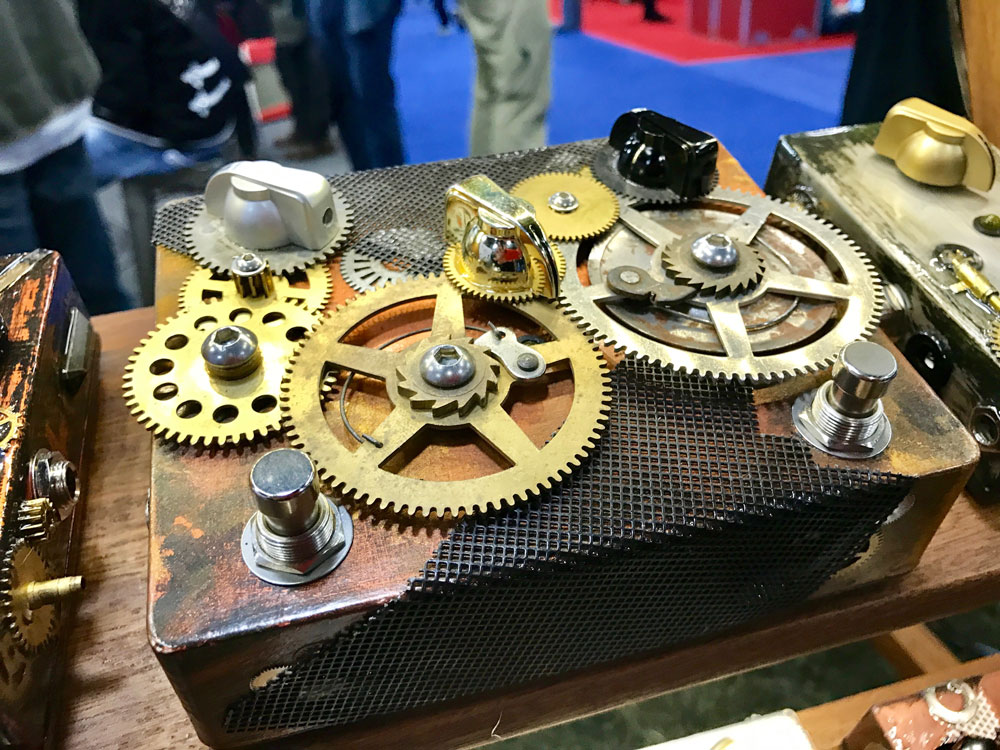
The Antikythera Mechanism of stompboxes from JAM Pedals. Yes, the gears work.
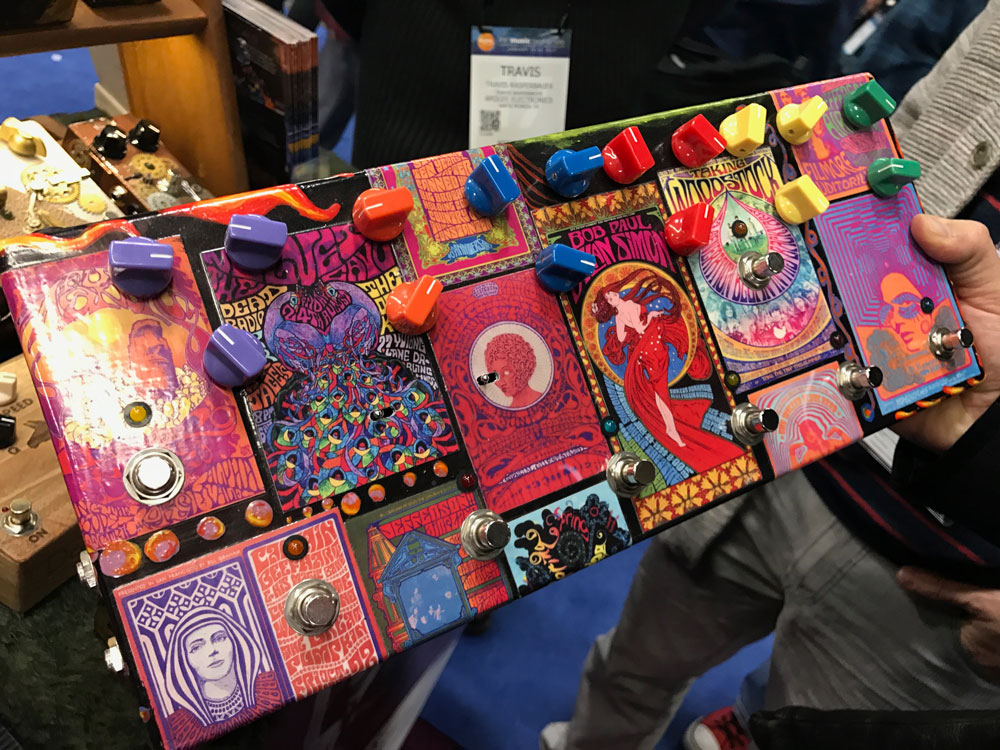
Fillmore poster meets multi-effect board — a lovely thing from JAM Pedals
Jannis Anastasakis, brilliant builder behind Greece’s JAM Pedals.
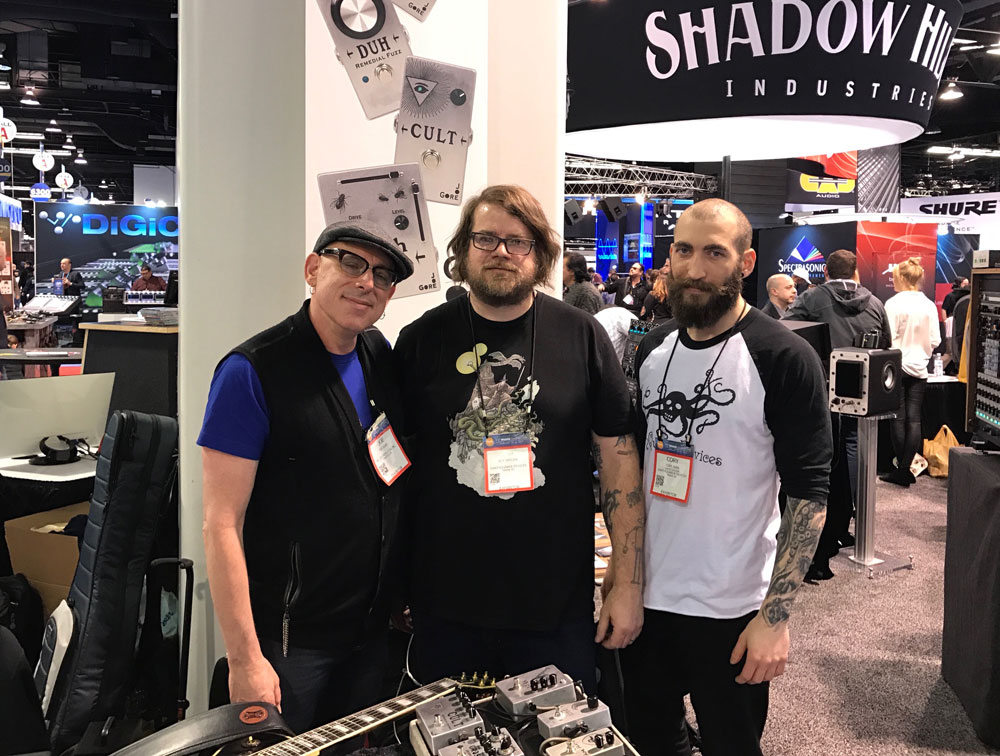
My NorCal crew [L-R]: Xander Soren, the mastermind in charge of music apps at Apple (and a fine player); Talking Head and producer extraordinaire Jerry Harrison; some schnook; engineer, producer, producer, and cool guy Travis Kasperbauer.
It was awesome to meet the guys behind those ever-inventive Earthquaker pedals.
So nice to run into the brilliant Mike Keneally.
Eleven JAM effect in a single integrated pedalboard.
Curves galore from TAO Guitars.
A metallic duo from McSwain Guitars.
A metallic duo from McSwain Guitars.
Jannis Anastasakis of JAM Pedals was kind enough to loan me one of the eye-popping pedalboards from his display (the last image in the slideshow). I’ll be posting a demo here soon!
As threatened, here’s a closer look at Strat with PAF humbuckers used for my recent “God Only Knows” cover. Most parts are from the long-suffering guitar used for all the Mongrel Strat Project experiments. And this one is especially mongrel-ific, with its blend of vintage Fender and Gibson.
Obviously, Gibson pickups is a Strat is far from a new idea. But usually, that arranged marriage is designed to spawn macho, high-gain solos minus the characteristic shrillness of vintage Strat bridge pickups. While many players I love have used humbucker-equipped Strats, I’ve always loathed playing them myself. But what, I wondered, if you didn’t use a hot humbucker, but an über-vintage PAF?
Like many players my age and younger, I was astonished when I first encountered a vintage-voiced humbucker. It was nothing like the dark, over-overdriven tones I associated with the word humbucker. A good PAF is sparkly, resonant, and perfectly capable of gloriously bright and clean tones. Here I used a Seymour Duncan Joe Bonamassa signature set, the same one heard in a more Gibson-like context here.
The results are … compelling. As expected, notes have far more mass than on a conventional Strat, and the bass response is vastly increased. There’s no shortage of top-end either, though the big lows can overwhelm the highs at times. So while I’m pretty much always obsessed with bass-cut controls (especially the high-pass section of the PTB circuit I’ve written about approximately 37 zillion times), it’s especially invaluable in this case. Since lows disproportionately drive distortion, even modest bass cuts clean up the tone and make highs speak more clearly.
I’ve also incorporated the dual-capacitor treble control I wrote about here. It creates a Vari-Tone/ToneStyler effect in a simplified way: Instead of using a clunky rotary switch to choose from a large set of treble-trimming capacitors, it fades between a large cap and a small cap, yielding the same resonant effect as the more complex options. I’ve incorporated this circuit in several guitars now, and it’s still working for me. It’s especially nice here, when paired with a Steinberger JackPot potentiometer, which lets you bypass the entire tone circuit for absolute maximum volume and brightness. I chose the small cap based on the minimum amount I’d ever want to remove from the signal, and the larger one based on the maximum cut I’d use.
I would have included a photo of the project in progress, but I didn’t because I’m embarrassed about how awful it looks inside. I needed to route out the pickup cavities to accommodate these larger pickups. But instead of taking it to a professional, or getting a proper router and learning how to use it, I chipped away with the tiny routing bit on an inexpensive Dremel tool. Do yourself a favor, kids, and don’t follow my lazy-ass example.
But hey, what’s a Strat pickguard for if not to conceal your shoddy workmanship? The guitar looks okay in the end, and I’m digging its sounds, even though it was far harder to get accustomed to than I’d anticipated. I had to recalibrate my right-hand dynamics to prevent treble notes from screeching. I was almost ready to chalk this up as a failed experiment, but after a few days of noodling around, I started to get the hang of it and enjoy the results. I think I’ll keep it this way for a while — or at least until the next Mongrel Strat concept wafts up from the bowels of Hell. 🙂
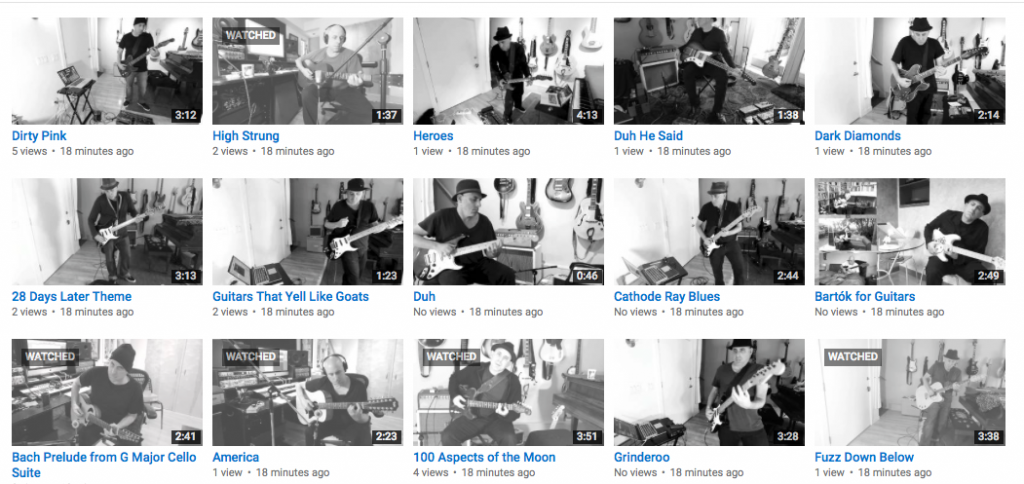
See, I recently finished the 100th video for my YouTube channel. Not quite ready to face the second hundred, I spent a few days reviewing all those clips. Some stuff I’m proud of. Some makes we wince. And I thought a few bits might stand on their own as music, so I plucked my 50 favorite exceprts and posted them as standalone performances, minus such distractions as tech mumbo-jumbo, incessant snark, and color. (But if you are curious about something you hear, note that each clip includes a link to the tech-slanted piece where it originated.)
(Fifty is a lot of videos. Just because I’m repeating myself doesn’t mean it wasn’t hard work!)
If you’re interested in all the above, you’re like me. (Sorry about that!) In that case, you can skip the playlists and just go in through the front door.
I’ve long been obsessed with Sam “The Man” Taylor’s epic sax solo on the Chords seminal 1954 rock ’n’ roll hit, “Sh-Boom.” But I never got around to learning, transcribing, and analyzing it till now. I heard it about 100 times while making and editing this video, and it still thrills me on every listen.
If you’re like me, you know it’s wise to study performances by non-guitarists, but seldom get around to doing it systematically. For once I followed through, and — at risk of sounding like a pedantic dork — I’ve analyzed what I heard and suggested ways to incorporate the concepts in styles far removed from the original doo-wop context.
You can download my transcription (in standard notation and guitar tab) here.
The final part of the video is a rant about how segregation shaped the course of early rock and roll, in which I piss all over the Crew Cuts’ tepid cover version of “Sh-Boom.” (Spoiler alert: It blows.) This was partially inspired by recent despicable comments from musical felon Pat Boone. I’ve linked to the following videos before, but I’m posting them again because the cost of quality music is eternal vigilance against sonic shit-shovelers.
Holy crap! It’s the coolest man in the universe! This foreshadows Hendrix, Prince, and the Beatles. Even lip-synched, it’s everything badass in one minute and 50 seconds. (And it speaks volumes about segregation in midcentury America.)
And then there’s this:
Unholy crap! It’s the least cool man in the universe. And this foreshadows nothing except the worst music of the last 60 years (though it too speaks volumes about race in 20th-century America).
Why beat this dead horse? Why pick on ol’ Pat 60 years after the fact? Maybe he regrets his musical misdeeds. Maybe he’s even developed a more nuanced view of race and racism.
Naw. When self-avowed white supremacist Dylann Roof murdered nine African-American churchgoers on June 17th, 2015, Boone leapt into action, penning an angry editorial that condemned … politicians who dared to refer to the atrocity as “racist.”
FUPB. There’s no statute of limitations on your crimes.

![My NorCal crew [L-R]: Xander Soren, the mastermind in charge of music apps at Apple (and a fine player); Talking Head and producer extraordinaire Jerry Harrison; some schnook; engineer, producer, producer, and cool guy Travis Kasperbauer.](https://tonefiend.com/wp-content/uploads/13.-Smart-Guys-1.jpg)