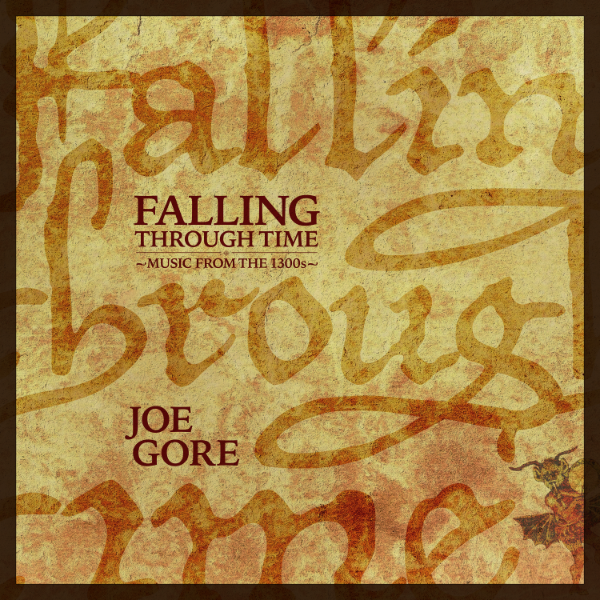
I’ve worked on many projects by many artists, but this is my first release under my own name. And it only took me 50 years!
It’s a back-to-the-roots project for me, though I have some fairly strange roots. When I was a teen I wanted to go into academia, specializing in early music (that is, European classical music from before 1650). Fate choose a different path for me, but I’ve always been fascinated by ancient music, especially the bizarre stuff that emerged toward the end of the Middle Ages. So this is a collection of music composed during the 1300s.
I followed a simple but strict “rule book”: I played only the notes and rhythms the composers specified, but I allowed myself total freedom in applying modern instrumentation and production. (As opposed to when I was young, when my goal, like that of most early music practitioners, was to perform the music as authentically as possible.) The resulting album is surreal, psychedelic, and, for better or worse, unlike anything I’ve ever heard.
This is a digital-only release for now, though I’ll do a vinyl pressing if there’s enough interest.
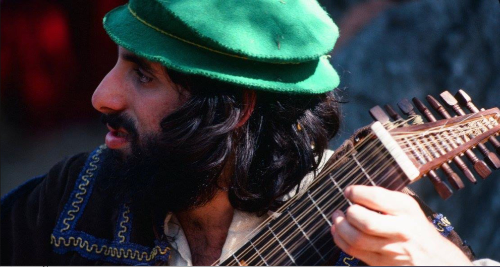
Me at age 17, playing my 15-string lute at — where else? — a Renaissance Faire. Yes, I was a dork even by 1970s standards.
I could say a lot more about the project, but I already did: I created a little booklet with credits, liner notes, background, and lots of amazing 14th-century images. It’s a free download from here:
I’m working on this version of Leonard Cohen’s “Suzanne” as part of album in progress: a collection of radically reinterpreted songs from 1967. I haven’t nailed down the final song list. (If you review the list of amazing songs from that year, you’ll understand why. And that link only cites the songs that charted, and doesn’t include classics like the first Velvet Underground album, some great Jobim tunes, random stuff like “Some Velvet Morning,” and lots more.) By hook or by crook, I hope to have the project done before year’s end in time to cynically capitalize on pay tribute to the 50th anniversary of that musically monumental year.
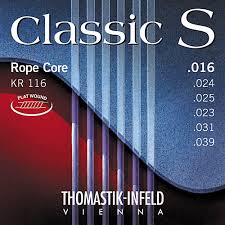
Some interesting tech notes: I’ve you followed this blog, you’re no doubt sick to death of my evangelizing for Thomastik-Infeld rope-core strings. But this is the first time I’ve put them on my Lowden S-25, my main acoustic guitar for nearly 20 years. Its default tone is super loud and bright. (Larry Fishman once referred to it as “a fucking cannon.”) But these days my ears are drawn to darker, softer tones. The Classic S transformed this laser-bright acoustic into an expressive crooner.
Meanwhile, I’ve become a bit alienated from traditional nylon strings over the years, but these, with their hybrid nylon/steel sound, hit just the right sweet spot for me. They’re extremely quiet (though they don’t sound like it when close-miked like this), but they have vast dynamic range and a smooth, sexy feel.
I’d previously written that this set is the same as the (cheaper in the U.S.) John Pearse Folk Series Fingerpicking strings, but I was mistaken. The story I hear was that the late Mr. Pearse, working with Thomastik-Infeld, devised this set for Brazilian guitar monster Bola Sete. But on the current Pearse set, the bass strings have nylon cores, while the Classic S bass strings have steel cores. That means you can use the TI set with a magnetic soundhole pickup, allowing you to plug into amps and effects. (I’ll be posting an example soon as a companion piece to this video.) But both sets sound lovely, and both allow you to bend strings as you would on an electric guitar — something you definitely can’t accomplish on conventional classical strings.
I don’t have a ton to add about the sublime Leonard Cohen. But “Suzanne” has always exerted a deep emotional spell on me — even, as here, minus the lyrics.
I’ve just returned from a vacation to Southern Italy and Sicily. It was a nerdy scholarly tour, with an emphasis on ancient Greek archaeological sites. (There are apparently more and better preserved Greek ruins in Italy and Sicily than on the Greek peninsula.) It was terribly serious — my wife and I spent a lot of time photographing Roman play figurines in front of Greek ruins, adding the occasional dinosaur and Vespa, just to go the extra mile in pursuit of historical accuracy.
This is EXACTLY how it looked 2,400 years ago.
But I had also music on my mind. I can’t go 100 yards in Italy without flashing on some piece of trivia from my college music history days. You can barely turn around without bumping into La Scala or whatever. Nearly every town along the train tracks triggered some music-geek memory. “Lookit,” I’d blurt at my ever-patient wife. “Arezzo! That’s where the most important music theorist of the Middle Ages invented staff notation and conceived the Guidonian Hand!” (If you’re ever forced to travel with me, bring snug-fitting, noise-cancelling headphones.)
I’d been to Sicily a couple of times before, but only to Taormina and Siracusa in the east. This time we started in Palermo. (Man, I love that city! So vibrant, funky, and delicious.) We then worked east, stopping at one Greek or Roman ruin after another. My favorite, I think, was Selinunte, a vast city of 30,000 until those Ba’al-worshippin’ Carthaginians trashed the place around 400 B.C. The peak population was triple that of Pompeii (which I also just visited for the first time), but unlike those ruins, Selinunte is nearly tourist-free, and you can freely clamber over and through the remains of ancient homes.
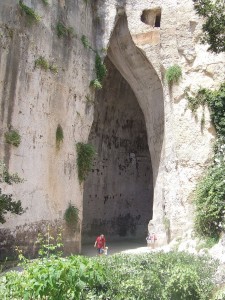
The Ear of Dyonisius—or Spock? (Creative Commons photo by Laurel Lodged)
When we arrived at Siracusa, I had a mission: When I first visited some 35 years ago, I was, like most visitors, awed by the remarkable echoes within the Orecchio di Dionisio (“Ear of Dionysius”). This tall, narrow, S-shaped grotto is part of the limestone quarries into the hillside behind Siracusa’s famed Greek theater. which is also chiseled into solid limestone. The space produces a remarkable echo, a series of strong, clear slapbacks that melt into moist-sounding reverberation.
On this visit, I was armed to capture the sound as an impulse response so I could mimic the effect in software. I carried a small digital recorder and (on the advice of blog reader Shizmab Abaye, in reply to my last attempt to capture historic ambience) an old-fashioned clipboard with a spring loaded clip.
(I’ve written about impulse responses before. In a nutshell: You record a percussive sound in an ambient space, and then process the recording in software so that you can mimic the ambience after the fact—for example, make it sound like you’re playing guitar in an ancient limestone cavern. How does it work? Easy—magic!)
However, your recording needs to be as free of other noises as possible. When we got to the grotto, it was full of tourists, one of whom was singing.
It sounded beautiful. I felt like a shit for just wishing he’d shut up. He eventually did. When the cavern grew relatively quiet, I started snapping the clipboard and recording.
A week or so later I was back in the studio. I scoured the recordings for the clearest clipboard snaps with the least background noise, and dropped the resulting files into an IR reverb plug-in. (I used both Audio Ease’s Altiverb and Space Designer, the convolution reverb included with Apple’s Logic Pro.) I got the best result from a snap recorded about 10 feet from the clipboard. Here’s how it sounded when applied to a couple of spooky guitars (low-tuned classical and a Dobro played acoustically with EBow.)
It’s not a precise replica of the space (even a touch of background noise compromises the results), but it’s a cool, eerie reverb that definitely doesn’t sound like some factory preset.
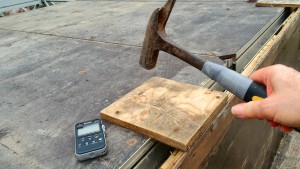
Someone left this hammer just SITTING here! It’s like leaving a loaded gun where a monkey can grab it.
I also snagged some other evocative IRs. In Taormina, we visited the Greco-Roman theater. (I’d played a gig there with Tracy Chapman in 2006. It was amazing to perform on that ancient stage with Mt. Etna looming in the background! We stayed an extra day, and that evening Italy won the World Cup. The rioting that night put to shame the meager outpouring of emotion in my neighborhood when our local baseball franchise wins the World Series.)
Naturally, I’d forgotten my clipboard on my recent visit, but they were dismantling the performance stage at the end of the concert season, and some worker conveniently left a hammer and some planks just lying around. I tried capturing the reverb as heard from the stage, plus a stronger echo in one of the side archways providing access to the stage and seats.
Finally, a not-so-ancient ambience: In Sorrento we stayed at the Hotel Tramontano, a fusty, old-school place with a remarkable history. It was a regular stopping point on the 19th-century Grand Tour. Prior guests included Byron, Shelley, and Keats. Ibsen wrote Ghosts while camping out there. Ernesto de Curtis even composed that sodden Italian restaurant warhorse “Torna a Surreinto” while lounging on the clifftop balcony. (You may know the tune as Elvis Presely’s “Surrender.”) Amazingly, I was in this beautiful tourist town for three days and didn’t hear it once. Life can be kind.
Anyway, I captured a spooky reverb in one of the stairwells.
Besides having a couple of new sound design tools, I’ve also got unique souvenirs: Mediocre sound recordings to counterpoint all my mediocre photos!
Got an IR reverb plug-in? Want to try these out? Download them for free here. Then just drop them into your IR ’verb of choice.
I’d like to call out several items of interest in the November issue or Premier Guitar. The first one is personal: As head honcho Shawn Hammond mentions in his monthly editor’s letter, I’m changing roles at the magazine. After two years as a part-time senior editor, I’m going part-part-time as a contributing editor.
It was a tough call for me — it was a fun gig working with awesome people on subjects I love. But I’ve felt an increasing need to dedicate more time to my own projects: playing, recording, writing, developing gear, and trying to make my tonefiend.com blog and YouTube channel seem a bit livelier than something you’d encounter at Urban Ghosts. (It’s one of my favorite websites, but not the attitude I’m aiming for here.)
If you’ve enjoyed the articles I’ve contributed to PG, well, first of all, thanks! And second, note that I’ll actually be contributing more columns and reviews than before. That may sound contrary to the laws of physics, but it’s possible because I will no longer be editing material by other writers. (I’d been processing an average of 35 stories per month in addition to my bylined pieces.) Picking up the slack will be new hire Ted Drozdowski, a fine writer and player, a lovely guy, and one of the music journalists I looked up to when I got into the guitar mag racket decades ago. (Ted was part of the now-legendary Musician magazine of the ’80s and ’90s.) Meanwhile, I’ll be contributing my Recording Guitarist column and at least three major gear reviews per issue.
Also in the issue are several tech-oriented pieces that I found particularly interesting. My old pal Frank Falbo — a leading pickup designer and master luthier — contributed a great piece on pot and capacitor substitutions. More than anything I’ve read, Frank’s article nails down exactly what changes to expect when swapping out part values, documented via audio files.
For me, the most fascinating part is how varying tone-pot values change your guitar’s tone, even when the tone knob is wide-open. Yeah, a lot of us would expect some change, because pots of varying resistances exert different loads on your pickups. But as far as I know, no one has ever nailed down the exact differences the way Frank has.
Others generalize. Frank Falbo nails it down.
Spoiler alert: The differences are massive — it’s a far bigger deal than I’d always assumed. Check out Frank’s first set of sound clips and prepare to be impressed.
It’s not a new idea that you can shift the overall tone of a guitar “bright-ward” or “dark-ward” by swapping pots, but Frank makes explicit how dramatic such changes can be, and what to expect from the likeliest substitutions.
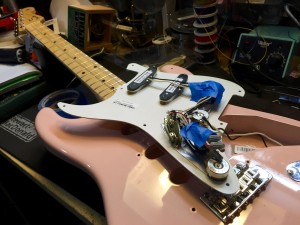
I also learned much from two articles I wrote. The first is a shootout between five sets of ultra-vintage-style Strat replacement pickups, featuring models by Amalfitano, Fender, Klein, Manlius, and Mojotone. (Spoiler alert #2: They all sound pretty great, though the Kleins and Mojotones were my personal faves.)
I only realized after evaluating tones that the two sets I loved most don’t deploy a hotter pickup in the bridge position, while the other three do. (I don’t mean some blazing-hot bridge pickup, but one just a tasteful tad louder than the others, an approach many Strat players seem to love.) In the Klein and Mojotone sets, the middle pickup is loudest. Food for thought.
There are good reasons why few guitar mags run serious pickups reviews, and almost never compare models directly: It’s labor-intensive, and it’s damned hard to establish a level playing field. Here, I tried to remove as many variables as possible, installing all the pickups in the same test guitar, scrupulously measuring everything from pickup height to mic position, and laboring mightily to create identical demo performances for each set. My favorite part appears on the final page of the article, where you can directly compare each pickup from each manufacturer side-by-side.
This poor pink Strat got one hell of a workout.
Finally, you might find interesting the audio clips in my latest Recording Guitarist column. It’s about is direct recording, a topic I’ve been covering since this blog began. I got cool sounds using a JHS Colour Box (a dumbed-down Neve channel in stompbox form) and especially with the Neve preamp simulations in the latest Universal Audio software. I’m hardly the first to point this out, but wow! Some recent plug-ins are so stupefyingly realistic that they can mimic analog gear pushed to extremes — a longstanding weak link in faux-analog plug-ins. I found it easy to create cool and compelling sounds without amps or amp simulators. Let me know what you think.
Okay, now I’m nodding off from jet lag. I just returned from a two-week trip to Italy, which generated some interesting musical thoughts and discoveries that I’ll share here soon. 🙂
Premier Guitar just posted my column on simultaneously recording multiple amps to create cool composite tones, both by blending their default sounds in varying way, or using only selected frequency “slices” from each amp and assembling them in layers (hence the amp sandwich metaphor).
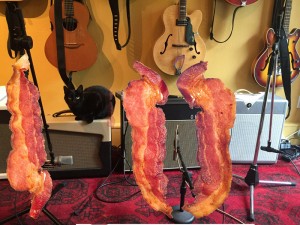
According to one PG reader, “It ain’t a sandwich without bacon.” So I Photoshopped in a few slices. :pacman:
What happens when you mix Fender-style Carr highs, Marshall lows, and tweed-like Divided by 13 mids? It sounds something like this.
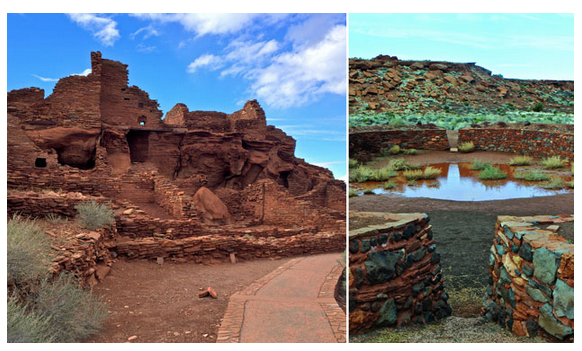
Premier Guitar just posted my latest Recording Guitarist column. The subject: Capturing the haunting reverbs of Southwestern ruins via impulse-response reverbs.
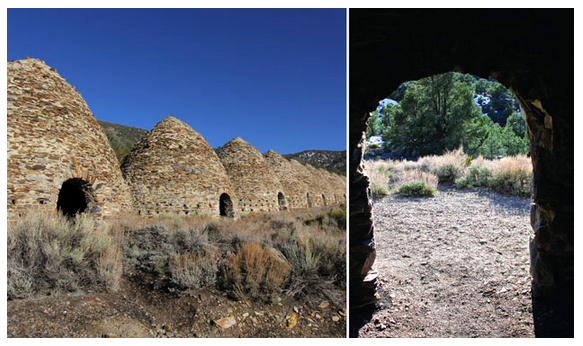
Many years ago I marveled at the eerie reflections within the stone-walled ball court at Wupatki, an hour north of Flagstaff, Arizona. On this visit, I attempted to clone the tone. I did the same at the Wildrose charcoal kilns in a remote, mountainous corner of Death Valley. The article includes audio clips, tech notes, and a download link for the impulse responses, suitable for use in any IR reverb program (or in the Logidy EPSi stompbox).
The 1870s charcoal kilns of Death Valley generate a spooky,, flange-like reverb.
Like a dope, I’d forgotten to bring the relatively high-quality recorder I’d intended to use, so I worked with noisy, lo-fi recordings from my iPhone 6’s Voice Memos app. After some digital cleanup (detailed in the article), the results were cool and compelling, though not a completely accurate audio snapshot due to various types of distortion.
(Actually, I had an earlier experience capturing quick-and-dirty reverbs when I visited the Neolithic caves of France and Spain last year. It wasn’t my idea—I just happened to wind up on a tour group with composer Craig Safan, who was conceptualizing a piece inspired by those evocative spaces. He’d packed a proper Zoom mobile recorder, and we made ad hoc impulse responses by clacking small stones together. Craig has since completed the work, Rough Magic, and he tells me his mixing engineer wound up using our IRs a great deal. I’ve heard the piece, and it’s awesome. It’s not public yet, but I’ll tell you when it is.)
Since writing this Premier Guitar piece, I’ve been pondering whether damaged/distorted impulse response files might be an interesting avenue for sonic exploration. Generating cool sounds via weird IRs isn’t a new idea—the Space Designer plug-in in Apple’s Logic Pro includes a little-known IR preset folder titled “Warped,” which uses unusual sources like synth tones and noise bursts to generate reverbs not found in nature. But my interests are reverbs that are both familiar and surreal—the echoes of distorted reality.
And coincidentally, just as I was writing this post, a friend sent this wonderful video: an old Teletubbies clip, processed through a smeary, distorted black-and-white filter and paired with Joy Division’s “Atmosphere.”
I’m pretty much talking about an audio equivalent to that video processing. Has anyone else thought about or explored this idea?
Premier Guitar just posted my latest recording column. It focuses on the “Multitrack Masters” recordings and other illicitly leaked audio files that deconstruct classic rock recordings into separate tracks with each instrument isolated.
This essential listening is thought-provoking for many reasons. The two that fascinate me most are a) what secrets these recordings reveal about the craft behind great rock records, and b) how they highlight some of the back-assward notions that underlie our laws governing copyright and intellectual property. I think it’s fascinating stuff, and I hope you agree!
Have you guys investigated any of this material? What are your observations?
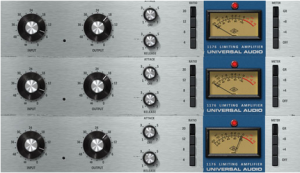
Using a variation on a technique borrowed from engineer Michael Paul Stavrou’s cool recording technique book, Mixing with Your Mind, I start with extreme settings that make it easy to hear the compressor’s effect, and then back the processing down to realistic levels.
If you ever find yourself twiddling those inscrutable knobs while remaining unclear exactly what, if anything, is changing, this case study may clarify the process. I hope it’s helpful! :pacman:
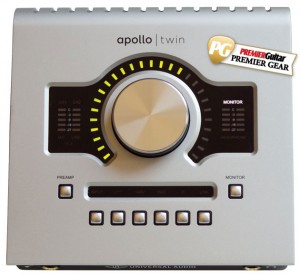
A rackmount Apollo interface has been the core of my studio for two years, replacing both a Pro Tools HD rig and a complicated Apogee setup. I adore Apollo’s great-sounding preamps, lucid interface, and innovative software, which, among other things, lets you track through simulated preamps on your way into your DAW. Also, UA’s analog modeling is second to none. (You hear their reverbs and tape simulations on most of the stuff I’ve recorded for this site.)
The intensity of my Apollo love is rivaled only by my scorn for the crappy mobile interfaces I’ve previously used with my live laptop rig. The problem isn’t audio quality — even the cheapest ones can sound surprisingly decent — so much as lousy ergonomics and flimsy construction. I’ve burned through half a dozen interfaces in the last few years. They just aren’t built to last onstage. Or anywhere else.
That’s why I’m so stoked to have the small-format Apollo on my digital pedalboard. It’s built well. The UI is brilliant. There are no horrid breakout cable octopi. It has the same preamps and processors as the rackmount Apollo. And I have access to my favorite UA plug-ins, including the juicy EMT plate reverb simulations, the stellar tape echo models, and a suite of low-latency virtual preamps. It’s pricy for a mobile interface: $700 for the single-processor model and $900 for the dual-processor model. But I’d spent far more than that on self-destructing junk that I wound up giving away or recycling.
Anyone else tried Apollo in its various formats? Or any other cool converters? Your observations, please?
I had a lot of fun putting together an article for Premier Guitar on using non-tube distortion. It features a smorgasbord of digital tones guaranteed to horrify tube purists. (It’s certainly horrifying a few commentators on PG‘s Facebook page.)
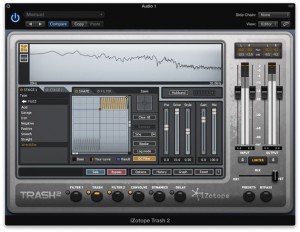
iZotope’s Trash 2 — like version 1, only trashier!
It was also a chance for me to explore iZotope’s Trash 2, on the recombination of my ol’ pal Jeff Cross, who is one of the most super-genius of the super-genius audio guys I’ve worked with at Apple. I was a fan of the first version of Trash, though I didn’t have the opportunity to use it a lot. This generation is even cooler, and seems to focus less energy on conventional amp modeling than on being a wild and open-ended distortion-designing tool. I’ll definitely be spending some more time with this! I also enjoyed playing with FXpansion’s Maul, which covers much similar territory.
Have any of you guys played with some of these digital distortion-designer tools? Any observations?