Categories
Digital Effects guitar

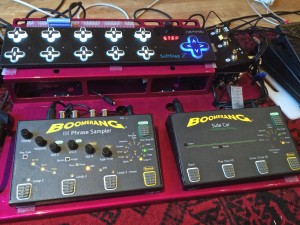
My New Live Looping Rig: Total “Faylor”

I haven’t posted any new video in months and months. It’s not just laziness or business, though I suffer from both. I’ve just been locked away in my studio, trying to create a new live looping system.

I still haven’t nailed it down, so I’m not going to get into a complete run-down yet. But here are the basic ideas.

I’ve moved from a hardware looper to software looping. When I started this godforsaken looping project years ago, I’d just finished a lot of work on Apple’s then-new MainStage software. At the time, the program’s looper simply wasn’t reliable enough for live performance. Also, my intense signal processing was pushing my MacBook Pro to its limits. But since then, the program has gone through many upgrades. Meanwhile, after years of relative stagnation, Apple finally issued a major MacBook Pro upgrade in 2017. Between the more powerful computer and the refined software, I could finally shift looping and signal processing to the computer. Yeah, there are a couple of disadvantages. For one thing, MainStage’s looper lacks a “copy” function, something I’ve come to rely on a great deal in my arrangements. But it sure is nice not having to run the entire mix through the relatively cheap hardware looper convertors — just the snazzy ones in my Apollo interface. (Of course, now that I’ve transitioned, Electro-Harmonix has just announced a compelling-looking 6-track looper. I’ll have to check that out…)

I’ve put aside for now the Fishman TriplePlay MIDI pickup. I have no complaints about TriplePlay, which is far and away the best MIDI pickup ever created, and a product I recommend without reservation. But I wanted to be free from the hardware setup. This way, I can plug in any guitar, any time. (I’ve been experimenting with acoustic looping — more on that soon.) I’m still using MIDI sounds, but again, it’s all in software via Jam Origin’s brilliant MIDI Guitar plugin. It works incredibly well without a MIDI pickup, but it’s not nearly as fast as TriplePlay. It’s fine for doubling, or for melodic and textural stuff, but it’s just not speedy enough to play MIDI drums at even moderate tempos. Which bring me to the other big departure …

I confess: I’m playing to a drum machine. I’m triggering and changing patterns using a KMI !2 Step foot controller. I really wrestled with this decision. I loved the idea of using no machine tempos — it all came from the hands. But at some point I realized that the main reason I was committed to that approach was for bragging rights: “No prerecorded tracks, and no machine rhythms” I could boast. But who cares except geeks like me? Anyway, I still have misgivings about the change, but I’m going with it for now. I think that means, though, that I’ll create more arrangements without percussion, just so I’m not locked to the machine for an entire set.

Meanwhile working with a tempo clock lets me do fun stuff with synchronized effects. I’m especially besotted with Sugar Bytes’s Effectrix, a mind-bending multi-effector that lets you activate and edit effects on a note-by-note basis. You hear it a lot in the “solo” in this video.

I’ve played a few shows with the new setup. The first one was flawed but promising. The second was an unmitigated disaster. Then I doubled up on practicing and (not kidding) started meditating again, which helped a lot. Last time I tried this live, it went really well! We’ll see how it goes at my gig this week.

Anyway, it’s still a work in progress. I’ll keep the curious updated.

I played this cover tune with no irony whatsoever. I love the original.

Categories
Digital Effects Recording

Echoes of Ancient Greece

I’ve just returned from a vacation to Southern Italy and Sicily. It was a nerdy scholarly tour, with an emphasis on ancient Greek archaeological sites. (There are apparently more and better preserved Greek ruins in Italy and Sicily than on the Greek peninsula.) It was terribly serious — my wife and I spent a lot of time photographing Roman play figurines in front of Greek ruins, adding the occasional dinosaur and Vespa, just to go the extra mile in pursuit of historical accuracy.

IMG_4841
This is EXACTLY how it looked 2,400 years ago.

But I had also music on my mind. I can’t go 100 yards in Italy without flashing on some piece of trivia from my college music history days. You can barely turn around without bumping into La Scala or whatever. Nearly every town along the train tracks triggered some music-geek memory. “Lookit,” I’d blurt at my ever-patient wife. “Arezzo! That’s where the most important music theorist of the Middle Ages invented staff notation and conceived the Guidonian Hand!” (If you’re ever forced to travel with me, bring snug-fitting, noise-cancelling headphones.)

I’d been to Sicily a couple of times before, but only to Taormina and Siracusa in the east. This time we started in Palermo. (Man, I love that city! So vibrant, funky, and delicious.) We then worked east, stopping at one Greek or Roman ruin after another. My favorite, I think, was Selinunte, a vast city of 30,000 until those Ba’al-worshippin’ Carthaginians trashed the place around 400 B.C. The peak population was triple that of Pompeii (which I also just visited for the first time), but unlike those ruins, Selinunte is nearly tourist-free, and you can freely clamber over and through the remains of ancient homes.

The Ear of Dyonisius—or Spock? (Creative Commons photo by Larel Lodged)
The Ear of Dyonisius—or Spock? (Creative Commons photo by Laurel Lodged)

When we arrived at Siracusa, I had a mission: When I first visited some 35 years ago, I was, like most visitors, awed by the remarkable echoes within the Orecchio di Dionisio (“Ear of Dionysius”). This tall, narrow, S-shaped grotto is part of the limestone quarries into the hillside behind Siracusa’s famed Greek theater. which is also chiseled into solid limestone. The space produces a remarkable echo, a series of strong, clear slapbacks that melt into moist-sounding reverberation.

On this visit, I was armed to capture the sound as an impulse response so I could mimic the effect in software. I carried a small digital recorder and (on the advice of blog reader Shizmab Abaye, in reply to my last attempt to capture historic ambience) an old-fashioned clipboard with a spring loaded clip.

(I’ve written about impulse responses before. In a nutshell: You record a percussive sound in an ambient space, and then process the recording in software so that you can mimic the ambience after the fact—for example, make it sound like you’re playing guitar in an ancient limestone cavern. How does it work? Easy—magic!)

However, your recording needs to be as free of other noises as possible. When we got to the grotto, it was full of tourists, one of whom was singing.

It sounded beautiful. I felt like a shit for just wishing he’d shut up. He eventually did. When the cavern grew relatively quiet, I started snapping the clipboard and recording.

A week or so later I was back in the studio. I scoured the recordings for the clearest clipboard snaps with the least background noise, and dropped the resulting files into an IR reverb plug-in. (I used both Audio Ease’s Altiverb and Space Designer, the convolution reverb included with Apple’s Logic Pro.) I got the best result from a snap recorded about 10 feet from the clipboard. Here’s how it sounded when applied to a couple of spooky guitars (low-tuned classical and a Dobro played acoustically with EBow.)

It’s not a precise replica of the space (even a touch of background noise compromises the results), but it’s a cool, eerie reverb that definitely doesn’t sound like some factory preset.

IMG_4852
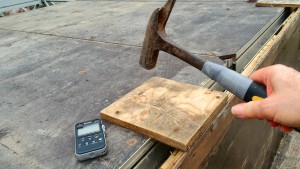
Someone left this hammer just SITTING here! It’s like leaving a loaded gun where a monkey can grab it.

I also snagged some other evocative IRs. In Taormina, we visited the Greco-Roman theater. (I’d played a gig there with Tracy Chapman in 2006. It was amazing to perform on that ancient stage with Mt. Etna looming in the background! We stayed an extra day, and that evening Italy won the World Cup. The rioting that night put to shame the meager outpouring of emotion in my neighborhood when our local baseball franchise wins the World Series.)

Naturally, I’d forgotten my clipboard on my recent visit, but they were dismantling the performance stage at the end of the concert season, and some worker conveniently left a hammer and some planks just lying around. I tried capturing the reverb as heard from the stage, plus a stronger echo in one of the side archways providing access to the stage and seats.

Finally, a not-so-ancient ambience: In Sorrento we stayed at the Hotel Tramontano, a fusty, old-school place with a remarkable history. It was a regular stopping point on the 19th-century Grand Tour. Prior guests included Byron, Shelley, and Keats. Ibsen wrote Ghosts while camping out there. Ernesto de Curtis even composed that sodden Italian restaurant warhorse “Torna a Surreinto” while lounging on the clifftop balcony. (You may know the tune as Elvis Presely’s “Surrender.”) Amazingly, I was in this beautiful tourist town for three days and didn’t hear it once. Life can be kind.

Anyway,  I captured a spooky reverb in one of the stairwells.

Besides having a couple of new sound design tools, I’ve also got unique souvenirs: Mediocre sound recordings to counterpoint all my mediocre photos!

Got an IR reverb plug-in? Want to try these out? Download them for free here. Then just drop them into your IR ’verb of choice.

Categories
Digital guitar Music Technique

Less-Boring Looping (“Pumped-Up Kicks” Cover)

For a while I’ve been playing this loop-based cover of Foster the People’s “Pumped-Up Kicks” at solo gigs and with my duo band, Mental 99. At risk of sounding like a pompous dick, I’ve annotated the performance, highlighting techniques I’ve found useful for making loop-based performances livelier and less predictable.

I’ve covered some of this ground before, particularly in this Premier Guitar looping-technique article. But here I call out the techniques mid-performance, and I’ve included a few new ones. I hope you find some of them useful.

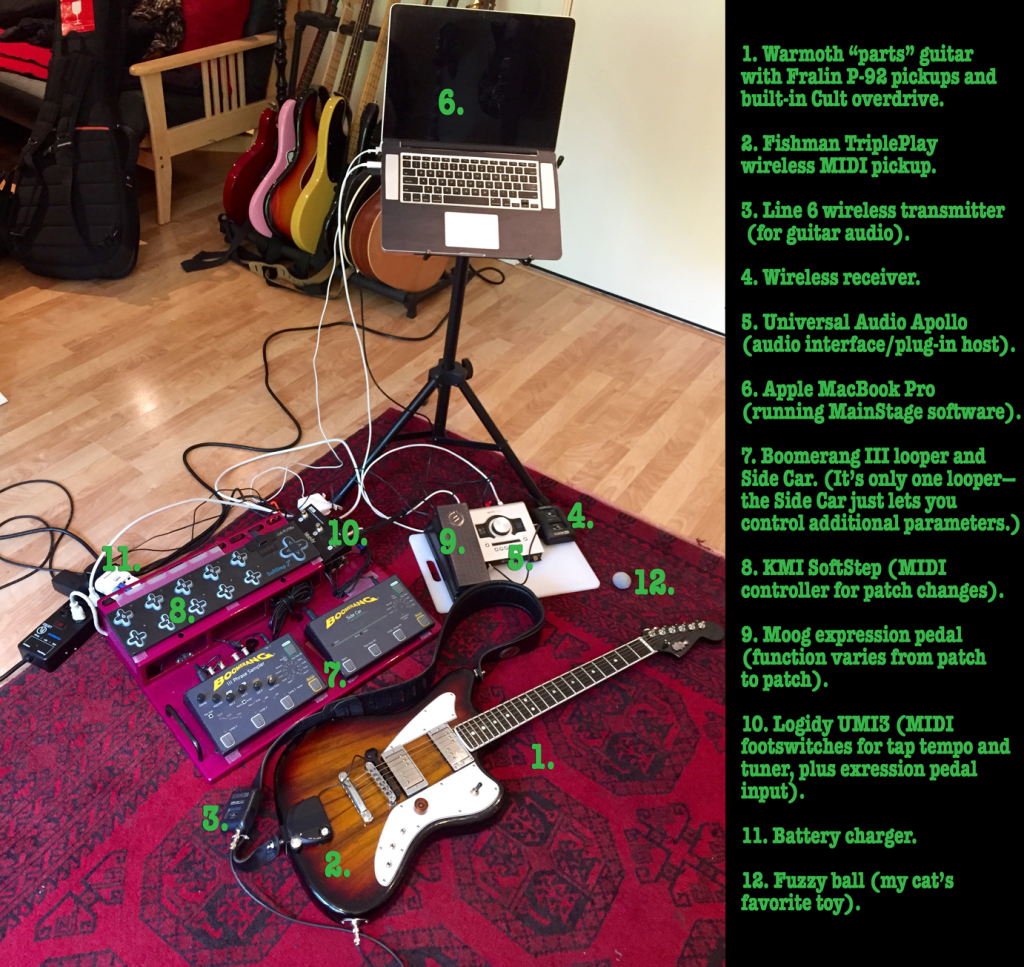
Likewise, I’ve already written about my live looping rig, but it’s changed a bit since then, and I’ve recently integrated a Universal Audio Apollo Twin interface (plus the stellar plug-ins it allows me to run). An updated overview:

Pedalboard-Diagram

The arrangement perform nicely, and I dig the individual components. But I dislike the system’s Rube Goldberg complexity—it’s a royal pain to set up and schlep. I’m always looking for ways to simply. (Other than, you know, just plugging the guitar into a frickin’ amp.) I’m open to suggestions for streamlining!

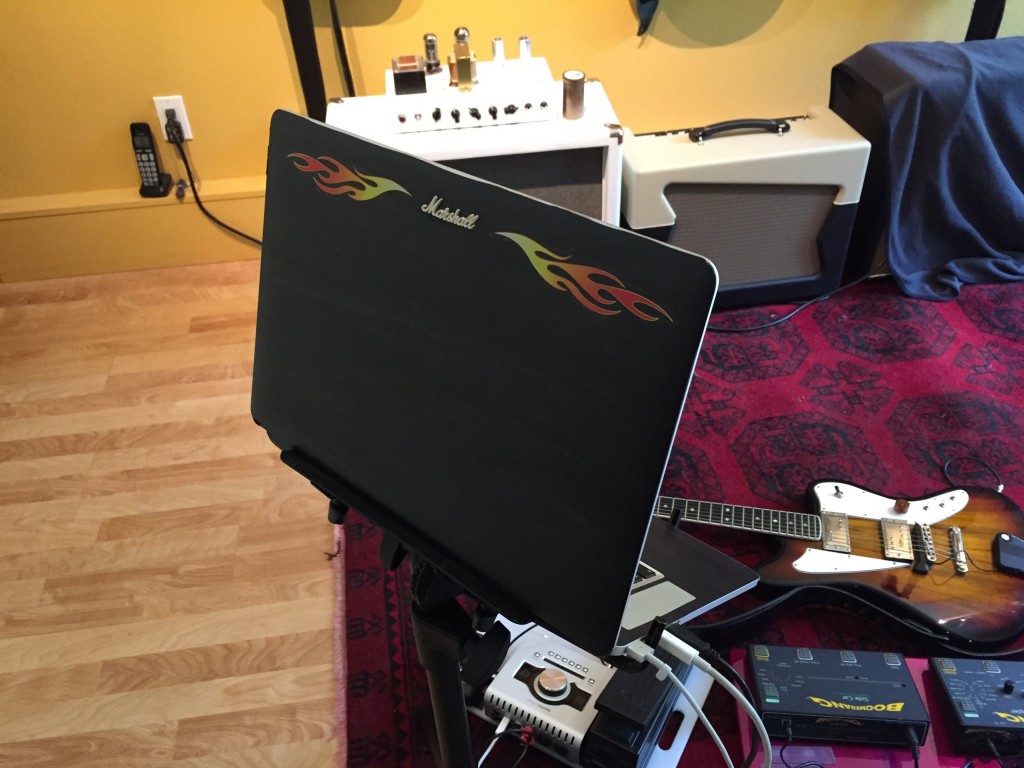
Black Mac
I love Apple products, but I hate having Macs onstage (mainly ’cause they’re so much better looking than me). Covering it in black wrap makes it less obtrusive. The Marshall logo is from one of those “toy” stacks (which, of course, can be far more than toys in the studio).
Categories
Digital Effects guitar Music

The Live Looping Lesson

This one’s a labor of love: Premier Guitar just published my live looping lesson. Included are most of the hard-won looping techniques I’ve acquired over the last few years. I crashed and burned 100 times onstage so you don’t have to! 😉

The percentage of my life spent looking at this exact view is too depressing to contemplate.

The 20 audio clips embedded in the article were trickier than usual to prepare. Ordinarily when I record music mag demos, it’s simply a matter of plugging in a guitar, amp, or pedal and noodling around while trying to make it sound good. But here I had to demonstrate techniques that unfold over time, which is harder than it sounds, at least for me. But I’m reasonably satisfied with how they turned out.

My emphasis throughout is going beyond looping cliches and defying listener expectations. That too is difficult — by definition, loops are predictable! But I’ve been racking my brain for years, trying to come up with ways to bust out of the usual patterns. Most of my ideas appear here. Hope you find them useful!

Categories
Digital Recording

My New Fave Mobile Interface

Apollo-Twin_WEB-Award

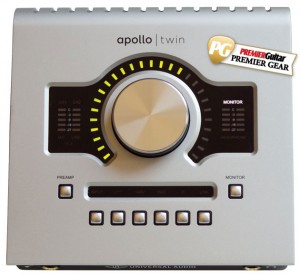
Premier Guitar has posted my review of Universal Audio’s Apollo Twin interface. Short version: I love the thing.

A rackmount Apollo interface has been the core of my studio for two years, replacing both a Pro Tools HD rig and a complicated Apogee setup. I adore Apollo’s great-sounding preamps, lucid interface, and innovative software, which, among other things, lets you track through simulated preamps on your way into your DAW. Also, UA’s analog modeling is second to none. (You hear their reverbs and tape simulations on most of the stuff I’ve recorded for this site.)

The intensity of my Apollo love is rivaled only by my scorn for the crappy mobile interfaces I’ve previously used with my live laptop rig. The problem isn’t audio quality — even the cheapest ones can sound surprisingly decent — so much as lousy ergonomics and flimsy construction. I’ve burned through half a dozen interfaces in the last few years. They just aren’t built to last onstage. Or anywhere else.

That’s why I’m so stoked to have the small-format Apollo on my digital pedalboard. It’s built well. The UI is brilliant. There are no horrid breakout cable octopi. It has the same preamps and processors as the rackmount Apollo. And I have access to my favorite UA plug-ins, including the juicy EMT plate reverb simulations, the stellar tape echo models, and a suite of low-latency virtual preamps. It’s pricy for a mobile interface: $700 for the single-processor model and $900 for the dual-processor model. But I’d spent far more than that on self-destructing junk that I wound up giving away or recycling.

Anyone else tried Apollo in its various formats? Or any other cool converters? Your observations, please?

Categories
Digital Effects guitar

Double Double MIDI Trouble

I just recorded a solo version of one of my fave film themes: Jerry Goldsmith’s main title to the 1967 spy spoof In Like Flint. I’ve adored the melody since childhood, and I blame it for instilling the love of chromaticism that made possible my extraordinarily uncommercial career.

I’d previously posted another version of this tune, performed upside-down on a friend’s lefty guitar. But that was all-analog — this time it’s digital. And I’ve used the video to highlight a favorite MIDI technique: doubling recognizable guitar sounds with non-guitar synths and samples.

I've been obsessed with this score since dinosaurs ruled the earth.
I’ve been obsessed with this score since dinosaurs ruled the earth.

It’s funny — being able to trigger pretty much any sound from the guitar isn’t necessarily as liberating as you might think. Sure, when you first try it out, it’s thrilling to conjure an electric piano sound from the fretboard. But who wants to hear some schmo noodle aimlessly on electric piano when they could be noodling aimlessly on guitar?

For better or worse, I find myself using this technique repeatedly. When I double a part effectively, the result still seems like part of the guitar cosmos. It feels like expanding the palette, as opposed to vomiting on it. (Not that I’d be above vomiting on a palette if it helped create a cool painting.)

Did anyone else encounter this sort of childhood musical contamination? A melody, progression, or tone that infected you early on, and colored everything after? I’m not talking image, like falling in love with the Beatles on Ed Sullivan or Nickelback on the CBC because they were so frickin’ cool. I mean a primal sonic imprint. Anyone?

Categories
Digital guitar Technique

Cue the Drummer Jokes!
Playing Drums with MIDI Guitar

strung_out_121213_small

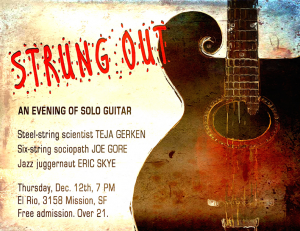
I’m thrilled to bits about a show I’m playing Thursday eve in San Francisco featuring two guitarists of impeccable skill and taste, plus me.

Teja Gerken and I are co-hosting a monthly solo guitar night at El Rio, my groovy neighborhood dive.Our guest is the amazing Eric Skye who, among other things, plays gorgeous solo guitar versions of classic Miles Davis tunes. If you happen to be in cold, cold San Francisco this week, stop by and say hi!

I’ve been doing the digital looping thing with Mental 99 for a few years now, and man, trying to work out solo arrangements with live-looped MIDI drums has been seriously humbling. You know all those jokes we love about how drummers speed up, slow down, drool, and generally disappoint? I can do all those things and everything else a drummer does, except occasionally play a competent groove. Some of the problems have to do with MIDI tracking in general, and some are simply general suckage. Man, it sure makes me appreciate my brilliant musical partner Dawn Richardson, who never speeds up and drools only rarely.

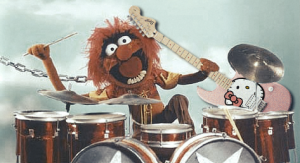
animal_drums

But those who can’t, teach. So I whipped up a little tutorial on playing drums with MIDI guitar. The first half covers the moves, and the second half features a live improv based on my fave afrobeat pattern. (Tony Allen is my rhythm god.) It also includes some of the hybird synth/guitar sounds I’ve been exploring, like double single-not lines an octave lower, mixing trashy guitar and trashy organ, and of course, space pigeons. (I stole the organ line from my pal Robin Balliger.)

In other news: I’ve been speaking to the ultra-knowledgable Rob Hull from Tube Depot about creating a minimalist DIY amp kit inspired by our conversations here. Lots more details to come. Tube Depot has a track record of making real nice amp kits, and Rob’s documentation/build instruction are the best in the biz. I reviewed their cool tweed Champ clone kit here.

Oh — anyone score any good holiday presents yet?

Categories
Digital Recording

Logic Pro X:
What’s New for Guitarists & Bassists?

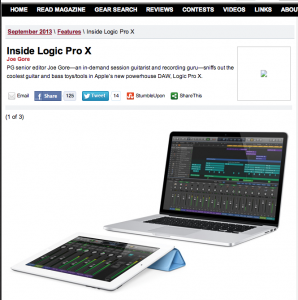
Inside Logic Pro XAs promised: an overview of Apple’s new Logic X Pro, with an emphasis on what’s new and cool for guitarists and bassists. Lots of movies and audio!

It’s here.

This is an exciting post for me, and not just because I get a desperately needed break from Klons and Screamers. I’m thrilled to bits about Logic Pro X and MainStage 3, though I’m still wrapping me head around them. (Yeah, I worked as a developer for both products, but I didn’t get a proper program-wide view until last week’s release.)

Also, it’s my first story for Premier Guitar, whose staff I’ve just joined as a senior editor. I’m stoked because it reunites me with PG editor Shawn Hammond and senior editor Andy Ellis, both of whom I remember fondly from my Guitar Player magazine days.

There’s much talent and coolness on the staff. I’m a happy little guitar nerd. Plus, the schedule is loose enough that I can still record, perform, and continue to work with audio/software clients.

What does the gig mean for this blog? Good things. I have no plans for a major course change — there are too many things I can only cover on a non-commercial site, including some of the topics closest to my heart. Meanwhile, working with PG will keep me more up-to-date on new music, new gear, and scurrilous guitar community gossip. In some cases, though, I may link to a PG article I’ve written rather than duplicate the work here. Today, for example. 🙂

Categories
Bass Digital Effects guitar Recording

Logic X is Here!

Nnnggg...pedals.
Nnnggg…pedals.

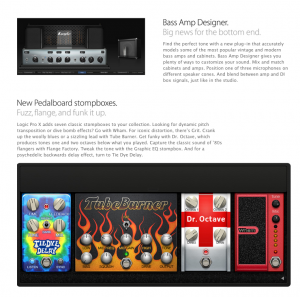
Apple released the long-awaited Logic X a few minutes ago. And it’s dripping with cool new guitar and bass stuff: a fabulous bass amp modeler. Lots of new virtual stompboxes. Vast new libraries of guitar tones, and newer, smarter ways of accessing them. More product info here.

FYI, I’m the furthest thing from an unbiased source: Apple is one of my clients, and I was a major indie developer for this product. But hey — the guitar features here are seriously bitchin’.

More details and examples in the coming days!

Categories
Acoustic Amps Bass Digital DIY Effects Gigs guitar Music Pickups Recording Technique

Tonefiend Book Week is Coming!

Tonefiend Book Week 2013

Next week at tonefiend we’ll be talking about our favorite guitar/music books. I’ll write about some of the titles I find especially useful, inspiring, or entertaining, and I hope you’ll chime in with some of your recommended reading.

Since there’s so much potential material here, I suggest we focus on a different book category each day. Here’s my proposed schedule:

Tonefiend Book Week is strictly an experiment, and a selfish one at that. If the past is any guide, the obsessive geeks experienced and sophisticated players who frequent this site will introduce us to lots of lively lutherie-linked literature. And I’ll do my best to keep up!

So scour your bookshelves, real and virtual. This shit is about to get real promises to be a most edifying conversation.