Categories
Effects guitar

Fuzz Detective:
The Case of the 12 Germanium Fuzzes

As threatened, the Fuzz Detective video:

WHAT: Twelve germanium fuzz circuits compared and analyzed. These represent the sounds of almost every fuzz pedal introduced between 1962 and 1968.

WHY: A tool to help players identify the circuits most relevant to their musical needs. This isn’t about particular brands of pedals, but the circuits they employ. If you hear something you like, you can either do as I did and build a clone from the schematic, or buy one based on that particular design. (The relative merits of rival clones is another story.) Of course, if you’re rich and you desire an ancient pedal that probably doesn’t sound as good as a new clone, you can always purchase a vintage original. 😉

HOW: I tried to establish a “level playing field” by removing as many sonic variables as possible. I used the same signal chain, the same guitars, the same musical material, etc. (Tech details below.)

WHO:

  1. Maestro FZ-1 Fuzz Tone
  2. Sola Tone Bender Mk 1
  3. Hornby-Skewes Zonk Machine
  4. Sola Tone Bender “Mk 1.5” (similar to Vox Tone Benders)
  5. Dallas-Arbiter Fuzz Face
  6. WEM Pep Box Rush
  7. Sola Tone Bender Mk II (same as Marshall Supafuzz)
  8. Mosrite Fuzzrite (germanium version)
  9. Orpheum Fuzz (germanium version)
  10. Selmer Buzz Tone
  11. Sola Tone Bender Mk III (same as Park Fuzz Sound, Carlsbro Fuzz)
  12. Baldwin-Burns Buzzaround.

WHEN: Like, now, man!

Categories
Effects

Fuzz Detective: The Plot Thickens!

Man, I’m glad I announced my intentions about this project! Thanks to your links and suggestions, the “Fuzz Detective” project has grown vastly more ambitious. I need a few more days to make my test recordings are assemble the results, but I believe this will be the most complete and “scientific” audio comparison of 1960s fuzz circuits yet attempted. I’m posting this update to share my current plans — and solicit last-minute suggestions for improving them. —Joe

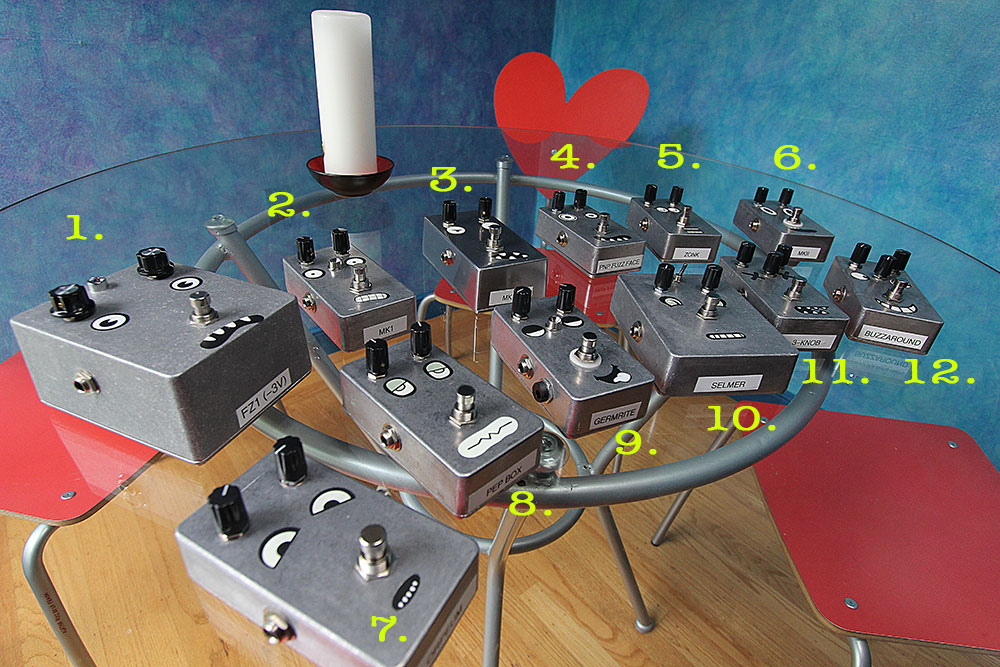
Wanker's Dozen: twelve Germanium fuzz pedals compete on a level playing field.
Wanker’s dozen: twelve germanium fuzz pedals will finally compete on a level playing field.

I’ve been a busy little solder monkey! Dig my new pedals:

1. Maestro Fuzz Tone FZ-1 clone
2. Sola Tone Bender “Mk I” clone
3. Sola Tone Bender “Mk 1.5” clone (near-twins: Vox Distortion Booster, Italian Vox Tone Benders)
4. Dallas-Arbiter Fuzz Face clone (very similar to Tone Bender Mk 1.5)
5. Hornby-Skewes Zonk Machine clone (near-twin: Tone Bender Mk 1)
6. Sola Tone Bender “Mk II” clone (near-twin: Marshall Supafuzz)
7. Orpheum Fuzz clone
8. WEM Pep Box Rush clone
9. Mosrite Fuzzrite clone (germanium version)
10. Selmer Buzz-Tone clone
11. Sola Tone Bender Mk III (“3-knob”) clone
12. Baldwin-Burns Buzzaround clone

About the Fuzz Detective project:

I’m attempting to create a comprehensive comparative sound library of germanium-transistor fuzz pedal circuits.

There’s no shortage of audio clips and demo videos featuring the great stompboxes of the ’60s and their modern clones. Yet it’s difficult to make qualitative comparisons between circuits because there are so many other variables at play. Who performed the examples? Using what gear? Were the examples recorded in a pro studio or on a mobile phone? Are the pedals ’60s originals or modern clones? What’s the condition of the transistors? And so on.

This isn’t about, say, deciding who makes the best Fuzz Face clone. The focus is the circuits themselves. The Fuzz Detective project aims to “level the playing field” by removing as many variables as possible.

Categories
Acoustic guitar

A High-Tech Plastic Guitar —
from Half a Century Ago

Plastic guitars are not a new idea!

In comments to a recent post on 3D-printed guitars, we were discussing the pros, cons, and general aesthetics of instruments molded from plastic. But this isn’t exactly a new idea.

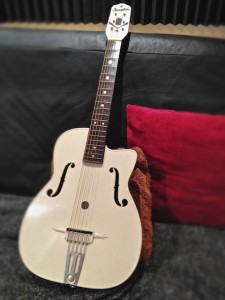
Back in the 1950s, luthier Mario Maccaferri conceived a line of plastic guitars and ukuleles. (This was many years after Maccaferri designed the D-hole Selmer guitars that will forever be associated with the Gypsy jazz of Django Reinhardt.) These plastic guitars were never very popular, and they’re not particularly valuable today.

I bought the one pictured here a few years ago at one of the music shops in London’s Denmark Street (I forget which one). I paid a couple of hundred bucks, and felt like a chump.

But I’ve grown attached to this guitar. It’s lovely to look at, and it plays great. The neck is substantial yet comfy, and it intonates well throughout its range. The tone isn’t warm, complex, or rich. But the Maccaferri has a cool, lo-fi character this sits well in a mix. I also like using it to double conventional acoustic guitars — the sharp, percussive tone adds a rough, aggressive edge.

Have a listen: