I’ve been obsessed with Henry Mancini’s music for decades. Here’s an example of his “tropical” exotica side.
My Mancini loved deepened after I joined Oranj Symphonette, a ’90s band founded by cellist Matt Brubeck (Dave’s son). It’s fascinating how accessible and catchy all his tunes are, even though you realized they’re incredibly weird and original once you look under the hood. You can hear those albums on YouTube. Plays Mancini includes only Mancini music (including a version of “Lujon” featuring our sorely missed friend Ralph Carney). The Oranj Album mixes Mancini with other retro sounds track themes.
Admittedly, there’s only a smidgen of looping here. I usually play this without a looper, but it’s nice being able to grab that lovely falsetto line at 02:25.
The guitar is a Guild X-15 arch top from the ’90s. It’s had many pickups over the years. This one is a lovely Lollar Charlie Christian model.
I probably sound like I’m being ironic, but no — I really love this Taylor Swift song.
The Hello Kitty! Stratocaster was a gift from my lovely friend and bandmate Jane Wiedlin. I replaced the factory humbucker with a Duncan Phat Cat (sort of a humbucker-sized P-90). Again, no irony intended. I like Sanrio characters! (Especially Aggretsuko!)
I got to interview Robert Smith for a Guitar Player cover story in 1992. It was one of funnest of the 1,000+ musician interviews I’ve conducted over the last few decades. Robert is brilliant, bitchy, and hilarious. We talked most of the night over too many drinks.
Years later I was recording with sociopath Courtney Love at Chateau Miraval in Provence, where the Cure recorded their Kiss Me Kiss Me Kiss Me album, including “Just Like Heaven.” The studio manager recalled how Robert would quote Apollinaire and Verlaine around the dinner table. En francais, bien sûr.
The guitar is a 000-sized Lowden I’ve owned since the early ’90s and have used on many sessions and tours. It’s fun playing acoustic guitar with distortion and effects, as long as you give up on the idea of generating traditional acoustic tones.
For Day 2 of Loopocalypse, here’s an angst-ridden original featuring brutal bit-crushed distortion and Tesla coil samples.
Thunderbeast Park was an Oregon roadside tourist attraction with cheesy plaster dinosaurs. I think I visited here as a kid, though I’m not certain. At least I would have pleaded for us to stop on one of my family’s up-the-coast road trips. I often got my way, ’cause my folks liked this stuff too.
The guitar is my DIY Birdmaster. The pickups are unpotted Duncan/Bonnamassa PAFs — probably the best humbuckers I own.
On the occasion of a daunting round-number birthday, I’ve just completed Loopocalypse, a concert-length video of my live looping show. I’ll be posting a song per day, each featuring a different guitar, from now till Thanksgiving/birthday. Here’s Day 1 of 17, a tribute to that dearest of the dearly departed, David Bowie. I’ve been playing this for years, and it just gets sadder and sadder. Tomorrow I’ll share something appropriately angst-ridden for the US election day. (Here’s a remembrance of my brief Bowie encounters, written the day after he died.)
Here’s an explanation of my live looping rig. The guitar is an all-original 1963 Strat that I’ve owned since 1980. For many years it was my only good guitar.
Fender’s Telecaster Deluxe has had an interesting and checkered history. Once regarded as yet another mediocre product from the company’s era of CBS ownership, these turn-of-the-seventies instruments now fetch huge prices on the collector’s market. I’ve never owned own. But when singer/songwriter Greer Sinclair loaned me one of Fender’s 2010 reissues, it was time for research — and experimentation.
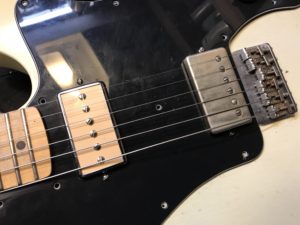
The made-in-Mexico 1972 Deluxe reissue is a cool guitar. It replicates many details of the original: the oversized headstock, the Strat-like belly cut and fixed Strat-style bridge, and the big-ass pickguard. But its pickups are definitely a departure. In lieu of the original’s large-format “Wide Range” pickups, it employs a P-94R (a humbucker-sized P-90 spinoff) at the neck, and a conventional Gibson-style humbucker at the bridge.
The Wide Range pickup was a unique beast. Fender had commissioned Seth Lover, the man who invented the Gibson humbucker, to create a Fender humbucker in hopes of cashing in on the growing popularity of hard rock. With DC resistance in the 10k range, the new Wide Range pickup was a bit hotter than a vintage Gibson humbucker. Wide Range pickups appeared in several of the era’s models, including the Tele Thinline, Tele Custom, and semi-hollowbody Starcaster.
Gibson humbuckers have a bar magnet within, but the pole pieces are not magnetic. But on Wide Range pickups, the pole pieces are magnetic, as on Fender’s single-coil pickups. Situating individual magnets closer to the strings yield a brighter sound with greater note defition and string-to-string separation — characteristics we associate with vintage Fender pickups. So the Wide Range pickup lent a uniquely “Fender” twist to the Gibson design.
Wide Range pickups are slightly larger than conventional humbuckers. Most of Fender’s circa-1970 Tele reissues substitute generic humbuckers of the standard size. Standard humbuckers can sound superb in a Tele, but they’re horses of different colors. Fender has also created some reissues with the larger-sized pickups, but these are also garden-variety humbuckers — the larger format is purely cosmetic. The pole pieces of the factory humbucker on Greer’s guitar don’t align with Fender’s wider string spacing. (But one thing I’ve leaned from my various Fender/Gibson hybrid experiments is that sonically, this can matter very little.)
The P-94R’s cream-colored top looks wicked against the guitar’s finish. It’s a warm, full-sounding pickup from the mellower side of the P-90 spectrum. Actually, it doesn’t sound all the different from a traditional Telecaster neck pickup. (Like that pickup, it works quite well for jazz.) Note, though, that its dimensions differs substantially from those of a Gibson P-90, as you can the in the photo where it sits alongside a historically accurate Lollar P-90. When you change the size of a pickup’s components, you inevitably alter the sound. The tones can be for better or worse — but they will be different. (more…)
Jon Cusack — the pedal builder, not the actor — recently turned me on to one of the best DIY tools I’ve ever owned: The Multi-Function Tester TC1.
Jon’s Michigan shop manufactures the pedals I design. He and I were trying to pinpoint the optimal gain for the germanium transistors in two of the new pedals I’m about to release.
I’d been using a multimeter to test gain, which is measured in terms of hFE. An old germanium transistor might have hFE of 50 or less, while a hot silicon Darlington transistor such as an MPSA13 might check in at hFE = 5,000. As you can imagine, it’s a crucial measurement for any stompbox that employs transistors.
But like many before me, I encountered two big problems. First, most multimeters don’t have an hFE function. (To make such measurements, the device needs a trio of sockets so you can plug in the transistor’s three legs.) It’s not a matter of cost. In fact, most high-end multimeters, such as the Fluke models whose prices start at well over $100, omit the function. (To be fair, we’re talking about antique transistor technology, which is pretty much extinct in most modern electronics.) You’re likelier to find an hFE tool on cheaper, more obscure models. So I’d been using bunch of cheap-ass Chinese multimeters just to measure hFE.
But there’s another problem: Those multimeter hFE testers are notorious for their inaccuracy. They’re especially prone to overstating the actual gain. They’re not quite useless, but they’re close.
Jon recommended the TC1 ($41.50), which apparently is only available via eBay in the US. And it’s more useful than I could have imagined.
First off, it gives accurate hFE readings within a hundredth of an hFE unit. It works with silicon and germanium BJTs, FETS, JFETS, and MOSFETS. And dig this: It doesn’t matter which way you orient the pins — it knows which leg is which, so no more jumping online to verify the pinout of a particular part.
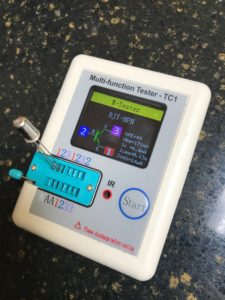
Check out the photo: The LCD image tells me that the pin in socket 3 is the collector. Had I inserted it the transistor the other way around, the collector would be marked with a 1. Better still, it also works with resistors, capacitors, and diodes. You don’t even have to switch metering functions, as on a multimeter. Just pop in the part, secure it with the clamp, and TC1 does the rest.
Trust me — if you work with transistors, resistors, caps, and diodes, you want this tool. Now I seldom use my crappy multimeter unless I need its continuity (“beeper”) tool.
Despite being obsessed with Charlie Christian for decades, I’ve never played a Gibson ES-150, the guitar he made famous. I’ve never even messed with a “Charlie Christian pickup,” even though it’s been a fairly common retrofit ever since the late Danny Gatton installed one in his Tele’s neck position. But I’ve always wondered: Could the C.C. pickup work in styles other than jazz? How would it sound in the bridge position? (The ES-150 had only a neck pickup.) And most of all, how would it sound with nasty fuzz?
Lollar Pickups helped me answer those questions with a loaner of three humbucker-sized Charlie Christian pickups. These differ cosmetically from the originals, lacking the cumbersome mounting hardware and the ornamental top plate. But they’re convincing sound-alikes, with similar magnets, wires, windings, blades, and modest output. (Their DC resistance is just under 3k ohms). Here’s what I discovered!
Clearly, it’s not a pickup for every rock guitarist (though it’s perfect for a swing-era jazz sound). Still, I found its non-jazz sounds strange and compelling, and I can definitely imagine using them in the studio. What do you think?
While making comparisons, I spend hours reacquainting myself with Charlie’s recordings, of which there are only a few dozen. His career was absurdly brief — it was less than three years from his first recordings with Benny Goodman through his death from tuberculosis (and probably other bad stuff) at age 25. But that was long enough to forever alter the guitar’s history. (more…)