Categories
DIY Effects guitar

The Prettiest Pedalboard! (Plus: A New DIY Lipstick Tube Guitar)

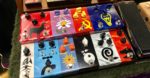
You know what sucks about attending NAMM as a manufacturer rather than a gear writer? I was epoxied to my booth all day, and I barely saw anything other than my guitar pedals. But on one rare break, I got to hang out with Jannis Anastasakis and his crew from JAM Pedals of Athens, Greece. (I highlighted some of their beautiful work in my pathetically skimpy “NAMM report.”)

Happily, there’s more to celebrate here than great visuals. JAM builds lovely versions of many classic analog effects. Their sounds and production quality are stellar, and JAM often adds modern updates such as realtime expression control, extra knobs, and internal trim pots for customizing tones. It’s quality stuff, used by many a guitar star.

And guess what? Jannis loaned me one of his magnificent Custom Shop analog pedalboards. Γαμώτο!

Sadly, I must now pack up and return this pretty pedalboard. But I’ll be getting my own JAM Delay Llama Supreme, an expanded version of the analog delay heard here, with tap tempo, a cool modulation section, and the almighty infinite-hold switch. (I reviewed it for Premier Guitar a few months ago.)

In the meantime, this experience makes me want to try my own DIY pedalboards. Not as an item for sale — just as a way to group related effects in a single enclosure for stage use. Gears are spinning ….
Categories
Effects guitar

Museum of Lost Effects:
Morley “Oil Can” Wah

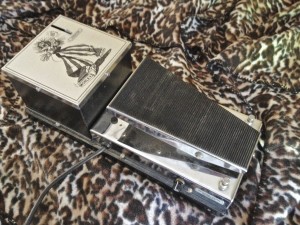
The mighty Morley Rotating Sound Wah

Two indisputable facts about Leslie rotating speaker cabinets: They sound awesome, and they’re approximately the size and weight of Rhode Island. Since the ’60s manufacturers have attempted to mimic the spinning-speaker effect in a more modest package. And one of the best mimics is the second exhibit in our Museum of Lost Effects.

The Morley Rotating Sound Wah is less well known than an earlier pseudo-Leslie, the Univox Uni-Vibe,forever associated with Hendrix. Like the Uni-Vibe, it a) tried to duplicate the Leslie, b) failed, but c) wound up creating a cool tone of its own. But while the Uni-Vibe milks its modulation from a series of optical sensors, the Morley relies on a rotating disc inside a can of electrostatic fluid. The result is a cool and complex modulation sound unlike any other (and one I’ve never been terribly successful at mimicking digitally).

This technology is descended from the “oil can” delays produced in the ’60s by the Los Angeles-based Tel-Ray company.In fact, Morley was a Tel-Ray spinoff — company founders Ray and Marv Lubow chose the name Morley for their line of guitar pedals based on the boast that this relatively compact modulation effect offered “more-lie,” as opposed to “less-lie.” (Note that I said “relatively” compact, since this beast is far and away the heaviest stompbox I’ve ever owned.)

The Morley Rotating Sound Wah is ugly, clunky, and klugey. If you drop it on your foot, you’ll never walk again. But I think it sounds incredibly cool.

Have a listen and see whether you agree: