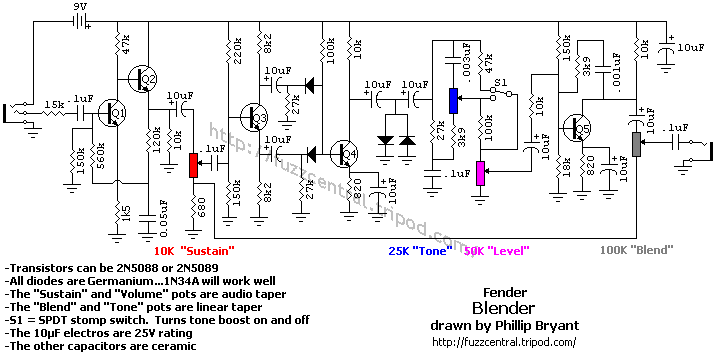
OK I have simulated a bit more of the circuit, and it is pretty wild how this thing actually operates. I will put some pictures up later when I have more time.
When hit with a strong enough signal, the output of the full wave rectifier stage puts out a narrow pulse twice for every cycle of the input signal. As these pulses are not equally separated in time, you’re not getting a true “octave” effect – there is still some fundamental. In fact, I don’t know what it is exactly without doing a spectral analysis. Nevertheless, the half wave rectifier circuit is critical for setting the position of these pulses in the overall cycle.
Also, as you vary the strength of the signal, the width of the pulses coming out of the full wave rectifier changes. The higher the level, the narrower the pulses. I would guess that this is going to sound something like an analog synth doing pulse width modulation – a bit of a “flangey” sound following the dynamics of your playing. The amplitude of the rectified signal is heavily clipped and so it has very little dynamic range.
So, while using a “fuzz” type front end will give you a more consistent level going into the full wave rectifier, it’s also going to change the spectrum a lot. I’m pretty sure it’s going to give a stronger octave effect. Depending on the dynamic range of the fuzz, it may also reduce this PWM aspect of the sound.
You may find the best solution (assuming you really like its current sound) is just to fix another gain stage or compressor in front of the existing half wave rectifier. But then again, who knows, maybe putting a fuzz circuit in place of the half wave rectifier is just the formula that the music world needs today for some re-invigoration. Maybe they are both so swell that you will want to have both sounds available at the flick of a switch.
|
 Author
 Can we save the Fender Blender?