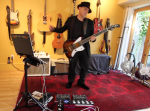
For a while I’ve been playing this loop-based cover of Foster the People’s “Pumped-Up Kicks” at solo gigs and with my duo band, Mental 99. At risk of sounding like a pompous dick, I’ve annotated the performance, highlighting techniques I’ve found useful for making loop-based performances livelier and less predictable.
I’ve covered some of this ground before, particularly in this Premier Guitarlooping-technique article. But here I call out the techniques mid-performance, and I’ve included a few new ones. I hope you find some of them useful.
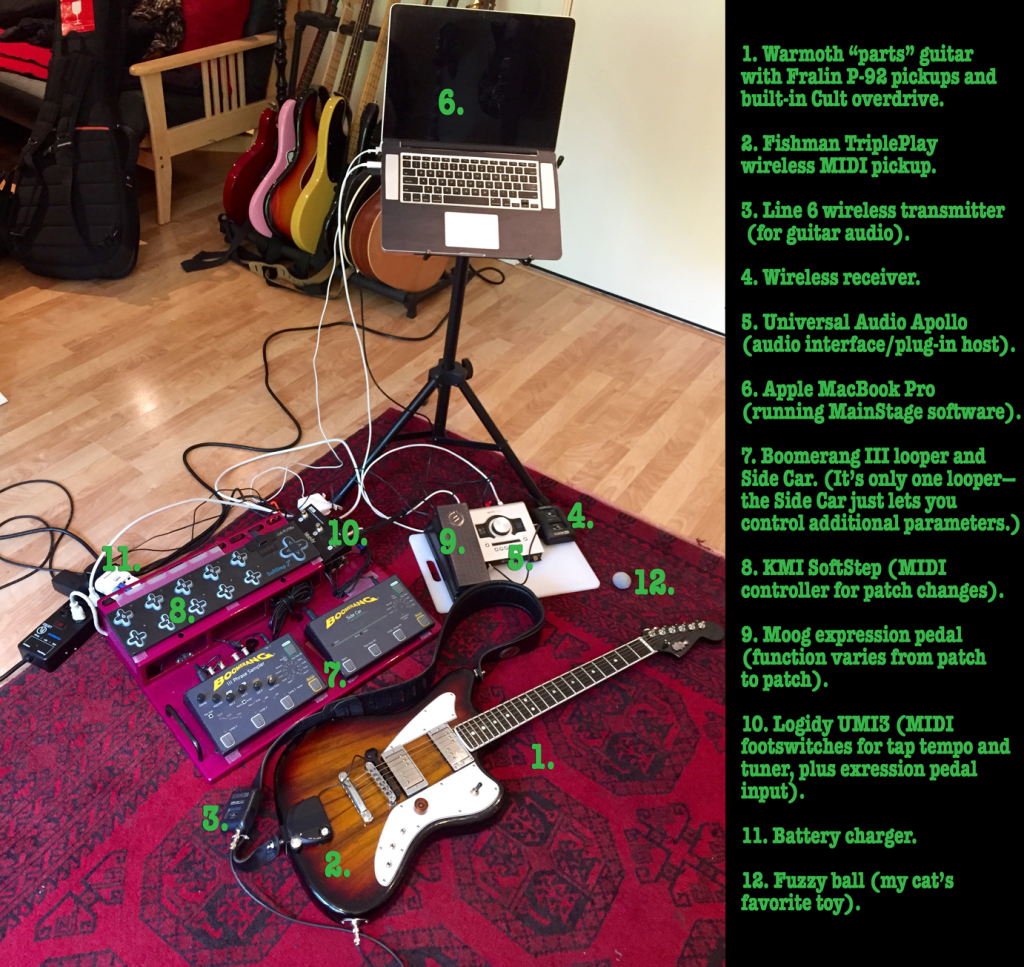
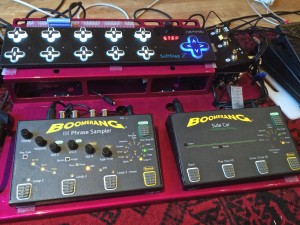
Likewise, I’ve already written about my live looping rig, but it’s changed a bit since then, and I’ve recently integrated a Universal Audio Apollo Twin interface (plus the stellar plug-ins it allows me to run). An updated overview:
The arrangement perform nicely, and I dig the individual components. But I dislike the system’s Rube Goldberg complexity—it’s a royal pain to set up and schlep. I’m always looking for ways to simply. (Other than, you know, just plugging the guitar into a frickin’ amp.) I’m open to suggestions for streamlining!
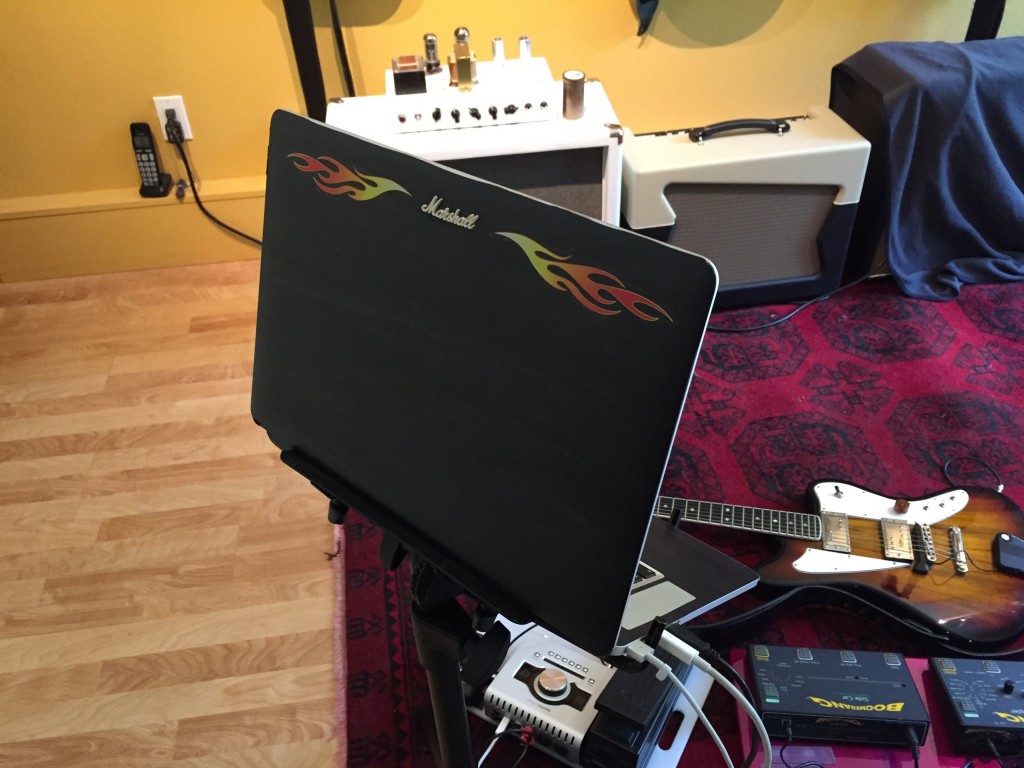
I love Apple products, but I hate having Macs onstage (mainly ’cause they’re so much better looking than me). Covering it in black wrap makes it less obtrusive. The Marshall logo is from one of those “toy” stacks (which, of course, can be far more than toys in the studio).
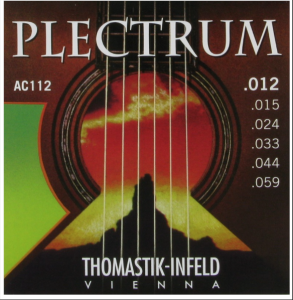
As if I weren’t already blowing enough money on arcane strings, I’ve got a new obsession: Thomastik-Infeld Plectrum series acoustic strings (which sell for $24 in the U.S.).
If you hang out here much, you’ve heard me bitch incessantly about acoustic strings. I hate the way most modern strings are all hyped treble zing and blaring volume, at the expense of deep, decisive fundamentals. With due respect to my vegetarian friends, too many strings are all sizzle and no steak.
Yeah, bright strings can seem energizing in a cocaine-binge sort of way. But all that glassy presence gets fatiguing. Meanwhile, darker bass strings leave sonic space for the treble strings to shine. Even on my teensy-tiny Martin 0-17, these low strings sing in a warm baritone voice, not like some squeaky, poorly Auto-Tuned teen idol.
This pricy Austrian set features brass-coated steel 1st and 2nd strings, while the bass strings are bronze, but with both silk inlays and flexible steel cores. The flatwound 3rd, 4th, and 5th strings nix finger noise and minimize tone contrasts between wound and unwound strings. The polished roundwound 6th string adds a touch of focus to the lowest register, yet introduces no awkward contrasts on melodies played across multiple strings.
The set is low in both tension and volume relative to most U.S.-made strings. Even though the low E is a chunky .059, it has a soft, relaxed feel that makes me want to linger over notes, shaping them. The harmonic range is fantastic, the dynamic range even more so. They’re long-lasting too — this video was recorded three weeks and many playing hours after installing the set.
I’m hooked. Damn it.
(Hey, Mr. Tambourine Man — I don’t want you getting your nasty treble overtones all over my acoustic strings, no matter how frickin’ jingle-jangle the morning happens to be. Just back off, pendejo.)
Okay, it’s not the ultimate lipstick-tube guitar for everybody, but it probably is for me. It’s my third lipstick-tube pickup experiment — and definitely my favorite.
You may have heard some of these parts before: I used the neck for all my Mongrel Strat projects, and the Strat-sized Seymour Duncan pickups appeared in my previous lipstick-tube experiments. (I love Duncan’s lipstick-tubes. To my ear, they sound way better than the ones in new-school Danelectros.) The new body is Warmoth’s Hybrid Tele model, in purple with butterfly stickers. It’s très macho. (Better not use if for gigs in Indiana and Arkansas.)
My previous lipstick tube experiments used a MIM Strat body, but I wanted something a little more distinctive, and with a built-in battery compartment (because nothing is a bigger pain than changing batteries in a traditional Strat control cavity). Also, I like how the design evokes both Strat and Tele, since the guitar has three-Strat sized pickups and a whammy, but is wired more like a Tele.
About that wiring: The 3-way pickup selector chooses neck, bridge or both pickups, like on a Tele. Meanwhile, a SPDT switch toggles the middle pickup on and off regardless of the pickup selector, so you get six settings: neck, bridge, neck + bridge, neck + middle, bridge + middle, and all at once. It’s a pragmatic variation on “Nashville Tele” wiring with a switch rather than a pot. That means you can’t dial in varying amounts of middle pickup—it’s all or nothing. But on the plus side, I can jump instantly to an out-of-phase sound from any pickup-selector setting, and it freed up space for the other weird crap I put in this guitar. (Yo, electrical engineers: Don’t bother telling me that combined-pickup settings aren’t really out-of-phase True, they’re not out-of-phase electronically, but they are acoustically, and the distinctive “hollow” sound of combined settings is precisely the result of phase cancellation from two pickups at different positions.)
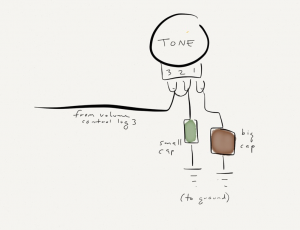
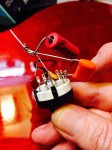
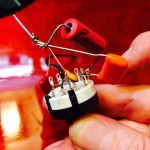
The weirdest detail is what I call a “cap-fade” tone control. It’s an idea I speculated about back in January, and to which many of you contributed cool perspectives. I pretty much followed the scheme in the original diagram:
The idea again: Instead of sending varying amounts of signal to ground via a tone cap, the pot here fades between a small-value cap (which defines the minimum cut when the control is engaged) and a larger one (defining the frequency of the maximum cut). In other words, instead of sending varying amounts of signal to ground, this circuit always sends everything above the cutoff frequency to ground, with the pot determining the frequency. (more…)
I recently reviewed the gorgeous little Veillette Avante Gryphon for Premier Guitar and liked it so much that I bought one. This was my first opportunity to record it in my studio.
The Avante Gryphon is a relatively low-cost version of Woodstock luthier Joe Veillette’s Gryphon, an 18.5″-scale 12-string designed to be tuned a minor seventh (an octave minus two frets) above standard. But while 12-string guitars feature octave-tuned string pairs, here all six courses are unisons, as on a mandolin. In fact, the Avante Gryphon sounds a lot like a mandolin, but with a wider range and guitar-like tuning. And unlike the couple of janky plywood mandolins I own, it plays gloriously in tune. It’s made (very nicely!) by Korean CNC robots and sells for $1,400, as opposed to $4K+ for Veillette’s hand-built models.
For years I’ve been looking for the right upscale mandolin, but now I’m happy I found this instead. My original motivation was a high-tuned soprano instrument for multi-guitar arrangements, or for magic-fairy-dust studio overdubs. But the thing is so fun — and sounds so darn pretty — that I can’t stop playing it solo. This Bach prelude, for example:
I won’t recap my review here—check it out if you’re curious. Instead, let’s yak about Johann Sebastian! (more…)
Oh man, I’ve been wanting to do this test for ages! A direct comparison between capacitor types in a standard guitar tone circuit.
So who’s right? The Tone Illuminati who discern dramatic tone improvements after installing vintage/audiophile caps? Or skeptics who say those perceptions are delusional? Does cap type matter at all?
This one’s a labor of love: Premier Guitar just published my live looping lesson. Included are most of the hard-won looping techniques I’ve acquired over the last few years. I crashed and burned 100 times onstage so you don’t have to! 😉
The percentage of my life spent looking at this exact view is too depressing to contemplate.
The 20 audio clips embedded in the article were trickier than usual to prepare. Ordinarily when I record music mag demos, it’s simply a matter of plugging in a guitar, amp, or pedal and noodling around while trying to make it sound good. But here I had to demonstrate techniques that unfold over time, which is harder than it sounds, at least for me. But I’m reasonably satisfied with how they turned out.
My emphasis throughout is going beyond looping cliches and defying listener expectations. That too is difficult — by definition, loops are predictable! But I’ve been racking my brain for years, trying to come up with ways to bust out of the usual patterns. Most of my ideas appear here. Hope you find them useful!
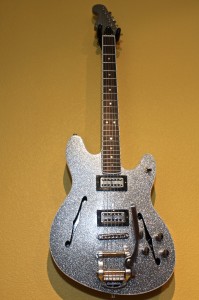
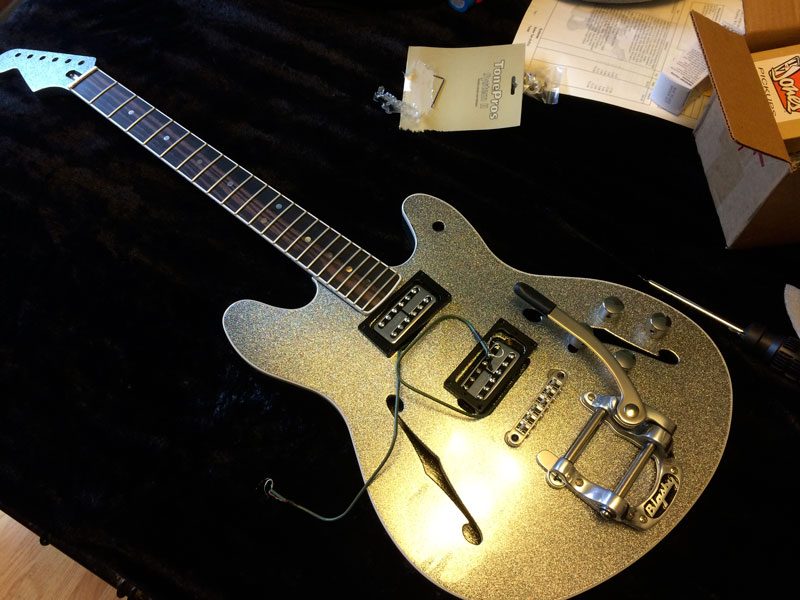
I just completed my third DIY guitar experiment using Warmoth parts. This one is a wacky Fender/Gretsch hybrid with a semi-acoustic Fender Starcaster body, a reverse, angled Strat neck, and various Gretsch-like elements, including TV Jones Filter’Tron pickups, a Bigsby/Vibramate vibrato, and a vulgar silver-sparkle finish — a tribute to the Gretsch Silver Jet, and the basis for this new guitar’s name: Kitschcaster.
Mind you, it sounds nothing like a Starcaster. I ordered the body (which Warmoth calls the Mooncaster) in warm-toned korina, and the neck is mahogany. (Fender used bright-sounding maple for the original necks and bodies.) True to form, the Gretsch-style humbuckers provide a percussive, “plinky” attack quite distinct from PAF-style pickups. The Bigsby assembly also nudges things further from Fenderland. But I always dug the Starcaster’s offset semi-acoustic body, and I thought it would make a nice platform for my latest platypus.
As before, I’m 100% delighted with Warmoth’s work. The finish is flawless (correction: was flawless till I dinged it), and everything fit together beautifully. The only hurdle came when installing the wiring. I failed to take into account the body’s thinness, and I didn’t have enough room to accommodate all the big push/pull and dual-concentric pots I’d planned to deploy. The comic highlight of the build came when I somehow managed to force a standard-sized pickup selector switch into the narrow lower horn. I disconnected a wire while doing so, and then found myself completely incapable of removing the switch. I took it to repair genius Gary Brawer, whose first comment was, “How did you get this in here? And more important, why?” But he managed to free the trapped part, and then he installed a cunning little access cover. Go, Gary!
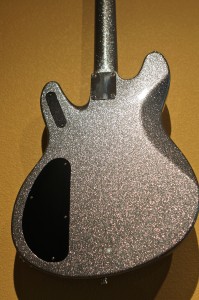
Yes, the neck is silver too. Gary Brawer added the pickup selector access cover.
I’m especially besotted with Warmoth’s “Clapton” profile necks, which I’ve used in all three of my builds. They have a pronounced V shape that feels so comfy in my left hand, and provides relief for my left thumb joint, where, sadly, I’m feeling my first tentative twinges of arthritis. It’s a trip having three radically different guitars with identical neck profiles. I dig the sleek, comfy body as well, and I love its ability to generate musically coherent feedback.
Anyway, consider this a work in progress. I’m still fussing with the tone circuit. (If I can find suitably sized rotary switches, I want to try a sort of “double Vartitone,” with separate treble-cut and bass-cut dials. If it works out as as planned, I’ll do another post on it.) I’ll also probably jigger with the built-in distortion, taking off some of the treble. Like my Bigsby equipped Les Paul, the Kitschcaster can have overly aggressive highs. Something about the combination of the Bigsby hardware and flatwound strings makes certain notes come screaming out of the amp. Both guitars benefit from a carefully controlled touch.
But even now, I’m really stoked about this fun, cheesy-cool instrument.
Look what UPS left on my porch: the neck and body for my latest ill-advised “parts” guitar project. I’ll be slapping it together in the coming days, but I couldn’t resist showing off the pretty parts. The body is Warmoth’s Mooncaster model, which is based on Fender’s semi-hollowbody Starcaster, a quirky cult guitar if ever there was one. But for the neck, I swiped an idea from Warmoth’s Josh Spataro, and substituted a reverse angled Strat neck. The tacky silver finish and extravagant binding are solely the result of my bad taste. (Josh compared it to a pinky ring, which is pretty accurate.) The body is korina, the neck mahogany.
If my last Warmoth parts guitar was a sort of Fender/Gibson hybrid, this one is more Fender/Gretsch. I’m planning to install a set of TV Jones pickups, and this will be my chance to try out a very different type of tone control scheme, one I’ve been thinking about for a while. If it turns out well, I’ll write about it. If not, I’ll probably delete the last few sentences and deny they ever existed.
This is my third Warmoth parts project since starting this blog. As before, I’m 100% delighted with the materials and build quality. Since I requested expensive options (like the vulgarly bound and finished neck) and I’m using fancy parts, the guitar probably won’t be vastly cheaper than if I’d bought it already made. But it should be unique and fun. Stay tuned — and I’ll hope the guitar does too.
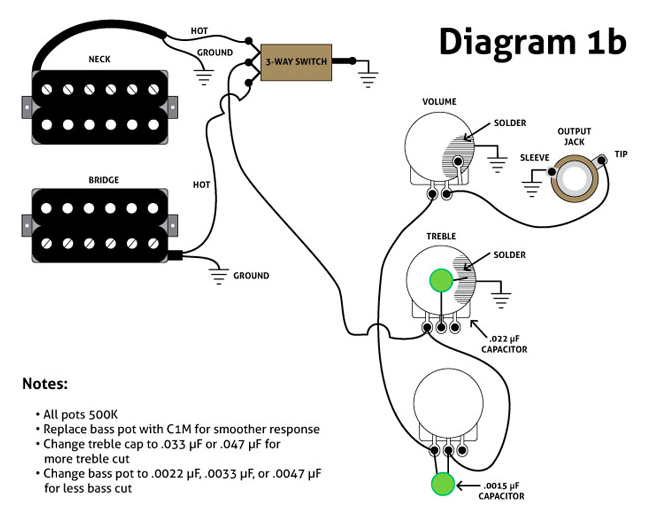
Premier Guitar just posted my new article on three favorite electric guitar wiring mods. The concepts won’t be new to anyone who hangs out here — I’ve pretty much flogged them all to death! But the new article includes the step-by-step walkthroughs that I never got around to creating for this site, and PG art director Meghan Molumby created beautifully clear tech diagrams like this one:
The descriptions and instructions in the new story are clearer and more detailed than my original posts here, plus I’ve refined some details, so I suggest working from the new PG versions.
My three choices:
Yup, the ol’ PTB tone control, the coolest mod I know, at least for players who love distortion. The new version of the project uses the 500K pots you probably already have in your guitar rather than the more eccentric G&L values.
I also revisited the Strat version of the “Nashville-style” Tele wiring popularized by Brent Mason and other Music City cats. It performs brilliantly in a Strat, and IMHO its benefits (vastly more blended-pickup options plus a musical and intuitive control layout) for outweigh the costs (loss of the middle-pickup-alone setting, cost of a 3-way switch). Not to launch a protracted Strat-vs.-Tele battle, but I love the whole notion of “Tele-fying” a Strat via wiring, control layout, and pickup choice.
In the article’s comments thread, several savvy readers also mention Strat wiring systems that provide the sounds of the Nashville mod without sacrificing any others. They’re right — but the more I mess with this stuff, the more I value simplified operation. I’m less concerned with having all options than with having the coolest ones, ergonomically organized. Still, there are many ways you can go here.
Finally, I’m once more beating the dead Varitone horse exploring variations on Gibson’s Varitone concept, updated for modern players. I added a new twist in the PG story: deploying these ideas via toggle switches, rather than a big, clunky rotary switch.
It was fun when PG editor Shawn Hammond asked me to choose my favorite mods. It was easy to decide though — these are the three I keep coming back to, and all three deliver dramatic results, unlike many better-known mods.
So which electric guitar mods would be on your short list? Wiring, hardware, whatever. How do you make your guitars cooler?
While in LA last weekend, I got to hang out with the guy who built my favorite modern guitar: the brilliant James Trussart.
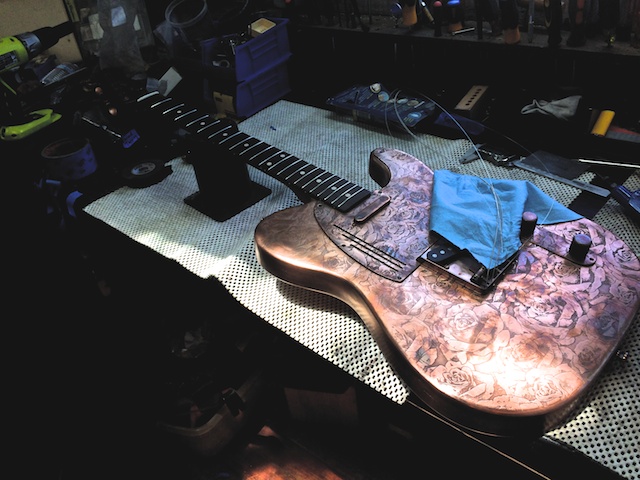
I’ve been privileged to know many great luthiers over the years, but the thing that always impresses me about James is the way his instruments seem to be just one expression of a larger artistic sensibility. James grew up on a farm in rural France, but came to the States in the ’70s to play Cajun fiddle. He seems to have always been fascinated by vanishing Americana, be it an endangered folk music style, a faded and rotting road sign, or an ancient car rusting in a field. With their richly textured surfaces and variegated patinas, his metal-bodied guitars exude that same aesthetic. I’ve never known brand-new instruments to impart such a strong sense of the past.
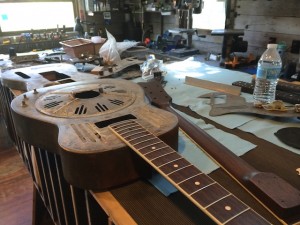
A Trussart resophonic under construction.
James lives in a rambling old Arts and Crafts bungalow in LA’s Echo Park neighborhood, a place where every room possesses a rich texture of passing time. He’s surrounded by cool instruments — both his own and many lovely vintage guitars — and much beautiful metal work: doors, gates, plaques, and whatnot, all crafted by James. A detached building in back houses the workshop where James and his assistants build several hundred instruments per year.
One of James’s Steelcasters has been my favorite modern guitar for over a decade. (Here is a nice example of the guitar in action with Tracy Chapman, and here’s another example with the Eels.) Later I got in the habit of tuning the entire thing down a whole-step, with the lowest string dropped to C. I recorded the entire Mental 99 album in a day using this inspiring instrument. Thanks, James.
A highlight of this visit was James’s demo of his Percuphone — an electro-mechanical stringed instrument created in the ’70s by his friend Patrice Moullet. (Here’s a French-language Wikipedia article about the instrument, and here’s a YouTube video of a more recent model.) Check it out:
I always feel inspired after hanging out with James. And not just guitar inspiration, but an overarching desire to make, do, and surround myself with inspiring things. Merci beaucoup, mon ami. :beer: