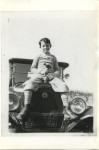
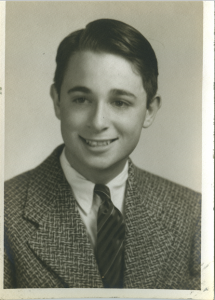
If my blog and video posts have seemed fewer and less fun in recent months, it’s not your imagination. I’ve been shuttling between San Francisco and my childhood home in the LA suburbs, spending as much time as possible with my dad in the wake of a back-to-back broken hip and terminal cancer diagnosis. He passed away on January 28th — my late mother’s birthday.
Dad was many things: an engineer, a thinker, a WWII vet, a rocket scientist, a college dean, a loving husband and father, a passionate progressive, a sci-fi/horror geek, and a world traveler who visited all seven continents.
But there’s one thing he definitely was not: a musician.
Dad wasn’t merely musically untrained — he was freakishly untalented. I always called him the Anti-Mozart, because I’ve never encountered anyone with less musical aptitude. I’m not merely talking “can’t carry a tune” or “poor sense of rhythm.” Dad couldn’t discern such basic musical parameters as high/low or fast/slow. Aside from the lyrics, his “happy birthday to you” was indistinguishable from his “oh, say can you see.” Mom was an enthusiastic amateur pianist and guitarist, and my beloved “second mom,” Anne, is a classical music fanatic. (Good sport that he was, Dad would attend the opera with Anne, but he’d spend the four hours devising alternate endings to the melodramatic stories. Or just dozing.)
But paradoxically, Dad had much to do with who I became as a musician. The older I get and the more musicians I encounter, the more I believe that how we play is less a matter of our training or intentions, and more about who we are as people. And by that reckoning, Dad exerted an enormous influence on how and what I play. I doubt I’ll untangle the connections before it’s my own turn to go, but several qualities leap to mind: humor, irreverent skepticism, and an attraction to the weird and unexpected. If you’ve ever enjoyed one of my snarky jokes, tech debunkings, or bizarre guitar noises, thank Marvin.
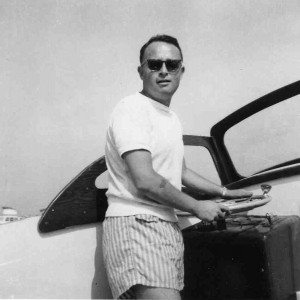
Dad was generally supportive of my music career. He and Mom paid my way through the undergrad years, though he didn’t understand my initial career goal of becoming an early music scholar and performer. (After I got my first Renaissance lute, he’d tell everyone that his son was at UCLA studying to be a shepherd.) He was proud of my later successes, and attended many of my Southern California concerts and TV gigs, even though they were in a language he didn’t understand: music.
Like me, Dad went to UCLA and then grad school at Berkeley. His field, in those pre-computer days, was electrical engineering. He worked in aerospace till my adolescence, when he went into education, eventually becoming dean of the business division at Mount San Antonio College. He often observed how his life coincided with the emergence of digital technology. He was a tech geek till the end. I loathed that stuff when I was young, never dreaming that computers would one day be central to my own creativity. Dad was a bit bemused in recent years when I’d query him about antique analog technology, like paper-in-oil capacitors or vacuum tubes. When he got into the field, even computers ran on tubes.
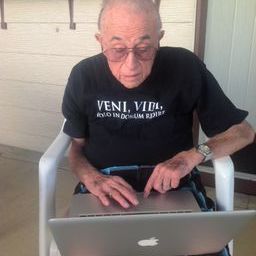
Dad was an Apple fanboy from the get-go, perpetually excited about the latest gadgets. Last year we went into an Apple store to get the new iPad for his 90th birthday.
The pimply sales dude started explaining the device as if to a child.
“I have just one question,” interrupted Dad. “Can I use it to download porn?”
The poor sales guy turned to me with a panicked expression, seeking a cue: Should he laugh, or pity my “senile” parent?
“Sorry,” I told him. “My dad really likes to work the ‘outrageous little old man’ angle.”
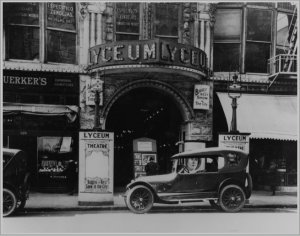
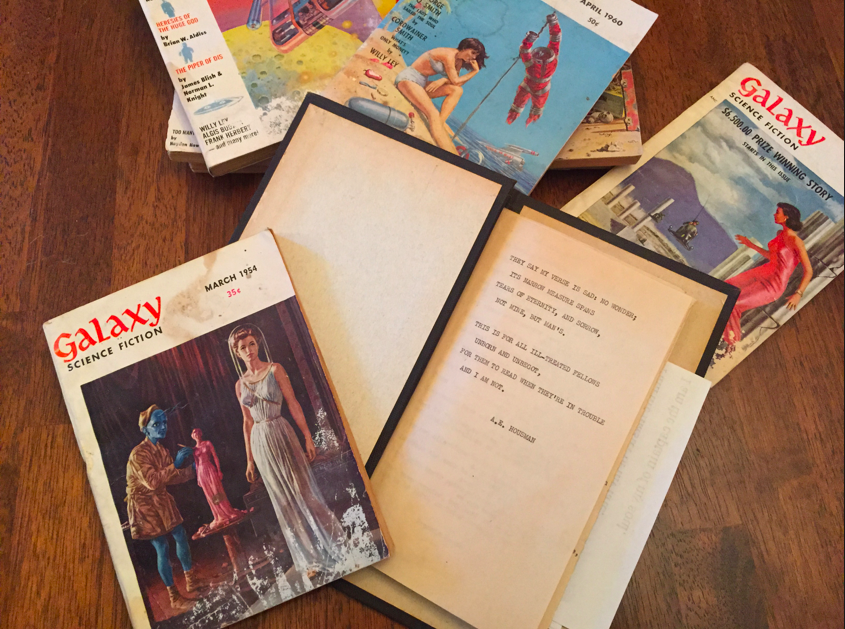
Dad was also a lifelong fan of the fantastical. Growing up in Depression-era Hollywood, he’d haunt the newsstands, devouring “weird fiction” pulp magazines. (He was old enough to have read H.P. Lovecraft tales when they debuted in cheap ink on disposable paper.) His father, Jacob, managed the old Lyceum Theater on Spring Street in downtown LA, so horror flicks, B-movie thrillers, and cliffhanger serials were also part of the mix. His life paralleled the development of sci-fi, from the pulp days of his youth through the “Golden Age” of the ’40s, the new wave of the ’60s/’70s, ’90s cyberpunk, and beyond. Dad dug it all.
The lurid covers of sci-fi paperbacks were a backdrop of my ’60s/’70s childhood. You bet your ass we watched the debut episode of Star Trek in 1966, though Dad had to explain to seven-year-old me what “trek” meant. Another highlight was the annual writers day at his college, which often featured sci-fi greats like Ray Bradbury and Harlan Ellison. (My mom once thrust her hand and a felt pen at Bradbury. “Illustrate me!” she demanded of the author of The Illustrated Man. He drew a little devil face on the back of her hand. But Mom’s quirks are an entirely different story.)
While I inherited Mom’s taste for literary fiction, Dad and I always bonded on the genre stuff. In recent years we simultaneously read books on our respective iPads in our respective cities, comparing notes. I’d dig up things he hadn’t read in 60 or 70 years, like A.E. Van Vogt’s novella “Slan” and Weird Tales reprints. I turned him on to recent horror phenom Laird Barron, and we both devoured Jake Arnott’s kaleidoscopic novel The House of Rumour, one strand of which deals with an LA sci-fi author of precisely my dad’s age. (Another strand features real-life figure Jack Parsons, the rocket scientist who founded Aerojet General, Dad’s employer during the ’50s and ’60s. Dad had no idea that Parsons was a full-on Satanist — an Alistair Crowley acolyte who conducted sex magick rituals at his Pasadena home with L. Ron Hubbard in the latter’s pre-Scientology days, as documented in George Pendle’s Parsons biography, Strange Angel — another book we consumed in tandem.)
Even the knowledge that he was dying of cancer didn’t slake Dad’s taste for creepy stuff. Just a few weeks ago it occurred to me that he might get a kick out of Dead Snow, a campy Norwegian horror flick about reanimated WWII storm troopers.
“Dad, what do you think of zombies?” I asked.
“I love them.”
“Yeah, but what do you think of Nazi zombies?”
“They must be destroyed!” he decreed.
We had fun watching it together, though he didn’t dig it as much as I did. He was more into recent TV shows like American Horror Story. The realization that Dad will never learn the ending of Hemlock Grove or Game of Thrones is enough to unleash another torrent of tears, despite the fact that there’s a good chance none of us will live to see the conclusion of GoT.
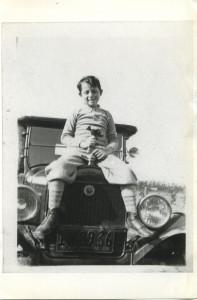
The more I contemplate it, the more I believe Dad’s tastes shaped the way I approach music. By their nature, sci-fi, fantasy, and horror continually ask, “What if?” Those genres are conceptual teeter-totters, balancing objective science and unknowable mystery. What if everything we believe is wrong? If everything good is really bad, and vice versa? How might a seemingly trivial past incident have altered the course of history? Do we face a future of promise or desperation?
I perceive echoes of these questions in the way I embrace my canonic classical music education while simultaneously distrusting it. I can’t listen to or create music without asking questions of my own: What if Bartók had played punk rock? If Joni Mitchell had lived in the 14th century? If Hendrix had played with Ellington in the ’30s? If Bach had been Nigerian? I find it exceedingly difficult to accept things as they are, or to leave well enough alone.
Dad had far more facets than “tech guy” and “sci-fi geek” — those are just two aspects ricocheting around my skull at the moment. I know I’ll spend the rest of my days contemplating his life and trying to learn from his example. He had much to teach about kindness, patience, and the not-so-simple art of being happy — skills that don’t come easily to me.
My dad’s cancer was dire but relatively painless. His mind remained razor-sharp till the end. He died with calm dignity, at home. He was ready. (When he got the fatal diagnosis, his first words were, “I can’t complain. I’m 91. I’ve had a good run.”) He’d wrapped up his business and made his farewells, and we all had the opportunity to say everything that needed to be said. He lived long and prospered, and we should all be so lucky as to go as peacefully as he did.
But damn, I miss you, Dad. Love you always.


Leave a Reply