UPDATE, Sunday, October 2nd: We had a nice little online meeting Friday eve. I’ll be posting a PDF with step-by-step instructions for Project 1 on Monday, the 3rd. Check back here!
Now that people have had a few days to assemble tools and parts, we’ll be diving into our first project after the weekend. Again, this will be basic stuff, suitable for absolute newbs. But I’ll be including info about mods and options that may be of interest to more experienced builders. Also, the projects themselves will sound seriously bad-ass, if I do say so myself. 🙂 (more…)
Most modern guitar pickups are potted. That means they’re dipped in wax to prevent their components from vibrating against each other in high-volume situations, which can produce unwanted feedback.
The process also prevents pickups from becoming microphonic, amplifying sounds traveling through air along with the magnetic information generated by the pickups interacting with the strings. Some pickups are so microphonic, you can literally talk into the pickups and hear your voice through the amp.
Want to hear a pickup that sounds like a cheap megaphone?
Check out this short article from Beavis Audio Research. Great advice on choosing a soldering iron, and a nice introduction to some of the basic moves, plus a few good jokes. Many other fine tutorials at this superb DIY site.
Chicarrelli on Jack White: "He has an attack unlike anyone else. The concussion of his playing is just unbelievable."
Joe Chiccarelli is one of music’s most respected producers and engineers—and one of the most versatile. After making his mark as Frank Zappa’s studio right-hand, he went on to work with such artists as U2, Elton John, Beck, Tori Amos, Morrissey, Dwight Yoakam, Rufus Wainwright, and Jason Mraz. He’s particularly admired for his recent work with guitar-heavy rock bands such as the White Stripes, the Raconteurs, the Strokes, My Morning Jacket, the Shins, and the Killers.
Joe started out as a bass player in his native Boston. He only plays a bit of guitar, but he knows more about getting great guitar sounds that almost anyone I know. I’ve been lucky to enough to record several albums under his supervision, and each time I’ve been floored by his superb taste, vast tech knowledge, superhuman work ethic, and mind-boggling attention to detail. He can be a real taskmaster! But he’s also one of the most patient, considerate, and just plain sweet guys I’ve ever worked with.
Joe is the polar opposite of those technicians who jealously guard their “secrets.” He’s always generous with his knowledge, and was kind enough to take a break from a recent session to let me fire a few questions at him. (more…)
He should have added: Don’t touch the hot end of the iron. Work in a ventilated space. Wash your hands afterwards. Don’t eat the solder. Sheesh! What’s wrong with kids these days? 😉
"Let me teach you a thing or two about CHUNK, sonny!"
The other day I posted a few audio clips I’d recorded using a Guild Archtop fitted with a Seymour Duncan Custom Shop Dynasonic® pickup. Going with the ’50s theme, I strung the guitar with flatwounds and coughed up a few Eisenhower-era licks.
Reader Dohmin Semper wondered how that setup would sound playing punk or metal. I muttered a polite response and moved on.
But later I felt guilty. With all this blog’s big talk about breaking things rules, why had I restricted my demo of this cool pickup to the most obvious uses? What a wuss! So I slunk back into my studio and bashed out a few riffs through high-gain amp simulations. (more…)
WARNING! This post contains the answers to the quiz! If you still want to take the test, stop reading now and challenge your ear here.
Don't worry, it's only Photoshop. We would never inflict anything this hideous on one of our winners.
It was only two weeks, but it feels so much longer—at least for me, after processing some 220 entries before receiving the third perfect eight-out-of-eight score last night, which concluded the contest.
I honestly didn’t think it would take as long as it did. Not that I’m complaining! The Amps Vs. Models Contest was a fascinating experiment that produced many interesting comments. Thanks to everyone who chimed in!
The final entry was from Jessie Nieboer of Walkerville, Michigan, who selected a Seymour Duncan Twin Tube Mayhem pedal as his prize. Several days earlier, Ralf Tyra of Hamburg, Germany, claimed second place. He chose a Twin Tube Classic and a Tweak Fuzz. And last week Colm Kelley of Dublin, Ireland, took first place with the first perfect score. He hasn’t yet decided which stompboxes he wants, but mentioned the possibility of three Deja Vu delay pedals.
I hereby call to order the first meeting of the Tonefiend DIY Club!
Our mission: To attain tonal mastery over our guitars, amps, and effects with the least possible damage to our gear, bodies, homes, and pets. When the smoke has cleared (and all the smoke alarms have been reset) you’ll be able to install pickups, customize your guitar’s electronics, mod and build stompboxes, repair cables, and brag about your technical prowess while waiting in line to file your insurance claims.
Take it from one of the laziest and clumsiest people ever to brandish a soldering iron: Anyone can learn these skills. They’re fun and creative, and they’re one of the best ways to “own you tone,” if I may borrow the Seymour Duncan motto.
As promised, this material will be suitable for absolute beginners. (Though I hope more experienced guitar hackers join in, because we’ll really need your help!)
Read on for lists of what you’ll need to build our first three projects, plus recommended reading while waiting for your stuff to arrive. (more…)
Take my advice: When MJ says she has something cool to show you, drop everything and investigate.
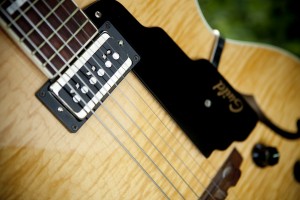
MJ, of course, is Maricela Juarez, the longtime manager of the Seymour Duncan Custom Shop. And the item in question was a clone of the DeArmond 200 pickup, also known as the Gretsch Dynasonic®. Predating the Gretsch Filter’Tron, the Dynasonic provided one of the key sounds of classic rockabilly, and was used at times by Cliff Gallup, Eddie Cochrane, and Duane Eddy. It’s also just about the prettiest-looking pickup I’ve ever seen. (more…)
In Part 1 of this series, I introduced 24 fingering patterns that can be jumping-off points to any number of warmup and dexterity-development exercises. As threatened, this installment introduces additional technical hurdles guaranteed to challenge even advanced players. Try these out—but only after you can play the everything in Part 1 comfortably and consistently (“like identical pearls on a string”).
 Now that people have had a few days to assemble tools and parts, we’ll be diving into our first project after the weekend. Again, this will be basic stuff, suitable for absolute newbs. But I’ll be including info about mods and options that may be of interest to more experienced builders. Also, the projects themselves will sound seriously bad-ass, if I do say so myself. 🙂 (more…)







![Cruel Finger Exercises [Part 2]](https://tonefiend.com/wp-content/uploads/hand_7-150x126.png)