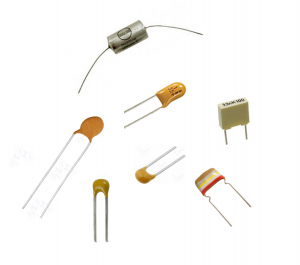
Many players know you can change the voicing of your tone pot by substituting capacitors of different values. I’ve seen many explanations online, though I’ve never come across side-by-side audio comparisons. This post is designed to fill the gap.
I’ll skip the “what’s a capacitor?” spiel. If you’re curious, check out this easy-to-understand article from Beavis Audio Research, one of the best (and funniest!) DIY sites.
For our immediate purposes, here’s all you really need to know:
The tone pot and capacitor comprise a low-pass filter, so, when you lower the pot, you lose treble and your tone gets darker. So far, duh. More intersting: as you substitute caps of higher value, you lose more and more highs as you lower the pot.
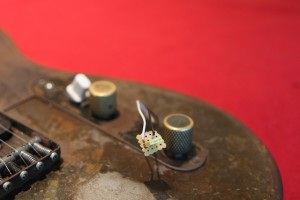
Today I was working on my fave guitar, a James Trussart Steelcaster. Instead of reconnecting my tone pot and capacitor as usual, I ran two wires from the tone pot’s wiper and ground terminals, the spots where the cap normally connects, and soldered them to a little piece of stripboard with sockets for connecting the caps. Then I recorded quick demos for six possible cap values. I started with the two most common values, and then added two lower values and two higher ones.
A few things to remember as you listen:
- The capacitor only contributes to guitar’s tone when you lower the tone pot. If you always play with your tone pot wide open, none of this matters.
- The guitar I used to demo the caps has passive single-coil pickups, but the principle is the same with humbuckers and even active pickups.
- The value of the capacitor—denoted by a number—is what matters. However, the type of capacitor makes no audible difference whatsoever, though it can make a sizable difference on your wallet. (If that statement makes your hackles rise, read the postscript below.)
- For whatever reason, there are three common systems for expressing capacitor value. I’ll skip the “logic” behind that and just cite all three names the first time I mention each cap value.
In this first section, you’ll hear three things in each demo: Some chords with the pot all the way open (maximum treble); all the way closed (minimum treble), and then a “manual wah-wah” effect as I strum chords and roll the pot throughout its range.
Let’s stat with the most common tone pot cap value, .047μ (also expressed as 47n and 473). This, BTW, is the recommended value in most of the wiring diagrams on the Seymour Duncan website.
.047μ Demo
But if you never play with a tone as dark as the fully-rolled off sound, you might consider a lower-value cap. The next example is an .033μ (also know as 33n and 333), another popular choice, followed by the smaller .022μ (also know as 22n and 223), and the even smaller .01μ (also know as 10n and 103). As the cap gets smaller, the minimum tone knob settings gets less dark. As the overall range of the tone pot decreases, it may be easier to locate any desired “nooks and crannies” between the highest and lowest settings.
.033μ Demo
.022μ Demo
.01μ Demo
Get the idea? Now let’s go in the opposite direction, using higher value caps for a darker sound when the tone knob is lowered all the way. You’ll hear a .068μ cap (also called 68n and 683) and a .01μ (AKA 100n and 104).
.068μ Demo
0.1μ Demo
A good question to consider at this point: What the absolute darkest tone you’d ever want from your guitar? I know the two times I’m likeliest to lower the tone pot are when I want a dark, jazzy neck pickup sound, and when I’m trying to get a clarinet-like sound using an EBow. These next examples show how the various caps behave in those situations. We’ll go from lowest value (minimum treble cut) to highest (maximum treble cut).
.01μ Dark Jazzy
.022μ Dark Jazzy
.033μ Dark Jazzy
.047μ Dark Jazzy
.068μ Dark Jazzy
.1μ Dark Jazzy
Now let’s hear some EBow:
.01μ EBow
.022μ EBow
.033μ EBow
.047μ EBow
.068μ EBow
.1μ EBow
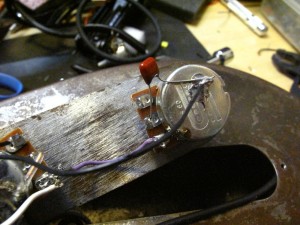
In the end I decided to go with the .033μ. Everything larger sounded too wooly to me on the neck pickup. If I didn’t play much EBow, I might even consider the .022μ. But you might make a different choice, especially if you were using brighter pickups. You won’t know for sure till you try it out with your instrument, amp, and hands, but I hope this gives you some idea of what to expect.
Postscript: About that “capacitor type doesn’t matter” statement: Them’s fighting words in many online forums, especially in the stompbox realm. You’ll often see the inclusion of some rare “mojo” capacitor cited as a selling point for a particular product. I used to think I sometimes could hear a difference—until I built a couple of effects with quick-change sockets for comparing cap types. The audible differences were negligible, no more meaningful than the variations between two caps of the same value and same type. My advice is, if someone tries to sell you anything based on cap type, proceed with much caution. I now strongly believe that cap type is of no importance, at least in guitar and analog stompbox applications.
Disagree? Don’t argue—supply me with repeatable audio evidence of how the same circuit sounds before and after swapping cap types, and I’ll happily admit I’m wrong. 🙂
“Mojo” is a fascinating word. It originally meant a magical talisman or amulet. Nowadays it’s used to refer to an abstract special something—talent, charisma, whatever—a remarkable quality that’s hard to define but impossible to miss. And in the world of DIY electronics, it has an additional meaning: total b.s.
Anyone have any cool to add to the capacitor conversation?


Leave a Reply