Man, it pays to curate a blog frequented by smart people!
I wrote last week about my experiment with silk-and-steel strings.
It’s the latest chapter in my ongoing search for the right acoustic strings. Most available options simply sound far too harsh and bright to my ears, especially for fingerstyle playing on the small-bodied guitars I favor. Even though the Martin silk-and-steels I used were dramatically quieter than most bronze strings, I dug their warmth and strong fundamentals — and the absence of the hyped sizzle of bronze.
Several of you responded in comments with string suggestions, including several types I barely knew existed. Despite some rather shocking expenditures for these high-end, imported strings, I found much to love. Now I’m rich in tone, if nothing else.
Since I’m hot on the trail of a cool new fuzz circuit, I haven’t yet had time to record demos (and besides, I’d rather wait till the strings wear in a bit). But I’d like to share details about several products that impressed me.
Reader Rebeat suggested John Pearse Phosphor Bronze and Silk, which I put on my 000-sized Lowden, an extremely bright instrument. The wound strings of this set (which is available only in gauge .011/.049) features a silk layer between the core are bronze wrap. The result truly seems to split the difference between bronze and silk-and-steel strings. They feel a bit like conventional bronze, but with markedly less string noise and hyped treble. They’re quieter too, though not as quiet as silk-and-steels. It’s exactly the adjustment I wanted for this guitar, and I’m delighted with the results. (Also, these strings seem far likelier to withstand aggressive pick-style playing than any regular silk-and-steel set.)
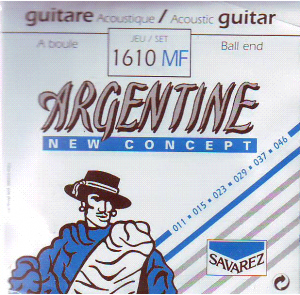
Reader smgear directed me to Savarez Argentines. As much as I love Django, I’ve never had much interest in trying to sound like him, so I’ve never tried a strings of this type. In fact, I had no idea how many manufacturers produce “Gypsy jazz” strings. (I also bought a set of seemingly identical John Pearse Nuage strings.) Both are quieter than bronze strings, with a soft, supple feel. There’s not a lot of mass to the sound — it’s more about a cutting tone to make single-note solos stand out in an acoustic band. Since the tone is a bit plinky, I put them on my two plinkiest-sounding guitars: the oddball Cathedranola heard here, and my plastic Maccaferri (a cheapo ’50s guitar conceived by the guy who created Django’s signature Selmers).
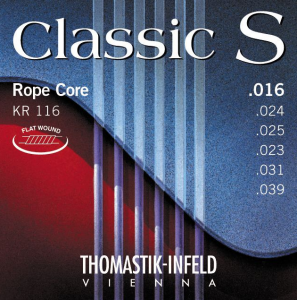
I owe extra thanks to renowned luthier/guitar tech Al Milburn, who directed me to Thomastik-Infeld Classic S rope-core strings. (I haven’t yet tried the non-rope-core version.) Holy crap — I’ve never encountered anything like these strings! The gauges are weird: .016 through .039! And all six are wound — the trebles feature nylon tape wound on a rope core, and the basses are flatwound, silver-plated copper on a rope core.
Sounds bizarre — but they don’t sound bizarre, if you follow. As you’d expect, they’re quieter than bronze, with a warmer, softer timbre. Yet there’s far more treble animation than you might suppose — you’d never call them “dark” or “dead-sounding.” You don’t get the nasty, scraping top-end of bronze, yet they have a lovely open/airy quality, paired with strong, clear fundamentals. And while the gauges are unconventional, the feel isn’t. If you weren’t paying attention, you’d think you were playing an .011-.046 set. Granted, they’re over $30 a set — but I’ve already discovered that the Thomastik flatwounds I’ve been using on many of my electrics last far longer than conventional roundwounds. We’ll see if that’s true for the Classic S set as well.
I am completely infatuated with the way these strings feel and sound — though I’d like to spend a few more days playing and recording with them before deciding whether it’s the love of a lifetime, or just a diverting summer crush.


Leave a Reply