Stay One Step Ahead with the Best Payment Methods for Online Casino Bonuses
When it comes to online gambling, finding the best MuchBetter casino sites can make all the difference in your gaming experience. MuchBetter is an innovative payment solution that allows players to make fast and secure transactions. With its seamless integration and user-friendly interface, this e-wallet has gained popularity among online casino enthusiasts. Whether you are a seasoned player or new to online gambling, choosing a MuchBetter casino can provide you with a convenient and enjoyable gaming experience.
One of the top MuchBetter casino sites is https://csiss.org/deposit-methods/muchbetter/. This online casino has embraced MuchBetter as a preferred payment method, ensuring that players can easily deposit and withdraw funds. CSISS offers a wide selection of casino games, including slots, table games, and live dealer options. With its user-friendly website and mobile app, players can enjoy their favorite casino games on the go. The casino also boasts a generous welcome bonus and regular promotions, ensuring that players have ample opportunities to boost their bankroll.
Another excellent MuchBetter casino option is csiss. Known for its extensive game selection, this online casino caters to players of all preferences. From classic slots to progressive jackpots and live casino games, there is something for everyone at CSISS. The site also features a sleek and modern design that allows for easy navigation, making it a pleasure to explore the wide range of games. With its integration of MuchBetter as a payment option, players can enjoy swift and secure transactions, ensuring that their gaming experience is hassle-free.
In conclusion, selecting the best MuchBetter casino sites can greatly enhance your online gambling experience. Not only does MuchBetter provide a convenient and secure payment solution, but it also allows for seamless integration with top online casinos like csiss.org. With its extensive game selection, user-friendly interface, and generous promotions, [CSISS] is an excellent choice for players looking for a top-notch gaming experience. So, why not give MuchBetter a try and enjoy the benefits it brings to your casino gaming?
When it comes to online gambling in Austria, one of the most important factors to consider is the withdrawal process. Players want to ensure that they can access their winnings quickly and conveniently. That`s why the best online casino instant withdrawal in Austria is in high demand among avid gamblers. One platform that stands out in this regard is https://online-casino-osterreich.org/sofort/. With its seamless and efficient withdrawal system, players can enjoy their winnings instantly.
One of the key reasons why this online casino is considered the best for instant withdrawals is its partnership with reputable payment providers. They offer a wide range of options, including popular e-wallets such as Skrill and Neteller, as well as traditional bank transfers. This means that players can choose the method that suits them best and receive their funds without any unnecessary delays. Additionally, the casino`s user-friendly interface and intuitive navigation contribute to a smooth withdrawal process.
Moreover, this platform also prioritizes security and fairness. It holds a valid gambling license, ensuring that players` transactions and personal information are protected. Furthermore, it provides a wide selection of high-quality games from renowned software providers, guaranteeing a fair gaming experience. Whether you prefer slots, table games, or live dealer options, this online casino has something to cater to every player`s taste.
In conclusion, if you`re looking for the best online casino with instant withdrawal options in Austria, online-casino-osterreichis the ideal choice. Its partnership with reputable payment providers, commitment to security and fairness, and extensive game selection make it a top-notch platform for any passionate gambler. Experience a seamless and convenient withdrawal process today by visiting their website.
When it comes to online casinos, one of the most important aspects for players is the availability of secure and convenient payment methods. This is where ecoPayz casinos online truly shine. As one of the best providers in the industry, ecoPayz ensures that players can enjoy a seamless and hassle-free gaming experience while keeping their financial information safe. With its user-friendly interface and widespread acceptance, ecoPayz is a preferred choice among online casino enthusiasts.
One of the top ecoPayz casinos online is https://online-casino-schweiz.org/ecopayz/. This casino not only offers a wide range of exciting games and lucrative bonuses but also provides the option to use ecoPayz for deposits and withdrawals. With just a few clicks, players can easily transfer funds, ensuring a smooth and efficient gaming experience. Additionally, this casino prioritizes customer security, utilizing advanced encryption technology to protect sensitive financial details.
Another reputable ecoPayz casino is [Your Anchor Text]. With its sleek and modern design, this casino attracts players from all over the world. Thanks to its collaboration with ecoPayz, players can enjoy quick deposits and withdrawals without any additional fees. Moreover, the casino offers a generous welcome bonus and ongoing promotions to enhance the overall gaming experience. With its extensive collection of games and seamless integration with ecoPayz, this casino is a top choice for online gamblers.
In conclusion, ecoPayz casinos online are excellent options for players looking for a secure and convenient payment method. With widespread acceptance and a commitment to user safety, ecoPayz ensures that players can enjoy their favorite casino games without any worries. By choosing top ecoPayz casinos like [Your Anchor Text], players can enjoy a seamless gaming experience while benefiting from quick and hassle-free financial transactions.

Pedaltrain didn’t dig the cover of the new Guitar World, so they changed it. (View the best Instagram ever here.) I think I’m going to have to go out and buy even more excellent Pedaltrain boards.
Funny thing: My friends outside the guitar biz tend to imagine that it’s some super-hip industry, when in fact, it’s a rather retro community where crap like this is depressingly common. Damn, with so many things in our culture to undermine girls’ confidence, who needs more from music mags?
As a palate cleanser, here’s a video of girls who actually play:
My band recently had the privilege of playing a Bay Area Girls Rock Camp benefit. The between-acts music was all recorded by the campers, and some of it was awesome. I’m not even a parent, yet I’m grateful the organization exists to counter crap like the Guitar World cover.
Are there any similar groups in your area? Do any of the moms and dads among you have thoughts about nurturing and empowering young musicians?
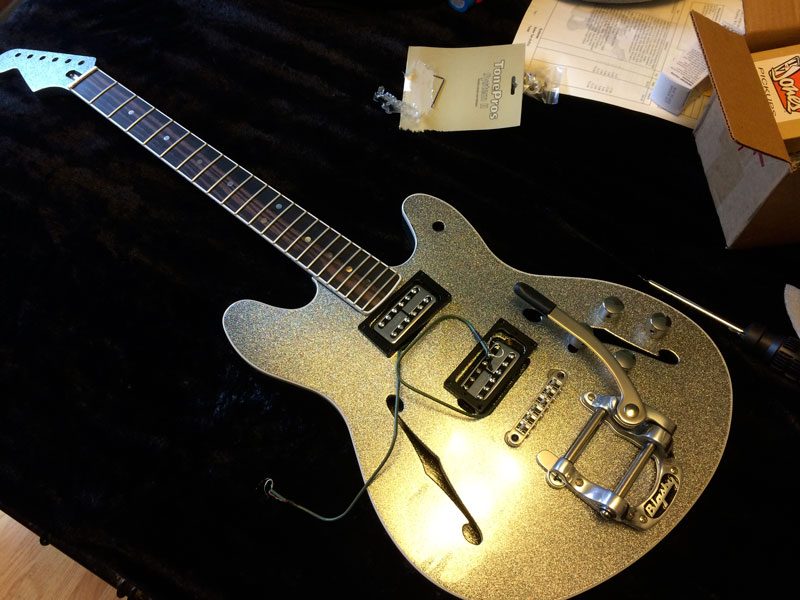
Look what UPS left on my porch: the neck and body for my latest ill-advised “parts” guitar project. I’ll be slapping it together in the coming days, but I couldn’t resist showing off the pretty parts. The body is Warmoth’s Mooncaster model, which is based on Fender’s semi-hollowbody Starcaster, a quirky cult guitar if ever there was one. But for the neck, I swiped an idea from Warmoth’s Josh Spataro, and substituted a reverse angled Strat neck. The tacky silver finish and extravagant binding are solely the result of my bad taste. (Josh compared it to a pinky ring, which is pretty accurate.) The body is korina, the neck mahogany.
If my last Warmoth parts guitar was a sort of Fender/Gibson hybrid, this one is more Fender/Gretsch. I’m planning to install a set of TV Jones pickups, and this will be my chance to try out a very different type of tone control scheme, one I’ve been thinking about for a while. If it turns out well, I’ll write about it. If not, I’ll probably delete the last few sentences and deny they ever existed.
This is my third Warmoth parts project since starting this blog. As before, I’m 100% delighted with the materials and build quality. Since I requested expensive options (like the vulgarly bound and finished neck) and I’m using fancy parts, the guitar probably won’t be vastly cheaper than if I’d bought it already made. But it should be unique and fun. Stay tuned — and I’ll hope the guitar does too.
I needed a 12-string acoustic in a hurry for a session, so I picked up a new Taylor 150e for under $700. It wasn’t a review model or anything — I just ordered one online, sight unseen and sound unheard.
This model has been generating much buzz as an affordable yet good-sounding 12-string. It’s savvy positioning on Taylor’s part: I suspect there are many players who, like me, would love to have a nice 12-string, but aren’t about to spend $2,000+ for that occasional color. Anyway, I’m duly impressed. Have a listen!
I’ve got it strung with a super-heavy set from Pearse, and it’s a bit too macho for me. I dig the volume and harmonic richness, but it’s a beast to maneuver, at least for complex fingerstyle stuff. Either I’ll restring with something lighter, or consider testosterone supplements.
I haven’t owned a 12-string acoustic since I was 13. My first decent acoustic guitar was a late-’60s Fender Villager 12-string purchased for under $200. I loved it, but unfortunately, the shop that worked on it removed the tone bar, an essential brace. Uh oh — after a couple of weeks, I opened the case to find that the guitar had imploded on itself overnight. Instead I got a Yamaki 6-string, a crappy Yamaha knockoff. I’ve spent years in therapy working through the trauma.
The 150e is a Mexican-made instrument with a solid spruce top and a layered sapele body. I didn’t even realize till I received the guitar that it included onboard electronics. I almost never use that stuff, but before typing this, I went to plug it in. And guess what? It’s a surprisingly decent-sounding system that relies on an internal microphone. It doesn’t sound as good plugged in as it does in the video, but it’s totally acceptable for stage use. I didn’t expect it to sound half as good.
Anyone tried one of these? Any other acoustic 12-string recommendations, observations, or rants? What’s the coolest 12-string riff? And who’d win in a fight: Leo Kottke, Ralph Towner, or Leadbelly?
Awesome! I just received production prototypes for my next three stompbox releases, in the wake of last month’s launch of my Duh Remedial Fuzz. I’m still making minor tweaks, but these should be available in just a few weeks. Whee!
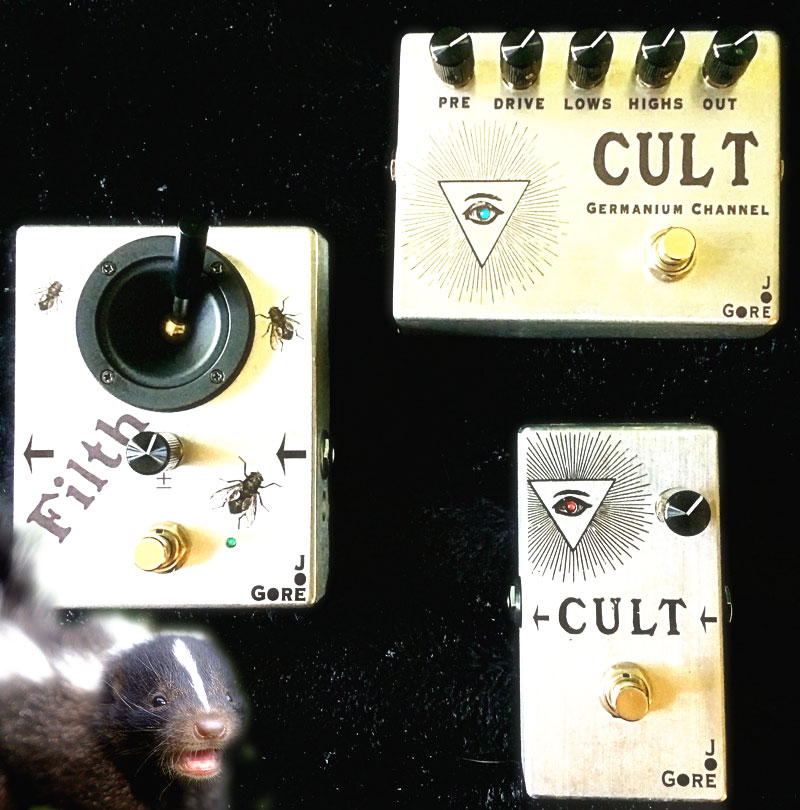 Filth is a freaky joystick fuzz. Cult is my oddball take on Rangemaster-style single-transistor overdrive. It’s my absolute favorite distortion device, and the same one heard in many of my videos and gear reviews. The Cult Germanium Channel supplements this simple but deadly circuit with extra controls and an active EQ stage.
(Baby skunk sold separately.)
Filth. I love whack-job fuzz boxes like the Z. Vex Fuzz Factory and the countless “sick fuzz” pedals it’s inspired over the last two decades. But here my goal was to create one with a higher percentage of “likely to use” settings — I wanted to make it easier to find the good stuff. Topologically, the circuit’s nothing tricky — basically a Fuzz Face descendent coupled with an extra JFET boost stage (though it doesn’t sound remotely like any Fuzz Face you’ve ever heard). The main innovation is the x/y control, which jiggers the transistor biasing, producing a broad array of timbres. It’s not a conventional tone control, though it’s arranged so that it’s easy to summon smooth, chubby tones or angry, brittle ones.
There was a lot of interest in this a couple of years ago when Fuzz Box Girl posted a demo (apparently no longer online) of one of my handmade ones. She focused on the pedal’s maximum-gain, My Bloody Valentine side, which was fine — Filth can definitely make your amp melt like a Salvador Dali timepiece. But now it’s easier to dial in crisp, lower-gain tones.
I’m making two Filth versions: the joystick model [pictured], and one with three conventional knobs. They sound identical — only the interfaces differ. The three-knob is good if you want to mark an exact setting for use onstage, while the joystick is more fun when concocting new sounds. (I don’t know the exact pricing yet, but the joystick model will cost more, because that’s an expensive part!)
I’m far from the first builder to create a joystick stompbox, but you usually encounter them on crazy noisemaker effects, or deployed as conventional EQ controls. I’m not aware of another pedal where it regulates the fuzz’s fundamental timbre this way. But then, I don’t get out as much as I should.
Cult. If you’ve seen my videos or heard my audio demos, you’ve probably heard Cult. I’ve built it into several guitars (while others have a built-in Duh fuzz). It’s a one-germanium-transisor boost descended from the Dallas Rangemaster of the 1960s, though the apple has rolled far from the tree: All part values differ, the EQ profile is modernized, and the gain control works in an unconventional way. But like a Rangemaster, it boasts spectacular dynamic response and electrifying tones that crackle with presence.
To my (admittedly odd) ear, no other distortion sounds as bitchin’ as a single-transistor boost between a good guitar and a great amp. The weird thing is, while most players know the countless ’60s rock tracks produced with such primitive boosters, many have never tried this sort of circuit. I love faithful Rangemaster clones, and I love many of the variations I’ve explored over the last five years. But Cult is my very favorite recipe.
Cult Germanium Channel. This one pairs the Cult circuit with relatively modern active EQ/boost stage, with proper tone controls that don’t suck tone. The added circuitry sacrifices a touch of Cult’s explosive presence, but it provides a greater range of tones. There’s also more gain on tap, so it’s better for those high-testosterone rawk tones that I’m far too much of an prissy, effete San Franciscan to use myself.
Thanks a Lott. As mentioned, these are manufactured by Cusack Music in Michigan, under the expert eye of engineer Tony Lott. Cusack builds pedals for numerous boutique brands you know, many of whom prefer to keep the fact a secret. But I’m proud of the relationship, because Tony and his team improve everything I submit. (More about the collaborative process below. It’s fascinating stuff, assuming you’re a geek — which I do assume, since you’re here.)
MORE→
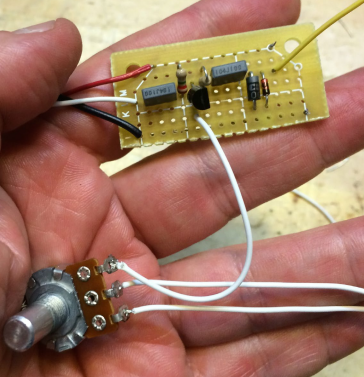 You can build an awesome-sounding designer distortion pedal for about $45. (Joe’s hand sold separately.) Have you been reading about DIY guitar effect projects for years and thinking about giving one a shot?
Here’s a good excuse: Premier Guitar just published my “Build Your Own Stompbox” article, which just may be the most ambitious project I’ve ever undertaken for a guitar mag. And there’s more to it than just building a great-sounding distortion pedal from scratch: It’s practically a “how to build your own guitar effects” course, covering everything from sourcing parts and prototyping through boxing and troubleshooting. You’ll learn how all the key components work, and how to choose the ones that best suit your needs. Most important, you’ll start customizing the circuit from the project’s first stages using techniques you can apply to all your future builds.
The project is based on the simple but powerful Electra distortion circuit, the same one used in many boutique overdrives. Yup — it’s the same circuit that I’ve been featuring as Project #1 in Tonefiend DIY Club for a couple of years. But this revised and expanded version is far superior to the original, thanks to lots of help from my talented PG colleagues. Art Director Meghan Molumby did an amazing job assembling the massive build guide PDF (which you can download for free here). The layout is incredibly user-friendly, and you’ve never seen nicer-looking schematics and diagrams. The text got a thorough going-over from ace editors Andy Ellis and Shawn Hammond, so there are far fewer of my usual boneheaded typos. And there’s a cool video demo by Nashville ace John Bohlinger, so for once, you don’t need to watch one of my twitchy performances to hear how it sounds. What’s not to like?
But wait, there’s more: My pals at Mammoth Electronics have put together a $45 prepackaged kit to spare you the hassle of sourcing all those pesky little parts and drilling your own enclosure. There are lots of cool optional upgrades, like painted enclosures, premium switches, and bitchin’ knobs. Details here. (Neither I not Premier Guitar have any financial stake in the kit. I just asked Mammoth to create one as a convenience.)
Seriously — this one’s good. If you’re finally ready to burn your house down master that soldering iron, well, zero hour is here!
… at least if, like me, you have the soul of a 12-year-old Japanese girl.
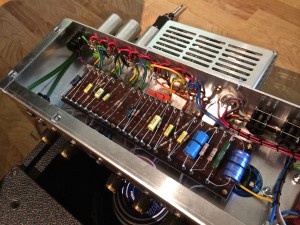 How come my DIY amps never look this pretty inside? A couple of weeks ago I posted here about a Premier Guitar project in which I built two Marshall 18-watt clone kits. Meanwhile, the magazine received a review model of Marshall’s latest iteration of the 18-watt, a high-end, hand-wired version that sells for $2,700. My new review is online at PG, if you’re curious to hear a proper Marshall as well as the clones.
My take: It’s a beautifully built, hand-wired amp that sounds as least as good as either clone. Unlike the kits with their single 12″ speakers, the Marshall has a pair of 10s, which I think I prefer in this circuit. At $2,700, though, it’s pretty darn expensive, even for a beautiful, hand-made instrument. But I’ll be sad when I send the review model back to Bletchley.
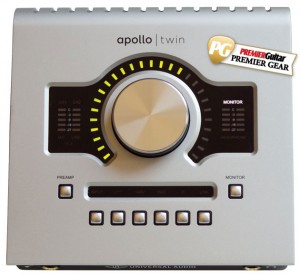
Premier Guitar has posted my review of Universal Audio’s Apollo Twin interface. Short version: I love the thing.
A rackmount Apollo interface has been the core of my studio for two years, replacing both a Pro Tools HD rig and a complicated Apogee setup. I adore Apollo’s great-sounding preamps, lucid interface, and innovative software, which, among other things, lets you track through simulated preamps on your way into your DAW. Also, UA’s analog modeling is second to none. (You hear their reverbs and tape simulations on most of the stuff I’ve recorded for this site.)
The intensity of my Apollo love is rivaled only by my scorn for the crappy mobile interfaces I’ve previously used with my live laptop rig. The problem isn’t audio quality — even the cheapest ones can sound surprisingly decent — so much as lousy ergonomics and flimsy construction. I’ve burned through half a dozen interfaces in the last few years. They just aren’t built to last onstage. Or anywhere else.
That’s why I’m so stoked to have the small-format Apollo on my digital pedalboard. It’s built well. The UI is brilliant. There are no horrid breakout cable octopi. It has the same preamps and processors as the rackmount Apollo. And I have access to my favorite UA plug-ins, including the juicy EMT plate reverb simulations, the stellar tape echo models, and a suite of low-latency virtual preamps. It’s pricy for a mobile interface: $700 for the single-processor model and $900 for the dual-processor model. But I’d spent far more than that on self-destructing junk that I wound up giving away or recycling.
Anyone else tried Apollo in its various formats? Or any other cool converters? Your observations, please?
Sorry my blog posts have been a bit scarce lately. A few weeks ago, my super-cool 91-year-old dad (who sometimes posts here) went to Joshua Tree, tripped, and fractured his hip. So to help out, I’ve been shuttling the 400 miles from my home in San Francisco to West Covina, the right-wing, smog-shrouded LA suburb where I grew up, and where Dad still lives with his equally cool wife. (He’s mending well, BTW, and is running his physical therapists ragged.)
On my last road trip, I got to thinking about musical geography in America, and how it once defined our music. Not too many decades ago, we associated musical styles with the regions that produced them. Cities had sounds: Detroit. Frisco. Philly. Memphis. Do those distinctions retain any meaning whatsoever? Or has music succumbed to the mass-media homogeneity that transformed the once vibrant medium of radio into the soulless monolith of Clear Channel, and once-glorious roadside America into an bleak expanse of Walmarts and Olive Gardens?
![Should you embrace your hometown influences? Or flee them? [Pictured: West Covina dipshits.]](https://tonefiend.com/wp-content/uploads/West-Covina-300x210.jpg) Should you embrace your hometown influences or flee them? (The dipshits I encountered on my last visit to West Covina made a strong case for “flee.”) My general question is rhetorical — of course we’ve sacrificed regional color to a beige, big-box economy! But there’s a more specific underlying question: Does where you come from continue to have any bearing whatsoever on what your music sounds like? Is it different for a middle-aged guy like me — who spent at least a few formative years at a time when musical geography mattered — than for young musicians coming up today? And most important, what about you? Is where you learned to play reflected in how you play?
I’d fled LA literally and conceptually by the time I was 20. (A stupid move, perhaps — I’d probably have a more successful career had I stayed.) But do I still have Southern California in my hands? Have subsequent decades in Northern California overwritten them? Or does that stuff even matter anymore?
It’s hard to tell, looking at myself. I conform to some San Francisco musical stereotypes but not others. (I’m freaky and free-spirited, but I hate meandering stoner jams.) Meanwhile, LA continues to represent much I loathe musically, but I bear the permanent mark of the kitschy SoCal pop of the ’60s my mom played when I was a little kid. The Association, Herb Alpert, the Fifth Dimension. (You know — the real sound of the ’60s.) And while I’m probably just flattering myself, I’ve always felt a kinship with the warped perspectives on roots music provided by outsider Southern Californians like Waits, Cooder, and Van Vliet.
How about you? Does your country, state, or city color your music? Can we hear where you’re from when you strum?
Premier Guitar just posted my new article on three favorite electric guitar wiring mods. The concepts won’t be new to anyone who hangs out here — I’ve pretty much flogged them all to death! But the new article includes the step-by-step walkthroughs that I never got around to creating for this site, and PG art director Meghan Molumby created beautifully clear tech diagrams like this one:
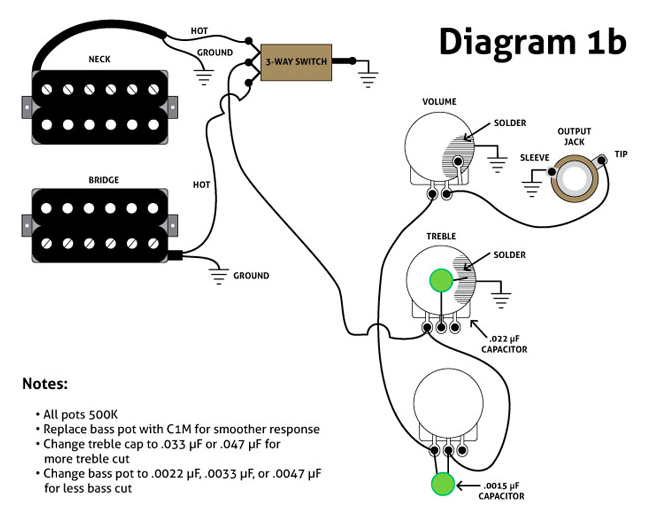
The descriptions and instructions in the new story are clearer and more detailed than my original posts here, plus I’ve refined some details, so I suggest working from the new PG versions.
My three choices:
Yup, the ol’ PTB tone control, the coolest mod I know, at least for players who love distortion. The new version of the project uses the 500K pots you probably already have in your guitar rather than the more eccentric G&L values.
I also revisited the Strat version of the “Nashville-style” Tele wiring popularized by Brent Mason and other Music City cats. It performs brilliantly in a Strat, and IMHO its benefits (vastly more blended-pickup options plus a musical and intuitive control layout) for outweigh the costs (loss of the middle-pickup-alone setting, cost of a 3-way switch). Not to launch a protracted Strat-vs.-Tele battle, but I love the whole notion of “Tele-fying” a Strat via wiring, control layout, and pickup choice.
In the article’s comments thread, several savvy readers also mention Strat wiring systems that provide the sounds of the Nashville mod without sacrificing any others. They’re right — but the more I mess with this stuff, the more I value simplified operation. I’m less concerned with having all options than with having the coolest ones, ergonomically organized. Still, there are many ways you can go here.
Finally, I’m once more beating the dead Varitone horse exploring variations on Gibson’s Varitone concept, updated for modern players. I added a new twist in the PG story: deploying these ideas via toggle switches, rather than a big, clunky rotary switch.
It was fun when PG editor Shawn Hammond asked me to choose my favorite mods. It was easy to decide though — these are the three I keep coming back to, and all three deliver dramatic results, unlike many better-known mods.
So which electric guitar mods would be on your short list? Wiring, hardware, whatever. How do you make your guitars cooler?
|
|