Categories
guitar

Those $24 Acoustic Strings

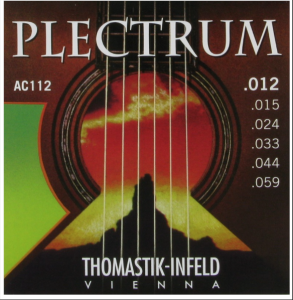
As if I weren’t already blowing enough money on arcane strings, I’ve got a new obsession: Thomastik-Infeld Plectrum series acoustic strings (which sell for $24 in the U.S.).

If you hang out here much, you’ve heard me bitch incessantly about acoustic strings. I hate the way most modern strings are all hyped treble zing and blaring volume, at the expense of deep, decisive fundamentals. With due respect to my vegetarian friends, too many strings are all sizzle and no steak.
Screenshot 2015-06-03 14.55.56

Yeah, bright strings can seem energizing in a cocaine-binge sort of way. But all that glassy presence gets fatiguing. Meanwhile, darker bass strings leave sonic space for the treble strings to shine. Even on my teensy-tiny Martin 0-17, these low strings sing in a warm baritone voice, not like some squeaky, poorly Auto-Tuned teen idol.

This pricy Austrian set features brass-coated steel 1st and 2nd strings, while the bass strings are bronze, but with both silk inlays and flexible steel cores. The flatwound 3rd, 4th, and 5th strings nix finger noise and minimize tone contrasts between wound and unwound strings. The polished roundwound 6th string adds a touch of focus to the lowest register, yet introduces no awkward contrasts on melodies played across multiple strings.

The set is low in both tension and volume relative to most U.S.-made strings. Even though the low E is a chunky .059, it has a soft, relaxed feel that makes me want to linger over notes, shaping them. The harmonic range is fantastic, the dynamic range even more so. They’re long-lasting too — this video was recorded three weeks and many playing hours after installing the set.

I’m hooked. Damn it.

(Hey, Mr. Tambourine Man — I don’t want you getting your nasty treble overtones all over my acoustic strings, no matter how frickin’ jingle-jangle the morning happens to be. Just back off, pendejo.)
Categories
Acoustic guitar Music

Magic Fairy Dust: The Veillette Avante Gryphon

I recently reviewed the gorgeous little Veillette Avante Gryphon for Premier Guitar and liked it so much that I bought one. This was my first opportunity to record it in my studio.

The Avante Gryphon is a relatively low-cost version of Woodstock luthier Joe Veillette’s Gryphon, an 18.5″-scale 12-string designed to be tuned a minor seventh (an octave minus two frets) above standard. But while 12-string guitars feature octave-tuned string pairs, here all six courses are unisons, as on a mandolin. In fact, the Avante Gryphon sounds a lot like a mandolin, but with a wider range and guitar-like tuning. And unlike the couple of janky plywood mandolins I own, it plays gloriously in tune. It’s made (very nicely!) by Korean CNC robots and sells for $1,400, as opposed to $4K+ for Veillette’s hand-built models.

For years I’ve been looking for the right upscale mandolin, but now I’m happy I found this instead. My original motivation was a high-tuned soprano instrument for multi-guitar arrangements, or for magic-fairy-dust studio overdubs. But the thing is so fun — and sounds so darn pretty — that I can’t stop playing it solo. This Bach prelude, for example:

I won’t recap my review here—check it out if you’re curious. Instead, let’s yak about Johann Sebastian!

Categories
DIY

Double Varitone: A Two-Headed Tone Control

I was kind of stoked about my latest wiring experiment: a “double Varitone” scheme I installed in my DIY “Kitschcaster.” I’ve written about these multi-capacitor tone switches a lot on this site, but this is the first time I’ve tried using a similar scheme to cut bass frequencies. The result is a lot like the G&Ls “PTB” circuit (covered here and at Premier Guitar), but with adjustable treble-cut and adjustable bass-cut.

The reason I say I was kind of stoked is, just as I was preparing this post, some fascinating marketing materials appeared in my comments queue. A manufacturer uploaded a barrage of marketing copy about his product, a prefab pickup-switching system. I visited the product site, and learned the most amazing thing: Unlike most of the stuff I write about here, his product can actually get you laid! No way can the double Varitone do that! Here’s how the product works:

Categories
Effects Recording

A Quick Compressor Class

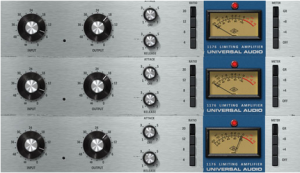
UA Compressors

Do compressors confuse you? And who don’t they confuse?

My just-posted Premier Guitar column covers some basics and walks you through a typical guitar compression scenario (with many audio examples).

Using a variation on a technique borrowed from engineer Michael Paul Stavrou’s cool recording technique book, Mixing with Your Mind, I start with extreme settings that make it easy to hear the compressor’s effect, and then back the processing down to realistic levels.

If you ever find yourself twiddling those inscrutable knobs while remaining unclear exactly what, if anything, is changing, this case study may clarify the process. I hope it’s helpful! :pacman:

Categories
DIY guitar

Kitschcaster: An Experimental Fender/Gretsch Hybrid

Kitschcaster front

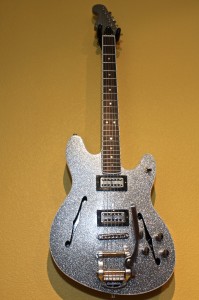
I just completed my third DIY guitar experiment using Warmoth parts. This one is a wacky Fender/Gretsch hybrid with a semi-acoustic Fender Starcaster body, a reverse, angled Strat neck, and various Gretsch-like elements, including TV Jones Filter’Tron pickups, a Bigsby/Vibramate vibrato, and a vulgar silver-sparkle finish — a tribute to the Gretsch Silver Jet, and the basis for this new guitar’s name: Kitschcaster.

Mind you, it sounds nothing like a Starcaster. I ordered the body (which Warmoth calls the Mooncaster) in warm-toned korina, and the neck is mahogany. (Fender used bright-sounding maple for the original necks and bodies.) True to form, the Gretsch-style humbuckers provide a percussive, “plinky” attack quite distinct from PAF-style pickups. The Bigsby assembly also nudges things further from Fenderland. But I always dug the Starcaster’s offset semi-acoustic body, and I thought it would make a nice platform for my latest platypus.

As before, I’m 100% delighted with Warmoth’s work. The finish is flawless (correction: was flawless till I dinged it), and everything fit together beautifully. The only hurdle came when installing the wiring. I failed to take into account the body’s thinness, and I didn’t have enough room to accommodate all the big push/pull and dual-concentric pots I’d planned to deploy. The comic highlight of the build came when I somehow managed to force a standard-sized pickup selector switch into the narrow lower horn. I disconnected a wire while doing so, and then found myself completely incapable of removing the switch. I took it to repair genius Gary Brawer, whose first comment was, “How did you get this in here? And more important, why?” But he managed to free the trapped part, and then he installed a cunning little access cover. Go, Gary!

Kitschcaster back
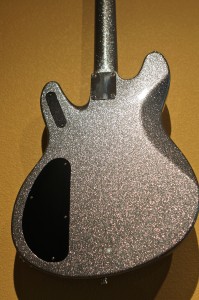
Yes, the neck is silver too. Gary Brawer added the pickup selector access cover.

I’m especially besotted with Warmoth’s “Clapton” profile necks, which I’ve used in all three of my builds. They have a pronounced V shape that feels so comfy in my left hand, and provides relief for my left thumb joint, where, sadly, I’m feeling my first tentative twinges of arthritis. It’s a trip having three radically different guitars with identical neck profiles. I dig the sleek, comfy body as well, and I love its ability to generate musically coherent feedback.

Anyway, consider this a work in progress. I’m still fussing with the tone circuit. (If I can find suitably sized rotary switches, I want to try a sort of “double Vartitone,” with separate treble-cut and bass-cut dials. If it works out as as planned, I’ll do another post on it.) I’ll also probably jigger with the built-in distortion, taking off some of the treble. Like my Bigsby equipped Les Paul, the Kitschcaster can have overly aggressive highs. Something about the combination of the Bigsby hardware and flatwound strings makes certain notes come screaming out of the amp. Both guitars benefit from a carefully controlled touch.

But even now, I’m really stoked about this fun, cheesy-cool instrument.

Categories
Digital Effects guitar

Double Double MIDI Trouble

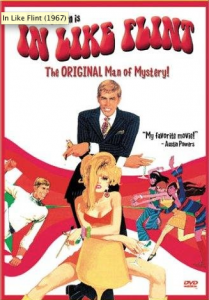
I just recorded a solo version of one of my fave film themes: Jerry Goldsmith’s main title to the 1967 spy spoof In Like Flint. I’ve adored the melody since childhood, and I blame it for instilling the love of chromaticism that made possible my extraordinarily uncommercial career.

I’d previously posted another version of this tune, performed upside-down on a friend’s lefty guitar. But that was all-analog — this time it’s digital. And I’ve used the video to highlight a favorite MIDI technique: doubling recognizable guitar sounds with non-guitar synths and samples.

I've been obsessed with this score since dinosaurs ruled the earth.
I’ve been obsessed with this score since dinosaurs ruled the earth.

It’s funny — being able to trigger pretty much any sound from the guitar isn’t necessarily as liberating as you might think. Sure, when you first try it out, it’s thrilling to conjure an electric piano sound from the fretboard. But who wants to hear some schmo noodle aimlessly on electric piano when they could be noodling aimlessly on guitar?

For better or worse, I find myself using this technique repeatedly. When I double a part effectively, the result still seems like part of the guitar cosmos. It feels like expanding the palette, as opposed to vomiting on it. (Not that I’d be above vomiting on a palette if it helped create a cool painting.)

Did anyone else encounter this sort of childhood musical contamination? A melody, progression, or tone that infected you early on, and colored everything after? I’m not talking image, like falling in love with the Beatles on Ed Sullivan or Nickelback on the CBC because they were so frickin’ cool. I mean a primal sonic imprint. Anyone?

Categories
Acoustic guitar

Strange, Strange Strings

No longer ridiculously expensive — just REGULAR expensive.
No longer ridiculously expensive. Now they’re just very expensive.

I spent last week covering the Musikmesse musical instrument trade show in Frankfurt, Germany, for Premier Guitar. I had a blast, and Chris Kies and I posted details and pics of more than 70 new products. (Here’s the short list of our personal faves.) Kies shot lots of video, and will be posting more than 50 demo segments to the PG site in the coming weeks.

But Messe is hellishly loud, far noisier than NAMM. When I finally got home and picked up a guitar, it was an acoustic. I was trying something new, based on info I obtained from Mary Faith Rhoads-Lewis, CEO of Breezy Ridge, a company that distributes several brands for acoustic musicians, including John Pearse strings.

I’d previously geeked out here about about the strangest and most expensive guitar strings I’d ever tried: this “rope core” set from Austria’s Thomastik-Infeld. Reader/cool guy Al Milburn turned me on to them, and I wrote about them here. And I recently posted this video demonstrating how the transformed my old Martin 0-17 into a compelling steel/nylon hybrid with a unique and expressive voice.

Anyway, Ms. Rhoads-Lewis told me that the late John Pearse originally created this set for Thomastik, and that the John Pearse Folk Fingerpicking set [PJ116] is identical to what the Austrian company sells. Best part: You can get them in the States for under $20, as opposed to a walloping $35 for the Thomastiks. She also told me that their magic works in reverse: You can put this relatively low-tension set on a classical guitar for a very different sort of hybrid steel-string sound. (This, she said, is exactly what the great Brazilian player Bola Sete used to do.)

I popped a set on my old Yairi classical. The feel was — totally strange, and in precisely the opposite way as on the Martin. The tone was edgy and exciting, but the tension seemed a little too extreme. If just seemed a little too … high-strung, in every sense. Then I tried lowering the entire tuning a whole step, with the sixth dropped all the way to C.

And … oh, my. Check it out:

Summary: Holy cannoli, I love how this sounds. And there’s something psychologically satisfying about the transformation too. See, this guitar has always been a bit … tragic to me. I got it when I was 16. My classical guitar prof at UCLA said I needed a better instrument, and my every-supportive folks, bless ’em, helped me buy this Alvarez Yairi for around $700 (in 1970s dollars). It was a top-tier model for Alvarez, signed by luthier Kazuo Yairi, and boasting lovely Brazilian rosewood backs and sides. It was a huge upgrade for me, but as I got deeper into classical playing, its shortcomings emerged. Had I not shifted my studies to composition, I’d have needed to upgrade again. I envied the Igancio Fleta y Hijos models my two teachers played, but at around $3,000, they were beyond my budget, even with parental help. (Pity — their current value is approaching $50,000.) So I’ve used this instrument as a limited but decent-sounding model suitable for pop work, if not serious classical concertizing.

Categories
Effects guitar Recording

Logidy EPSi Review:
The First Customizable Convolution Reverb Pedal

One of the coolest gizmos from last weeks NAMM show is already in my grubby little hands: It’s the Logidy EPSi, the first customizable convolution reverb pedal. I ordered it the instant I heard about it, and it arrived right before I left for Anaheim.

Convolution (or impulse response) reverbs can mimic acoustic spaces and outboard gear with astonishing accuracy. (If this concept is new to you, check out this article by me. Or better yet, this one written by someone who knows what he’s talking about.) Nutshell: You create impulse response (IR) files by playing and recording a test tone in rooms or through gear. Once you load the file into an IR reverb device or plug-in, it can make anything sound as if it was recorded with the same ambience.You can also generate eerie, otherworldly sounds by loading unusual audio files.

Many software and hardware amp and effect modellers use IRs to mimic gear. Software convolution reverb plug-ins such as Audio Ease’s Altiverb, Logic Pro’s Space Designer, and Waves IR1 include reverb libraries, and also let you load your own IRs. But as far as I know, EPSi us the first device that lets you load your IRs into a stompbox and access them without playing through a computer.

I’m psyched to add IR reverbs to my (mostly) analog pedalboard, and EPSi makes it relatively easy to load the IR libraries I’ve compiled. The files require special treatment: They must be 44.1kHz WAVs, and the names must be formatted quite specifically, as detailed in Logidy’s documentation. The interface is extremely minimal: just a bypass footswitch and a knob/button pair to navigate the simple menus.

This unique reverb stompbox sounds great and offers limitless opportunities for creative sound design. You can load your own impulses, or add ones from from some of the fine freeware libraries online. (Thanks for the link, Scott!) On the downside, it’s difficult to load or edit sounds on the fly, so while it might be fun to spelunk for new sounds in the studio with EPSi, don’t plan on modifying sounds onstage. (The ability to recall several saved presets would vastly improve EPSi as a gigging tool.)

Categories
Digital Recording

Logic Pro X:
What’s New for Guitarists & Bassists?

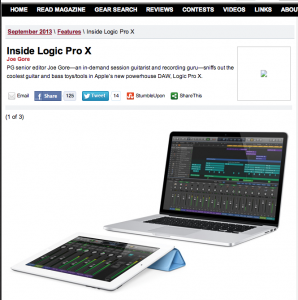
Inside Logic Pro XAs promised: an overview of Apple’s new Logic X Pro, with an emphasis on what’s new and cool for guitarists and bassists. Lots of movies and audio!

It’s here.

This is an exciting post for me, and not just because I get a desperately needed break from Klons and Screamers. I’m thrilled to bits about Logic Pro X and MainStage 3, though I’m still wrapping me head around them. (Yeah, I worked as a developer for both products, but I didn’t get a proper program-wide view until last week’s release.)

Also, it’s my first story for Premier Guitar, whose staff I’ve just joined as a senior editor. I’m stoked because it reunites me with PG editor Shawn Hammond and senior editor Andy Ellis, both of whom I remember fondly from my Guitar Player magazine days.

There’s much talent and coolness on the staff. I’m a happy little guitar nerd. Plus, the schedule is loose enough that I can still record, perform, and continue to work with audio/software clients.

What does the gig mean for this blog? Good things. I have no plans for a major course change — there are too many things I can only cover on a non-commercial site, including some of the topics closest to my heart. Meanwhile, working with PG will keep me more up-to-date on new music, new gear, and scurrilous guitar community gossip. In some cases, though, I may link to a PG article I’ve written rather than duplicate the work here. Today, for example. 🙂

Categories
Digital guitar

Fishman TriplePlay Demo:
Now with More Nasty!

For the first Fishman TriplePlay demo I posted last month, I featured pretty, naturalistic acoustic sounds. This time around I went for something a little less polite.

I’ve been having a blast — albeit a humbling blast — trying to play real-time drum parts from the guitar. I still suck if it’s much more complicated than what I play here, but I can imagine learning to do it well. It’s also fun using the guitar to access the big keyboard sound libraries I’ve built over the years. Perhaps most exciting of all are the hybrid guitar/synth/sample sounds I’m starting to develop. (There aren’t any in this demo — the sounds are either samples or processed guitar, though I blur the lines with guitar-ish samples and guitars processed to sound like machinery. Next time, though, I’ll try to showcase some of those unholy hybrids.)

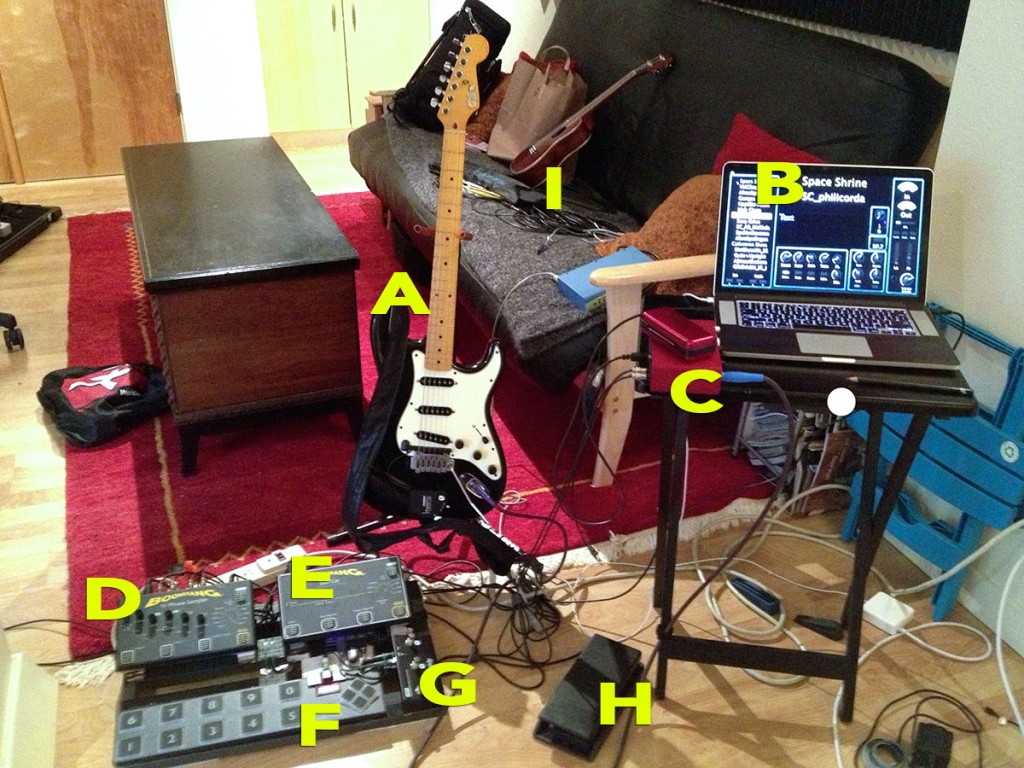
Here’s how the setup looks from my perspective. (I’m not trying to be secretive about what’s on the floor — it’s just hard to fit into the frame, even with a wide-angle lens.)

Joe's looping/MIDI rig.
Joe’s looping/MIDI rig.
  1. Homemade strat with Fishman controller/pickup. MIDI transmitted wirelessly.
  2. MacBook Pro running Apple’s MainStage software. I use a ridiculous number of plug-ins and some ridiculously huge sample libraries. My main sampler is NI Kontakt.
  3. Focusrite Scarlett interface. All the prosumer interfaces sound pretty decent to me these days, though I like the fact that this one isn’t made out of cheapo plastic.
  4. Boomerang III looper. I love its ergonomics and smooth looping points. I screw up my loop points constantly, but I have fewer disasters with the Boomerang than with anything else I’ve tried.
  5. Boomerang Sidecar. Basically just extra buttons for the Boomerang so you can access more features without reprogramming it or performing awkward foot moves.
  6. Keith McMillen SoftStep MIDI controller. Powerful, rugged, feather-light, and not too expensive.
  7. Logidy UMI3. A nice, rugged, and inexpensive USB MIDI controller — just to have a few extra switches.
  8. Generic controller pedal. Its role varies from patch to patch. It might be a mod wheel, a pan pot, a fader, a filter cutoff control, etc.
  9. Piles of crap. These magically materialize every time I start messing with this stuff.

Just to be clear — these sounds are from my collection, and are not included with TriplePlay. Also, I used TriplePlay in “simple mode” for this video — in other words, I’m not using the dedicated TriplePlay application, but simply using TriplePlay as a generic MIDI controller to trigger sounds loaded into MainStage.

BTW, I’m about to head out for Musik Messe in Frankfurt, Germany, where I’ll be demoing this contraption. Oddly, I’ve never been to this vast musical instruments show, which has been described as a much larger NAMM show with more sausage, beer, and accordions. I’ll be sure to tell you about any cool stuff I see!

DISCLOSURE: Fishman, Apple, and Keith McMillen are among my clients, but no one paid me to make or post this video.