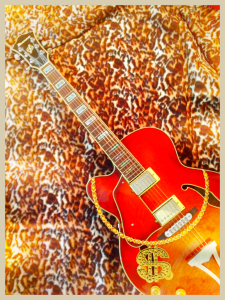
Okay, the funky gold foil pickups found in cheapo Japanese and American gutiars in the 1950s and ’60s are popular again. And trend slut that I am, I’m smitten with them. But they do this one really weird thing ….
It has to do with the capacitive relationship between the guitar volume knob, pickups, and downstream pedals and amps. If you don’t use your guitar’s volume knob as an expressive device, this behavior probably doesn’t matter. But if you do, this is potentially a big deal, one worth considering before purchasing a pair of gold foils.
I first realized this as I was preparing my Gore Pedals demo for the NAMM show. Many of my pedal designs depend on the ability to alter tones from the guitar — it’s how I get away with using relatively few knobs. It’s the quality you hear in the first minute of my Cult pedal demo:
You just can’t do that with gold foils. Apparently, the rubber magnets in gold foil have a different capacitive relationship with downstream gear, relative to conventional alnico- and ceramic-magnet pickups. Some of the peaky, high-resonance sound you get when rolling back the volume knob on a guitar with gold foils are pretty cool, and I can certainly imagine using them. But I definitely have to modify my technique when using gold foils.
I recently reviewed one of the bitchin’ new Supro guitars for Premier Guitar. Their pickups are based on a different historic gold foil model, but they exhibit the exact behavior demoed in my first video above. After writing that review I spoke with Ken Calvet of Roadhouse Pickups, who created the excellent-sounding Valco-style gold foils for Supro. He acknowledged the unusual volume knob behavior and attributed it to the rubber magnets used in historically accurate gold foils.
My first video above demonstrates this property using a capacitance-dependent vintage-style Fuzz Face. Not only do you encounter the same thing with many non-buffered (i.e., cool) fuzzes and boosters, but also when plugging directly into an overdriven amp. You can’t summon clean sounds from a dirty amp via the guitar volume knob the way you can with most conventional passive pickups.
But despite all of that, I’m still crazy for the Lollar Gold Foils in my DIY Resistocaster:
Has anyone else noticed this quirky characteristic?