I’ve been obsessed with Henry Mancini’s music for decades. Here’s an example of his “tropical” exotica side.
My Mancini loved deepened after I joined Oranj Symphonette, a ’90s band founded by cellist Matt Brubeck (Dave’s son). It’s fascinating how accessible and catchy all his tunes are, even though you realized they’re incredibly weird and original once you look under the hood. You can hear those albums on YouTube. Plays Mancini includes only Mancini music (including a version of “Lujon” featuring our sorely missed friend Ralph Carney). The Oranj Album mixes Mancini with other retro sounds track themes.
Admittedly, there’s only a smidgen of looping here. I usually play this without a looper, but it’s nice being able to grab that lovely falsetto line at 02:25.
The guitar is a Guild X-15 arch top from the ’90s. It’s had many pickups over the years. This one is a lovely Lollar Charlie Christian model.
I probably sound like I’m being ironic, but no — I really love this Taylor Swift song.
The Hello Kitty! Stratocaster was a gift from my lovely friend and bandmate Jane Wiedlin. I replaced the factory humbucker with a Duncan Phat Cat (sort of a humbucker-sized P-90). Again, no irony intended. I like Sanrio characters! (Especially Aggretsuko!)
I got to interview Robert Smith for a Guitar Player cover story in 1992. It was one of funnest of the 1,000+ musician interviews I’ve conducted over the last few decades. Robert is brilliant, bitchy, and hilarious. We talked most of the night over too many drinks.
Years later I was recording with sociopath Courtney Love at Chateau Miraval in Provence, where the Cure recorded their Kiss Me Kiss Me Kiss Me album, including “Just Like Heaven.” The studio manager recalled how Robert would quote Apollinaire and Verlaine around the dinner table. En francais, bien sûr.
The guitar is a 000-sized Lowden I’ve owned since the early ’90s and have used on many sessions and tours. It’s fun playing acoustic guitar with distortion and effects, as long as you give up on the idea of generating traditional acoustic tones.
For Day 2 of Loopocalypse, here’s an angst-ridden original featuring brutal bit-crushed distortion and Tesla coil samples.
Thunderbeast Park was an Oregon roadside tourist attraction with cheesy plaster dinosaurs. I think I visited here as a kid, though I’m not certain. At least I would have pleaded for us to stop on one of my family’s up-the-coast road trips. I often got my way, ’cause my folks liked this stuff too.
The guitar is my DIY Birdmaster. The pickups are unpotted Duncan/Bonnamassa PAFs — probably the best humbuckers I own.
On the occasion of a daunting round-number birthday, I’ve just completed Loopocalypse, a concert-length video of my live looping show. I’ll be posting a song per day, each featuring a different guitar, from now till Thanksgiving/birthday. Here’s Day 1 of 17, a tribute to that dearest of the dearly departed, David Bowie. I’ve been playing this for years, and it just gets sadder and sadder. Tomorrow I’ll share something appropriately angst-ridden for the US election day. (Here’s a remembrance of my brief Bowie encounters, written the day after he died.)
Here’s an explanation of my live looping rig. The guitar is an all-original 1963 Strat that I’ve owned since 1980. For many years it was my only good guitar.
I’ve just finished recording a concert’s worth of live looping performances. I’ll be posting these a day at a time, starting later today and continuing through Thanksgiving, 2018. (And there’s a daunting round-number birthday in there somewhere.) I’ve covered my looping setup before, but it’s changed a lot since the last time I wrote about it.
MainStage users, you can download my looping template here. It includes no user patches or third-party plug-ins — it’s just a raw template. But if I’d had this when I started out, it would have saved me a day or two!
Man, I’ve been wanting to do this experiment for ages — and largely because it’s been a black hole off ignorance for me. As mentioned in the video, I used to think they were the same pickup. But as you can hear, they’re quite distinct, and the differences are far from subtle.
Polly’s Firebird is a 1960s original.
Until now I’ve never owned a guitar with either pickup type. My chief experience with mini-humbuckers was when I demoed a set in this sane Strat for my Strat replacement pickups comparison. I liked them there as well, though I was using a set of Seymour Duncans, while these are Lollars. (I’d be cautious about making tone comparisons, since the two videos were recorded using very different tone chains.)
Annie Clark designed her own signature guitar.
I once played Polly Harvey’s original reverse Firebird on a gig, and I wasn’t that blown away at the time. (Though there were many other variables at play.) But I adored the way the Firebird pickups in Annie Clark’s Musicman St. Vincent model sounded, and I gave the instrument a rave review for Premier Guitar. I was struck then, as now, by their extraordinary dynamic response. Small variations in touch yield big tonal contrasts. My hope was that they’d sound like Fender pickups on steroids in a Strat, and to my ear, they do. (By “steroids,” I don’t mean high output — I generally recoil from extra-hot Strat pickups. Tones are simply fatter without neutering the high end as super-hot single coils tend to do.
I liked both pickups sets a great deal, but the Firebirds are a better match for my fingerstyle playing. What do you think?
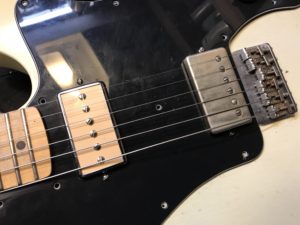
Fender’s Telecaster Deluxe has had an interesting and checkered history. Once regarded as yet another mediocre product from the company’s era of CBS ownership, these turn-of-the-seventies instruments now fetch huge prices on the collector’s market. I’ve never owned own. But when singer/songwriter Greer Sinclair loaned me one of Fender’s 2010 reissues, it was time for research — and experimentation.
The made-in-Mexico 1972 Deluxe reissue is a cool guitar. It replicates many details of the original: the oversized headstock, the Strat-like belly cut and fixed Strat-style bridge, and the big-ass pickguard. But its pickups are definitely a departure. In lieu of the original’s large-format “Wide Range” pickups, it employs a P-94R (a humbucker-sized P-90 spinoff) at the neck, and a conventional Gibson-style humbucker at the bridge.
The Wide Range pickup was a unique beast. Fender had commissioned Seth Lover, the man who invented the Gibson humbucker, to create a Fender humbucker in hopes of cashing in on the growing popularity of hard rock. With DC resistance in the 10k range, the new Wide Range pickup was a bit hotter than a vintage Gibson humbucker. Wide Range pickups appeared in several of the era’s models, including the Tele Thinline, Tele Custom, and semi-hollowbody Starcaster.
Gibson humbuckers have a bar magnet within, but the pole pieces are not magnetic. But on Wide Range pickups, the pole pieces are magnetic, as on Fender’s single-coil pickups. Situating individual magnets closer to the strings yield a brighter sound with greater note defition and string-to-string separation — characteristics we associate with vintage Fender pickups. So the Wide Range pickup lent a uniquely “Fender” twist to the Gibson design.
Wide Range pickups are slightly larger than conventional humbuckers. Most of Fender’s circa-1970 Tele reissues substitute generic humbuckers of the standard size. Standard humbuckers can sound superb in a Tele, but they’re horses of different colors. Fender has also created some reissues with the larger-sized pickups, but these are also garden-variety humbuckers — the larger format is purely cosmetic. The pole pieces of the factory humbucker on Greer’s guitar don’t align with Fender’s wider string spacing. (But one thing I’ve leaned from my various Fender/Gibson hybrid experiments is that sonically, this can matter very little.)
The P-94R’s cream-colored top looks wicked against the guitar’s finish. It’s a warm, full-sounding pickup from the mellower side of the P-90 spectrum. Actually, it doesn’t sound all the different from a traditional Telecaster neck pickup. (Like that pickup, it works quite well for jazz.) Note, though, that its dimensions differs substantially from those of a Gibson P-90, as you can the in the photo where it sits alongside a historically accurate Lollar P-90. When you change the size of a pickup’s components, you inevitably alter the sound. The tones can be for better or worse — but they will be different. (more…)