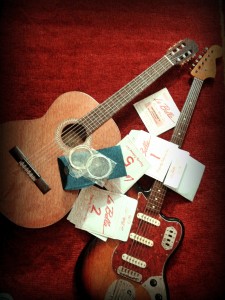
So frickin’ expensive!
Hi. I’m Joe, and I’m a flatwound addict.
It took me a long time admit it. “What wrong with a little recrational flatwound use?” I used to ask. “I can quit anytime I want.”
Sure, I’d sometimes put flatwound strings on my Guild archtop. And sometimes on a bass. And yeah, I did that post about how flatwounds are the key to nailing that ’60s electric 12-string sound. And that other post on how flatwounds brought my reissue Fender Bass VI to life. And yeah, I may have happened to blurt out that I like using flatwounds on a MIDI guitar.
But I wouldn’t use them on, you know, one of my normal guitars.
But then I recorded that Bartók piece, using the above-mentioned Guid and Bass VI alongside two standard-tuned guitars with roundwounds. The piece has a lot of counterpoint — all these motifs bouncing between the instruments. And the more I listened, the more I realized that I liked the tone of the two flatwound guitars far more than that of the two roundwound guitars.
And then I bottomed out. I put flats on four more guitars. It wasn’t just musically risky — it was economically catastrophic! And that’s what brought me here tonight.
Funny thing about flatwounds: Everytime I pick up a guitar with flats, I react negatively to the dullness of the wound strings. Where’s the shimmer? Where’s the zing?
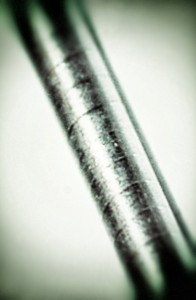
But the more I listen, the more I get sucked in. Parts layer over each other more readily. Chords speak more clearly. Fuzz and distortion yield sweeter overtones. It’s easier to get a consistent sound from melodies spanning wound and unwound strings. And the feel? Smooth, sleek and sensual.
Sigh. Maybe I’ll try and kick the habit again tomorrow.