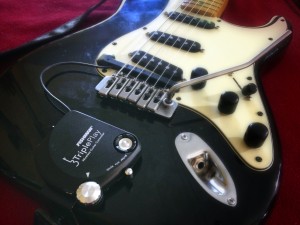
For the last few months I’ve been working with Fishman on the documentation for TriplePlay, their long-awaited wireless MIDI guitar system, which will finally ship this quarter. I had a blast demoing TriplePlay at MacWorld a few weeks ago, and I’m looking forward to doing so again at Musikmesse in Frankfurt in April.
But at times, it’s been frustrating. I power up TriplePlay to study some feature, get all excited, and then have to turn it off and write about it instead of going off and playing it for six hours. This little demo was my first real chance to just fool around with the thing. Thoughts and details after the video.
I’ve only dabbled in MIDI guitar till now, and TriplePlay has much to do with my current interest. It’s simpler, cheaper, more ergonomic, and generally less of a pain in the ass than previous systems. But the other part of the equation is today’s wealth of great-sounding and relatively inexpensive software synths and samplers. (TriplePlay comes bundled with ton of cool software, but here I’m using sounds from other libraries.)
I was originally going to post three “songs”: this naturalistic-sounding one with its acoustic instrument samples, an ’80s retro-electro thing, and something spooky and atmospheric. But I wound up spending all day on this one piece as I tried to wrap my head around the prospect of integrating TriplePlay the laptop-based digital rig I use with my duo band. Anyway, I’ll be posting future stuff in very different styles.
Some random thoughts after a few hours of playing:
• I’m not yet sure of the best way (for me) to fine-tune sounds within this system. The options are a bit overwhelming: I can customize the tone and response of my patches in the TriplePlay software, within whatever synth or sampler plug-in I happen to be using, and as a performance parameter in MainStage, my software host. You can really geek out on those settings! I sometimes have a hard time deciding whether it’s better to tweak the patch to match my touch, or tweak my touch to match the patch.
• As an experiment, I strung my homemade strat with super-thick flatwound strings, with a .013 on top. I don’t believe thicker strings or flatwounds make the system perform any better. (It tracks pretty darn well on every TriplePlay-equipped guitar I’ve tried.) But with flats, there’s less contrast in feel and tone between the treble and bass strings, which for some reason makes me think outside the guitar box. I suppose they give the guitar some of the register-to-resgister consistency of a keyboard, and that just feels right to me. I’m going to keep the flats on there for a while. (Especially since they’re so frickin’ expensive!)
• You don’t need a particularly buff computer to run the factory version of TriplePlay. But streaming some of the huge sample patches heard here definitely pushed my MacBook Air to the brink, even with my sample drive connected via Thunderbolt. (You can hear a overloaded digital crackle or two if you listen carefully.) Also, a faster machine will let me run everything with even less software latency. (This isn’t a reflection on the TriplePlay hardware, which tracks ridiculously well.) The timing will get tighter with a faster processor.
• One thing that really excites me — and which is not reflected in this particular performance — is warping MIDI guitar sounds within the liquid audio environment of a modern DAW. While this cover tune was fun to play and record, it’s not especially representative of the sorts of sounds I envision creating with TriplePlay. I’m less stoked about faking a violin or harp than by the notion of creating hybrid guitar tones that blend analog pickup colors with atmospheric synths and samples. It was pretty exciting opening MainStage and seeing the analog guitar sound and wireless MIDI data appear on adjacent channels, ready for desecration customization.
But hey, there are worse ways to spend an afternoon that pretending to be a violinist or harpist. :pacman:
BTW, here’s the official word on the TriplePlay release: Before the end of March for the Mac version, with the PC version to follow soon after. In other words: Get back to work, Joe!


Leave a Reply