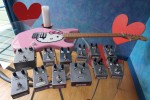
As threatened, the Fuzz Detective video:
WHAT: Twelve germanium fuzz circuits compared and analyzed. These represent the sounds of almost every fuzz pedal introduced between 1962 and 1968.
WHY: A tool to help players identify the circuits most relevant to their musical needs. This isn’t about particular brands of pedals, but the circuits they employ. If you hear something you like, you can either do as I did and build a clone from the schematic, or buy one based on that particular design. (The relative merits of rival clones is another story.) Of course, if you’re rich and you desire an ancient pedal that probably doesn’t sound as good as a new clone, you can always purchase a vintage original. 😉
HOW: I tried to establish a “level playing field” by removing as many sonic variables as possible. I used the same signal chain, the same guitars, the same musical material, etc. (Tech details below.)
WHO:
- Maestro FZ-1 Fuzz Tone
- Sola Tone Bender Mk 1
- Hornby-Skewes Zonk Machine
- Sola Tone Bender “Mk 1.5” (similar to Vox Tone Benders)
- Dallas-Arbiter Fuzz Face
- WEM Pep Box Rush
- Sola Tone Bender Mk II (same as Marshall Supafuzz)
- Mosrite Fuzzrite (germanium version)
- Orpheum Fuzz (germanium version)
- Selmer Buzz Tone
- Sola Tone Bender Mk III (same as Park Fuzz Sound, Carlsbro Fuzz)
- Baldwin-Burns Buzzaround.
WHEN: Like, now, man! (more…)