Categories
Amps DIY

Hey, Gang! Let’s Design a DIY Amp!

Let’s not just talk about one-knob gear — let’s design some! Any interest in conspiring to create a minimalist DIY amp?

Frankly, the intensity of the reaction to my recent One Knob Manifesto startled me. I had a general sense there was a growing interest in minimalist gear, but I was no idea the sentiment was so intense. (Though I’d hesitate to draw too many conclusions based on a focus group of the obsessive geeks who hang out here.)
Now, don't get your hopes up — we probably won't create anything QUITE this awesome.
Now, don’t get your hopes up — we probably won’t create anything QUITE this awesome.

Since posting that piece, folks have been sending me info on relevant new products, like Henretta’s no-knob stompboxes and the Mill Hill Love amplifier, reportedly being used by Jonny Lang.

The limited edition Love amp fascinates me. Not its ornate furnishings, but the minimal controls: no tone stack, not even a volume control. It’s pretty much exactly what I was talking about when I expressed an interest in an amp with nothing but an on/off switch. That desire became even more focused last week when I reviewed a fabulous amp from a new Colorado Springs company called Toneville. (I’ll link to the Premier Guitar review when it goes live in a couple of weeks.) The Toneville Beale Street model I reviewed features a full compliment of blackface-style controls, but the tone controls are voiced so that the tone stack can largely be removed from the circuit, and there’s also a pot to remove the negative feedback loop for a more tactile/primitive response. As with some other ultra-high-end amps I’ve written about recently (like the Little Walter 50/22 covered here), the tone controls sound great wide-open, and it matters surprisingly little where you set the volume — you just drive it hard enough to warm things up, and then shape the tone from the guitar. With a nicely voiced and biased amp, you need far fewer controls than you might think. And the more crap you omit, more livelier the reponse and the more immediate the tone
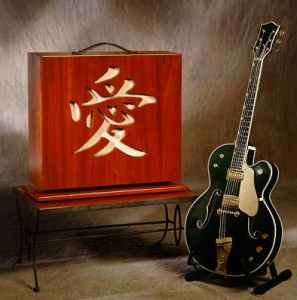
The no-controls Mill Hill Love amp.

So why don’t we collectively create something in this vein? A simple but great-sounding tube amp with nothing but an on/off switch? I’ve never designed anything such thing and have little relevant expertise beyond the knowledge that, unlike 9v stompboxes, AC-powered amps can kill you. But I’ve built enough kit amps to know that a one-knob head can be easy, potentially inexpensive (though you could invest in ultra-premium tranformers, vintage tubes, NOS parts, and so on), and it should sound stunning. If we come up with a plan, we can source the parts, create step-by-step instructions, and probably get a vendor to put together a kit for us. (I’m thinking out loud here, so bear with me.)

I’m not firm on many details other than these:

  • head-only design (at least initially)
  • low-wattage for home/studio use — something you can crank without self-evicting
  • should sound big and bad-ass (not a cheap, practice-amp sensibility)

Any interest, folks? And more important, any ideas? And more important, any ideas? What would make this fun, useful, and bitchin’?
Categories
guitar

The Latest in Guitar Prosthetics!

Ever wish your finger was a little bit longer?

I just procured some clever new gizmos designed to help unfortunate players who were born without 12-inch fingers and five-foot arms.

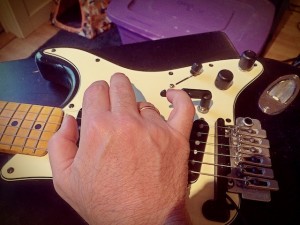
First up: The VKnob from Option Knob, an angled plastic lever that replaces standard volume and tone knobs. It’s worth investigating if you’re interested in pedal steel-style swells, “manual tremolo,” or wah-flavored tone-knob manipulation. There’s a half-inch notch in the lever, perfectly position for resting your picking-hand pinky and spinning the knob without having to stray too far from the springs. It takes getting used to, and it may collide with some whammy bars, but it’ll be a cool solution for many players. FWIW, I tend to play fingerstyle, and I’m accustomed to spinning knobs with my pinky while picking strings with my thumb. Even so, the VKnob makes the technique easier, and it may be a godsend for pickstyle players. (Price: US $13.)

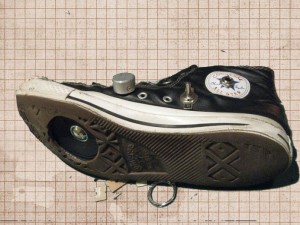
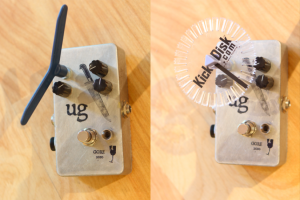
Option Knob also created the OKnob, a Y-shaped replacement knob for stompboxes. It lets you manipulate pedal knobs by “kicking” the OKnob’s arms or resting your foot in the fork where they meet. I’ve enjoyed using OKnobs to control the cutoff frequency on filter-type effects, especially when playing The World’s Nastiest Stompbox™. Like so:

Uglyface Demo

But now the OKnob has competition in the form of the KickDisk, a circular, clear plastic replacement knob.

The OKnob (left) and KickDisk (right).

Both knobs work great, and each has its advantages. The OKnob doesn’t force you to position your foot at a specofic altitude, and it looks freaky-cool. But it can be awkward to manipulate from some angles, especially when the arms are positioned north and south. The KickDisk is easier to operate from all angles, and its transparency prevents it from obscuring stompbox LEDs. I like both options. (OKnobs are ten bucks each, or $12 for the glow-in-the-dark model. KickDisks go for $7.50.)

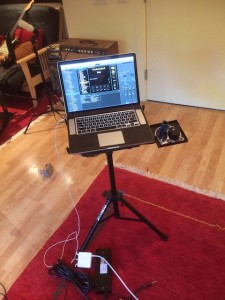
Obviously, your stompboxes must be secured to a pedalboard or other surface, or you’ll just kick everything over. But while knocking pedals over is a drag, it’s not nearly as bad as toppling your laptop. That’s why I was eager to replace the flimsy stools and utility tables I’ve been using for laptop gigs with my band Mental 99.

Don't tread on me.
Don’t tread on me.

There are several stage-worthy laptop stands, though most are tabletop models aimed at laptop-lugging DJs. I opted for the Quik Lok LPH-003, a sturdy metal tripod when a laptop shelf plus an extensible mousepad surface, which works great as a holder for picks, slides, EBows, and street drugs.

The LPH-003 weighs a lot more than my old stands, but it’s far less likely to get knocked over, even by a hyperkinetic klutz like me. Particularly reassuring are the four adjustable, rubber-tipped arms that secure your leptop, even at steeply slanted angles. So far, I’m digging it. I’ll let you know how it works at gigs. (I paid a little under $100 for mine.)

Have any of you tried these? Or can you share info on any other clever, simple, and cheap guitar prosthetics that help you do what you do?