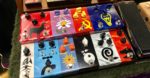
You know what sucks about attending NAMM as a manufacturer rather than a gear writer? I was epoxied to my booth all day, and I barely saw anything other than my guitar pedals. But on one rare break, I got to hang out with Jannis Anastasakis and his crew from JAM Pedals of Athens, Greece. (I highlighted some of their beautiful work in my pathetically skimpy “NAMM report.”)
Happily, there’s more to celebrate here than great visuals. JAM builds lovely versions of many classic analog effects. Their sounds and production quality are stellar, and JAM often adds modern updates such as realtime expression control, extra knobs, and internal trim pots for customizing tones. It’s quality stuff, used by many a guitar star.
And guess what? Jannis loaned me one of his magnificent Custom Shop analog pedalboards. Γαμώτο!
Sadly, I must now pack up and return this pretty pedalboard. But I’ll be getting my own JAM Delay Llama Supreme, an expanded version of the analog delay heard here, with tap tempo, a cool modulation section, and the almighty infinite-hold switch. (I reviewed it for Premier Guitar a few months ago.)
In the meantime, this experience makes me want to try my own DIY pedalboards. Not as an item for sale — just as a way to group related effects in a single enclosure for stage use. Gears are spinning ….
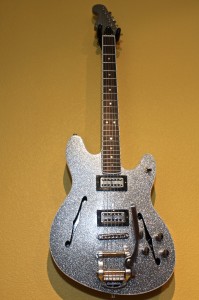
I just completed my third DIY guitar experiment using Warmoth parts. This one is a wacky Fender/Gretsch hybrid with a semi-acoustic Fender Starcaster body, a reverse, angled Strat neck, and various Gretsch-like elements, including TV Jones Filter’Tron pickups, a Bigsby/Vibramate vibrato, and a vulgar silver-sparkle finish — a tribute to the Gretsch Silver Jet, and the basis for this new guitar’s name: Kitschcaster.
Mind you, it sounds nothing like a Starcaster. I ordered the body (which Warmoth calls the Mooncaster) in warm-toned korina, and the neck is mahogany. (Fender used bright-sounding maple for the original necks and bodies.) True to form, the Gretsch-style humbuckers provide a percussive, “plinky” attack quite distinct from PAF-style pickups. The Bigsby assembly also nudges things further from Fenderland. But I always dug the Starcaster’s offset semi-acoustic body, and I thought it would make a nice platform for my latest platypus.
As before, I’m 100% delighted with Warmoth’s work. The finish is flawless (correction: was flawless till I dinged it), and everything fit together beautifully. The only hurdle came when installing the wiring. I failed to take into account the body’s thinness, and I didn’t have enough room to accommodate all the big push/pull and dual-concentric pots I’d planned to deploy. The comic highlight of the build came when I somehow managed to force a standard-sized pickup selector switch into the narrow lower horn. I disconnected a wire while doing so, and then found myself completely incapable of removing the switch. I took it to repair genius Gary Brawer, whose first comment was, “How did you get this in here? And more important, why?” But he managed to free the trapped part, and then he installed a cunning little access cover. Go, Gary!
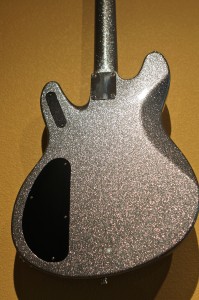
Yes, the neck is silver too. Gary Brawer added the pickup selector access cover.
I’m especially besotted with Warmoth’s “Clapton” profile necks, which I’ve used in all three of my builds. They have a pronounced V shape that feels so comfy in my left hand, and provides relief for my left thumb joint, where, sadly, I’m feeling my first tentative twinges of arthritis. It’s a trip having three radically different guitars with identical neck profiles. I dig the sleek, comfy body as well, and I love its ability to generate musically coherent feedback.
Anyway, consider this a work in progress. I’m still fussing with the tone circuit. (If I can find suitably sized rotary switches, I want to try a sort of “double Vartitone,” with separate treble-cut and bass-cut dials. If it works out as as planned, I’ll do another post on it.) I’ll also probably jigger with the built-in distortion, taking off some of the treble. Like my Bigsby equipped Les Paul, the Kitschcaster can have overly aggressive highs. Something about the combination of the Bigsby hardware and flatwound strings makes certain notes come screaming out of the amp. Both guitars benefit from a carefully controlled touch.
But even now, I’m really stoked about this fun, cheesy-cool instrument.
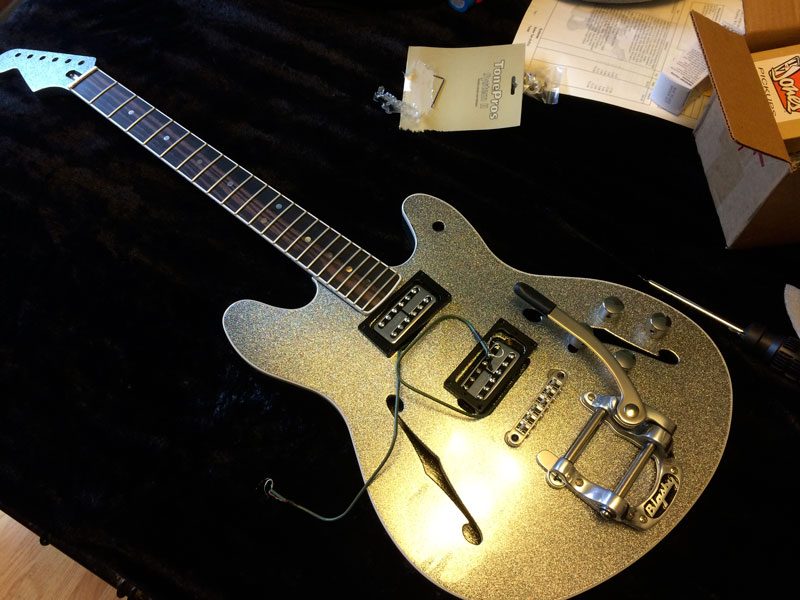
Look what UPS left on my porch: the neck and body for my latest ill-advised “parts” guitar project. I’ll be slapping it together in the coming days, but I couldn’t resist showing off the pretty parts. The body is Warmoth’s Mooncaster model, which is based on Fender’s semi-hollowbody Starcaster, a quirky cult guitar if ever there was one. But for the neck, I swiped an idea from Warmoth’s Josh Spataro, and substituted a reverse angled Strat neck. The tacky silver finish and extravagant binding are solely the result of my bad taste. (Josh compared it to a pinky ring, which is pretty accurate.) The body is korina, the neck mahogany.
If my last Warmoth parts guitar was a sort of Fender/Gibson hybrid, this one is more Fender/Gretsch. I’m planning to install a set of TV Jones pickups, and this will be my chance to try out a very different type of tone control scheme, one I’ve been thinking about for a while. If it turns out well, I’ll write about it. If not, I’ll probably delete the last few sentences and deny they ever existed.
This is my third Warmoth parts project since starting this blog. As before, I’m 100% delighted with the materials and build quality. Since I requested expensive options (like the vulgarly bound and finished neck) and I’m using fancy parts, the guitar probably won’t be vastly cheaper than if I’d bought it already made. But it should be unique and fun. Stay tuned — and I’ll hope the guitar does too.
Last weekend I went to a memorial service for a music pal I hadn’t seen since the ’80s. Judging by the pictures I saw and the stories I heard, Brett remained the gentle, generous music lover I’d remembered till he died in his sleep a few weeks ago.
I ran into lots of old music friends and bandmates, and we alternately smiled and winced as our old photos and concert videos flashed on the big screen. Were we really that skinny? Did we actually wear that stuff without being coerced at gunpoint?
Like we tend to do at such moments, I left brimming with resolutions: Appreciate life. Cherish friends. Remember that music is a joy as well as a job. And do something nice for my sad old Strat, the guitar in all those old photos and videos.
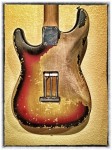
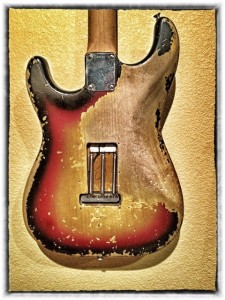
See, back then I only had one guitar — an all-original ’63 Strat I’d picked up in 1980, when pre-CBS Fenders were still perched on the precipice between collectible and affordable. (I paid $450, a staggering investment for me at the time.) It remained my only serious guitar for a decade. It was in near-perfect condition when I bought it, and it was a battered ruin by decade’s end. (The ’80s were a tough time for guitars, what with all those studded belts.) I was a young player with a bad attitude and little concern for collectibility, as opposed to the middle-aged player with a bad attitude and little concern for collectibility that I am today.
I’ll some thoughts about Strats then and now. But first, have a listen:
Yes, it's bad Photoshop. You can't REALLY print a guitar at home . . . not quite yet, anyway.
UPDATE:Check out the comments, where reader J links to videos of a 3D-printed guitar and violin.It’s cool and INTENSE.
Last weekend I got to enjoy one of my favorite things in the universe: the Maker Faire, held each year in San Mateo, California, outside San Francisco.
The event, which draws 100,000 people each year (not counting the thousands who attend satellite fairs in NYC, Detroit, and other cities), was launched by Make magazine, the closest thing to a house publication for the international DIY movement. Adherents of maker culture — or just plain “makers” — are a loose aggregation of artists, geeks, hackers, Steampunks, subversive ETSY craftspeople, and others who embrace various facets of DIY culture. “If you can’t open it, you don’t own it” is one of many unofficial mottos. Another is “Void your warranty, violate a user agreement, fry a circuit, blow a fuse, poke an eye out…”
And who isn’t in favor of poking out a few eyes? 😉
The Faire, now in its eighth year, is a joyous affair, assuming you derive joy from things like flashing Van der Graaf generators, 50-foot-tall kinetic sculptures that spew fire, the Faire’s iconic cupcake cars, and the sight of hundreds of cute kids learning to solder DIY projects at rows of workstations.
Each year there’s more new stuff than you can possibly consume, but even even amidst the ear-pounding experimental music and eye-pounding LED art, one development seemed to dominate: 3D printers are getting faster, smarter, and cheaper (as in, several DIY kits sell for less than $500). And it’s difficult to imagine them not changing how we will create and mod our musical instruments in the very near future.