Categories
Digital guitar Pickups

Synth Guitar:
Did They Finally Get It Right?

Anyone here ever owned a synth guitar? Not a Keytar, but a guitar fitted with a hexaphonic pickup that transmits MIDI data to external devices? And if so, do you readily admit it?

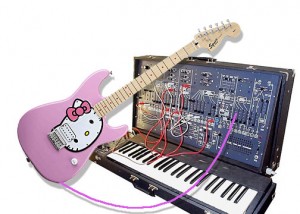
The synth guitar has had one of the most checkered histories outside of, well, checkers. Since the ’70s, many brilliant minds have tried to bridge the gap between the plucked string and the external tone generator. But despite a few notable exceptions (mostly in the prog/fusion realm), guitarists have been reluctant to embrace the technology.

I’ve had a Yahama synth system (basically a clone of the Roland GK-2) for many years, though I rarely use it. Like a lot of players, I balk at the installation hassle and the ugly, cumbersome hardware. (Plus, I’ve played keys longer than I’ve played guitar, so I don’t really need a guitar to conjure synth sounds.) Also, those systems are expensive! Many players have been disappointed. Many businesses too — the Avatar guitar synth probably killed off the ARP company.

But I’ve been thinking about guitar synth again since last January’s NAMM show, where Fishman previewed their Triple Play system, a new take on MIDI guitar which I mentioned at the time here. (Here’s much more info from the company’s Summer NAMM press release.)

I finally got to play a late-stage prototype this weekend. But before I discuss the experience, I need to confide that a) Larry Fishman is a pal of mine, and b) I may be working with his company on the product’s documentation and marketing. (My words of praise are 100% sincere — but as always, consider the source.)
Categories
Bass DIY guitar Pickups

How to Install Pickups

“I always forget — which end gets hot?”

Somewhat embarrassingly, I never got around to changing one of my own pickups until I was knocking on senility’s door recently. I owe part of the inspiration to that fabulous DIY Fest known as the Maker Fair, where each year hundreds of little kids learn to solder craft projects at long picnic tables. Or maybe it was the awesome soldering tutorial by 11-year old W0JAK. Well, after a buttload of pickup installs inspired by this blog, I guess I qualify as some sort of solder “expert,” because Seymour Duncan asked me to make a video designed to walk n00bs through the pickup install process for the first time. It was a lot of fun to prepare, and I learned some important things, like the fact that it’s hard to solder, talk, and operate a camera at the same time. Check it out:

Categories
guitar Pickups

What’s the Deal with Alnico VIII Magnets?

Like this royalty-free clip-art illustration, the Alternative 8 manages to be both aggressive and round.

I was talking to some of the Seymour Duncan dudes the other day about pickups models deserving greater public awareness. One of the first names on everyone’s lips was the Alternative 8, a a high-output humbucker that uses a powerful alnico VIII magnet in lieu of the alnico II or alnico V magnets that fuel the vast majority of non-ceramic pickups.

I was intrigued, so I popped one into the bridge position of my Hamer 20th Anniversary. Yow.

If you’ve been following this blog, you’ve probably noticed that I tend to gravitate toward lower-output, vintage-flavored pickups, generating gain from the amp or a number of sketchy homemade distortion boxes. The Alternative 8, with its blistering DC resistance of 17.68k, is definitely a departure for me, but I found myself captivated by its deft balance of aggression and definition.

Have a listen and see what you think. Post-mortem after the video.

Categories
guitar Pickups

Mixing Magnets in One Pickup

Aggressive on the bass side, sweet on the top.

I was talking to Seymour the other day about the types of magnets used in vintage Fender pickups. I knew that Fender used strong, punchy alnico V magnets in most of their models, but I didn’t know that the earliest Teles used softer-sounding alnico IIs, or that the first Strats used even softer-sounding alnico IIIs, a detail confirmed by Fender’s page on the topic.

I recently had a chance to compare the sound of alnico II and alnico V while hacking together guitars for the Mongrel Strat Project. I’d tried an Alnico II Pro in the middle position of this mongrel, and liked it. But as I continued to experiment, I gravitated back to the more traditional alnico V sound — maybe because I play so much in lowered tunings, and in bands without bass, so I really like the strong, defined fundamental you get from an alnico V.

But until now I’d never tried literally splitting the difference via Duncan’s Five-Two, a hybrid that has three alnico V rods for the bass strings and three alnico II rods for the trebles. The idea behind this arrangement is to deliver a bold, snappy sound in the low resister, but with some softening and sweetness on top.

How does it sound? You tell me — here’s a demo video I made. Plus, there’s a micro-contest: The first person to name the tune I’m playing will have their name immortalized for the ages mentioned in an upcoming post. (That might be better than a poke in the eye, depending on whose eye it is.)

Have a listen:

Categories
DIY guitar Pickups

The Ultimate Mongrel Strat? (with Obsessive/Compulsive Tone Control!)

Not for everybody: The sickest mongrel strat yet.

Okay, I lied.

In the previous installment of our ongoing mongrel strat series, I experimented with a version of Gibson’s oddball Vari-Tone circuit. I said it was too fussy and complex, and that I wanted to experiment with a simplified version.

So naturally, I built a “parts” Strat with a Vari-Tone twice as complicated as the original — a configuration I’ve dubbed the “Obsessive/Compulsive Tone Control.” I also deployed some of my favorite quirks and wiring tricks from previous strat experiments, plus a few new hardware discoveries. Result: a weird-ass guitar that only a geek could love a cool, one-of-a-kind instrument.

Check out the demo. Post-mortem after.

Categories
DIY guitar Pickups

Twang Bangers, Vari-Tones & More Strat Strangeness

The latest Mongrel Strat (artist's conception).

Welcome to the second installment in the Mongrel Strat Series!

If I were a sensible person, I would have split this week’s experiments into several posts. But much like eating pistachios, it’s tough to know when to stop .

Anyway, this project tackles three topics:

1. Several readers dug the sound of the Telecaster-inspired Seymour Duncan Twang Banger pickup used in Mongrel #1, where I  paired it with a Duncan Lipstick Tube for Strat neck pickup and a Alnico II Pro middle. But I wanted to hear how the Twang Banger sounded in a more traditional Strat array, so this time I paired it was a couple of vintage-accurate SSL-1s, with a reverse-wound, reverse-polarity model in the middle position.

2. Over in The Secret Room, a participant brought up the subject of the Vari-Tone control used in the Gibson ES-345. I wanted to learn more about this often misunderstood circuit (well, I never understood it, anway) and explore whether it had relevance for Strats.

3. In response to another Secret Room topic, I wanted to resolve whether there’s any sonic benefit in bypassing the tone circuit completely.

And the results? You tell me — here’s the video:

Categories
DIY guitar Pickups

The Mongrel Strat Project!

I've got a box of strat pickups and I'm not afraid to use it!

Okay, this should be an interesting experiment!

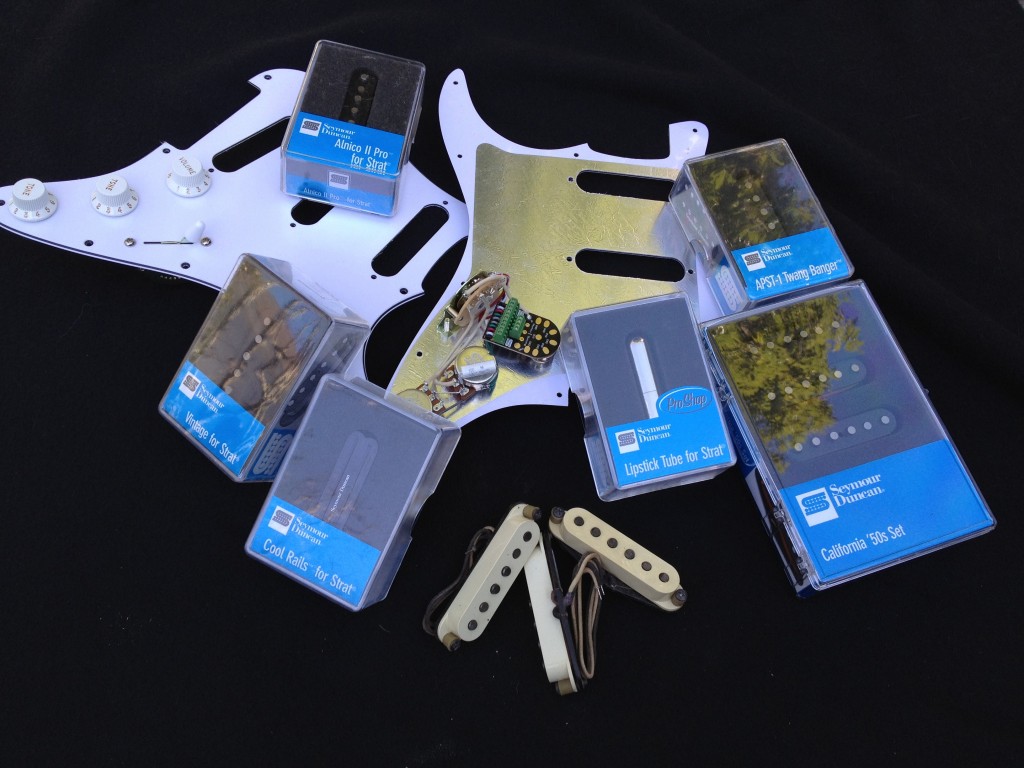
I’ve scored a box stuffed with wildy varied Seymour Duncan replacement pickups for Strat™ guitars, plus a couple of the company’s just-announced BYOP Liberator Pickguards. (These are prewired pickguard assemblies, minus the actual pickups — “BYOP” stands for “Bring Your Own Pickups.”) That means I can pop in whatever pickup I want to try without even firing up the soldering iron.

No, I’m not going to make comparison recordings of different replacement pickup sets (though that would be a worthwhile project). Instead, I’m going to experiment with unusual/unlikely pickup combinations, searching for something cool and unique.

Will I strike pickup-pairing pay dirt? I guess we’ll find out together!

I’ll also be taking a look at some of the alternate three-pickup wiring schemes we’ve been talking about over in The Secret Room, such as the bridge-pickup on/off switch and the middle-pickup fader option.

In the meantime, I’d love to hear about your experiences in choosing pickups for Strat-style guitars — especially any successes you’ve had in combining pickups that weren’t necessarily intended to go together. If you have a story to share, cough it up in comments!

I have a hunch we’ll uncover some cool new things. Stay tuned.